ScienceNot yet confirmed elsewhere1 publisher2 min readPublished
Franklin worked out DNA helix features from a flawed X-ray before Photo 51, archive study says
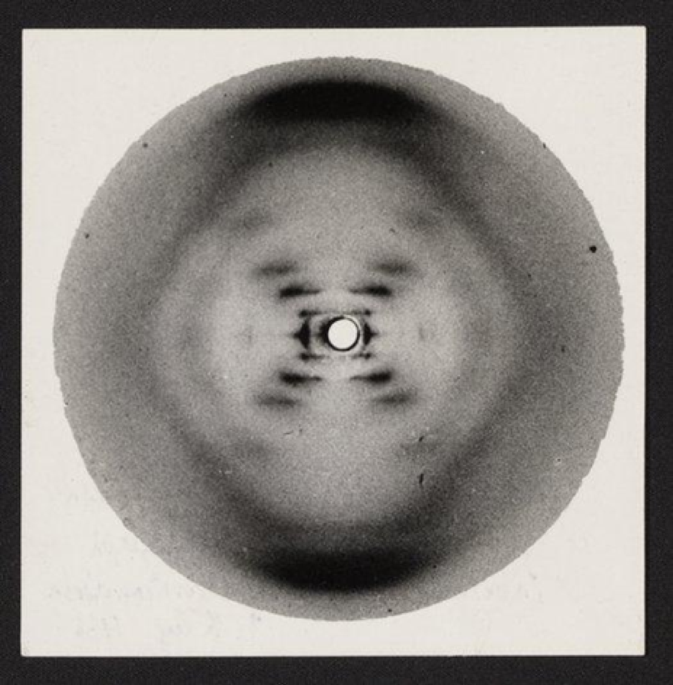
King's College London and Science History Institute researchers say Franklin calculated DNA helix features from Photo 49 before Photo 51. Their archival study challenges the long-held belief that she did not recognize what Photo 51 showed.
The Scientist · Science desk
What happened
- Photo 49 carried a blemish where a component inside the X-ray camera slipped across the film and obscured part of the image.
- When Franklin used Photo 49, she had not yet established whether DNA was a single, double or triple helix, though she knew the pattern could reveal helical structure.
- Photo 51 was shown to James Watson in early 1953 without Franklin's knowledge, and less than two months later he and Crick had built their model.
- The team worked from notebooks, manuscripts and photographs in Philadelphia, Cambridge and London, and from Franklin's original camera and slides at King's College London.
Why it matters
- contradiction Watson's account says what the photograph did for him and Crick, while later retellings say Franklin missed its meaning. The archive study is the first of these accounts to test that second claim against her own records.
- constraint The claim concerns what Franklin understood, and the authors say it leaves Watson and Crick's model-building intact.
- precedent The re-examination of this old attribution question began when the Science History Institute acquired a collection in 2025.
A history paper has no control group, so the useful question is what the records can rule out. Here the answer is order of events. By the researchers' account, Photo 51 was a carefully planned, high-quality repeat of Photo 49, an image Franklin had already used to calculate key features of the helical structure [1]. A deliberate, clean repeat of a flawed picture is hard to square with a researcher who did not see what the pattern offered. That step is our inference from their account.
The flaw in Photo 49 matters to the logic. Despite the blemish, Franklin extracted useful information from the image and used it to determine key features of the DNA molecule's structure [4].
The collaboration behind the paper pairs two kinds of expertise. Brian Sutton, emeritus professor of molecular biophysics at King's College London, is a co-author [12]. He said that he and the historian Alistair Sponsel "might better understand exactly why she and Gosling took Photograph 51, and in particular the importance of Photograph 49" [10].
The phys.org report does not say which features Franklin calculated, or what values she got. It quotes only the authors. The order of events, with the Photo 49 calculations first, is therefore the researchers' statement here, and not something a reader can check from this account.
In our view the sequence is the strongest part of the case. The dated notebook entries in the paper itself are what to check before leaning on it.
What to watch
- The paper's dated notebook entries and the specific features and values Franklin derived from Photo 49.
- Responses from other historians of DNA to the claim that her calculations came before Photo 51.
- Further findings from the History of Molecular Biology Collection, which includes Franklin's own copy of Photo 51.
Clarity's read
What the record supports and how the coverage leans. The claims behind it follow.
Reality
- Evidence55
- Adoption
- Insufficient
- Hype gap+15
- Incentives
- Insufficient
- Confidence50
Claim ledger
Ranked by verification strength, evidence, and original report placement.
- [1]
Photo 51 was a carefully planned, high-quality repeat of an earlier image, Photo 49, which Rosalind Franklin had already used to calculate key features of DNA's helical structure.
ReportedSupportedSource: phys.org, reporting the King's College London and Science History Institute studyView cited source - [2]
The research is from King's College London and the Science History Institute and was published in the Journal of the History of Biology.
- [3]
Photo 49 contained a blemish caused by a component inside the X-ray camera slipping across the film and obscuring part of the image.
- [4]
Despite the blemish, Franklin was able to extract useful information from Photo 49 and use it to determine key features of the structure of the DNA molecule.
- [5]
Franklin and her graduate student Raymond Gosling took Photo 51 at King's College London in 1952.
- [6]
Photo 51 was shown in early 1953, without Franklin's knowledge, to James Watson; less than two months later Watson and Crick had built their double-helical model, published in Nature alongside a paper by Franklin and Gosling describing Photo 51.
- [7]
Watson later wrote that seeing the photograph helped him and Crick develop their model, while subsequent accounts have often portrayed Franklin as having failed to recognize the significance of the image herself.
- [8]
The researchers examined laboratory notebooks, manuscripts, photographs and other historical records held in Philadelphia, Cambridge and London, as well as Franklin's original X-ray camera and photographic slides in the King's College London archives.
- [9]
Co-author Alistair Sponsel began reexamining Franklin's DNA research in 2025 after the Science History Institute acquired the History of Molecular Biology Collection from the J. Craig Venter Institute, a collection that includes Franklin's own copy of Photo 51.
- [10]
Brian Sutton said he and Sponsel "might better understand exactly why she and Gosling took Photograph 51, and in particular the importance of Photograph 49."
- [11]
The researchers say their findings do not diminish the importance of Watson and Crick's work in developing the double-helix model, but give a fuller picture of how Franklin's experimental work contributed to understanding DNA's structure.
- [12]
Brian Sutton is emeritus professor of molecular biophysics at King's College London and a co-author of the research.
- [13]
At the time of Photo 49, Franklin had not established whether DNA was a single, double or triple helix, but the research shows she already knew the X-ray pattern could provide important information about its helical structure.
Sources
1 independent publisher whose own reporting we read for this story.
Topics and entities
Follow any of these and your For You feed starts watching them — no settings page required.
Topics
- History of ScienceFollow
- Scientific archivesFollow
- Discovery of DNA's structureFollow