Science1 publisherNot yet confirmed elsewhere2 min readPublished
Rice lab's 3D-printed mirror inserts fit light sheet imaging into commercial sample chambers
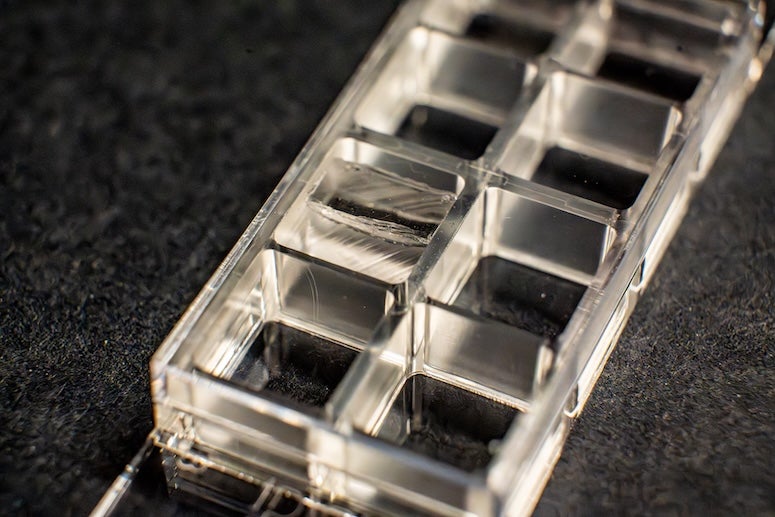
Rice University researchers report 3D-nanoprinted mirror inserts that let a single objective run light sheet microscopy in most commercial sample chambers. That could spare labs a second objective or a specialized chamber, the two things Anna-Karin Gustavsson says the technique typically required.
The Scientist · Science desk
What happened
- The approach began in microfluidic chips, where the team used a single objective and reflected the light sheet into the sample inside the chip.
- Because chips are harder to work with and do not suit every sample, the team built a pipeline to fabricate inserts that fit snugly into commercial chambers.
- Gustavsson's lab has posted open-access CAD files with insert designs for several commonly used sample chambers.
- The work appears in Nano Letters, with Nahima Saliba and graduate student Siyang Cheng as co-first authors.
Compiled by The ScientistSomething wrong?How this is made
Why it matters
- capability Cell assays built around standard chambers can add selective illumination at imaging time, aimed at single-molecule work where background light hides the signal.
- cost The cost of entry moves from optics to fabrication, since each insert is a 3D-nanoprinted part and adoption depends on access to that kind of printing.
- constraint Gustavsson claims most commercial chambers, so a lab using an unusual chamber would need its own insert design before it could try the method.
The design puts a mirror inside the sample chamber. Light goes in through the same objective that collects the fluorescence, and the mirror reflects it into the sample as a sheet, so one lens both illuminates and detects [5][8]. "We realized we could 3D nanoprint a noncytotoxic insert to generate a mirror for light sheet reflection," said Nahima Saliba, a co-first author and Rice alumna [6]. The material has to be safe for cells because the insert stays in the chamber while they grow [6][8].
That last point is where I think the work is most useful to a cell biology lab. "With our new approach, we can now place a combined insert into most types of sample chambers, add the cells and continue on with the assay as usual, growing and treating the cells for our experiments," said Siyang Cheng, the other co-first author and a graduate student [8]. Gustavsson, an assistant professor of chemistry at Rice and the corresponding author, said the method enables "better imaging with less damage to the sample without having to adjust sample preparation workflows" [2][12].
Light sheet imaging lights only a thin slice of the sample. That cuts background light and limits photodamage and photobleaching [1]. Cheng said the single-objective version "reduces background light when imaging, making it easier to see the individual molecules you're interested in," and that it also reduces light damage and photobleaching [11]. The press release gives no figures for those gains, no comparison with a two-objective setup, and does not say what printer the inserts require. The Nano Letters paper by Saliba and colleagues is where a lab would check them [10].
I think the central claim, that a lab can bring this method to chambers it already buys, holds with two conditions written into the source. Gustavsson's own wording is "most commercially available sample chambers," which leaves some out [4]. Each insert is also a 3D-nanoprinted part [6]. The open designs cover the design step, but a lab still has to get the part printed before it can image anything [9].
What to watch
- Whether the Nano Letters paper's measured background and photobleaching gains hold up against a conventional two-objective light sheet system.
- Whether outside labs print inserts from the open CAD files and publish results from their own chambers, or a supplier begins offering the parts.
- Whether the design library grows beyond the initial set of commonly used chambers.
Clarity's read
What the record supports and how the coverage leans. The claims behind it follow.
Reality
- Evidence45
- Adoption
- Insufficient
- Hype gap+20
- Incentives40
- Confidence50
Claim ledger
Ranked by verification strength, evidence, and original report placement.
- [1]
Light sheet microscopy selectively lights up a thin slice of a sample, improving image contrast by reducing background light while reducing photodamage and photobleaching.
- [2]
Anna-Karin Gustavsson, an assistant professor of chemistry at Rice University and corresponding author, published in Nano Letters a method that extends light sheet microscopy to a single objective in commercially available sample chambers.
- [3]
"Prior to this, light sheet microscopy typically required two objectives or specialized sample chambers," said Gustavsson.
- [4]
"This new method allows us to use light sheet microscopy with a single objective in most commercially available sample chambers."
- [5]
Gustavsson's team first adapted light sheet microscopy to microfluidic chips with a single-objective approach in which the light sheet was reflected into the sample inside the chip.
- [6]
"We realized we could 3D nanoprint a noncytotoxic insert to generate a mirror for light sheet reflection," said Nahima Saliba, co-first author and Rice alumna.
- [7]
Microfluidic chips can be more complicated to work with and are not compatible with all samples, so the team developed a pipeline for fabricating inserts that fit snugly into commercially available sample chambers.
- [8]
"With our new approach, we can now place a combined insert into most types of sample chambers, add the cells and continue on with the assay as usual, growing and treating the cells for our experiments. When we are ready to image, the mirror allows us to create and manipulate the light sheet from the same objective that we use to detect the light from the sample," said Siyang Cheng, co-first author and graduate student.
- [9]
Gustavsson's lab has created and provided open access to CAD files containing insert designs for multiple commonly used sample chambers.
- [10]
The paper is Nahima Saliba et al, "Versatile and Scalable Reflective Micromirrors for Single-Objective Light Sheet Microscopy," Nano Letters (2026); Saliba and Siyang Cheng are co-first authors.
- [11]
"Using our single-objective light sheet reduces background light when imaging, making it easier to see the individual molecules you're interested in. It also reduces harm caused by the light and photobleaching."
- [12]
"This opens up a more refined version of light sheet microscopy to anyone whose system would benefit from this type of selective illumination, enabling better imaging with less damage to the sample without having to adjust sample preparation workflows," Gustavsson said.
Sources
1 independent publisher whose own reporting we read for this story.
- phys.org3D-printed inserts bring single-objective light sheet microscopy to commercial sample chambers
1 article · October 8, 2026
Topics and entities
Follow any of these and your For You feed starts watching them — no settings page required.
Entities
- Rice UniversityFollow
- Anna-Karin GustavssonFollow
- Nahima SalibaFollow
- Siyang ChengFollow
- Nano LettersFollow