Science1 publisherNot yet confirmed elsewhere3 min readPublished
OpenCGChromatin simulates chromatin more than ten times larger than earlier models of similar resolution
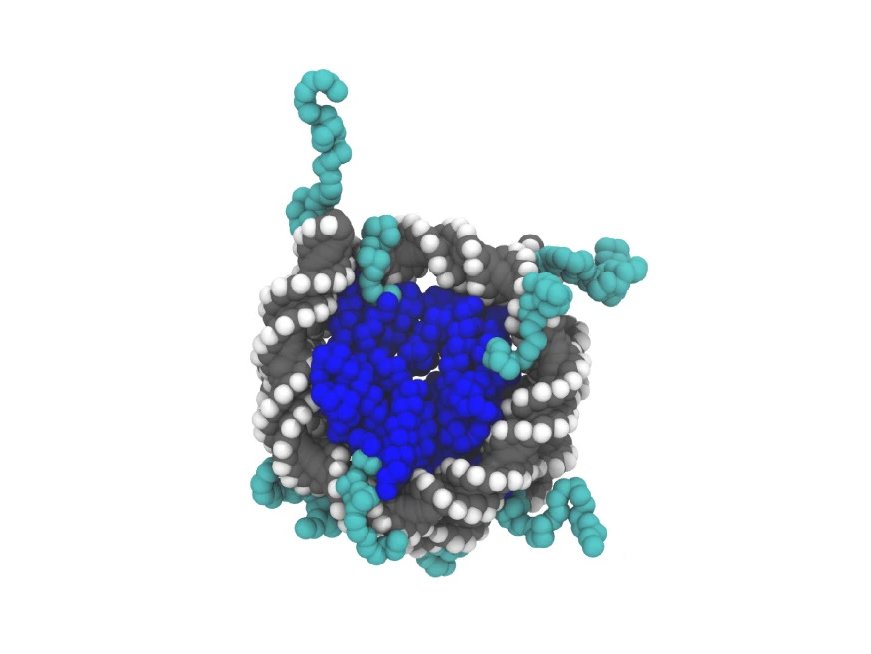
IRB Barcelona, Cambridge and UT Southwestern scientists built OpenCGChromatin, software that simulates chromatin over ten times larger than comparable models. The code is open source, so other labs can now test their own DNA-packaging hypotheses with it.
The Scientist · Science desk
What happened
- The simulated systems include assemblies of hundreds of nucleosomes, the units in which DNA wraps around histone proteins.
- Cryo-ET work from Michael Rosen's group at UT Southwestern and HHMI inspired the tool, and that group co-led the study.
- The study appears in Nature Communications, with Kieran Russell as first author.
Compiled by The ScientistSomething wrong?How this is made
Why it matters
- capability Labs can now ask, inside one model, how nucleosome spacing or histone modifications change chromatin behaviour across stretches far larger than a single nucleosome.
- constraint The histone-region motions the model adds are the ones experiments struggle to resolve, so those findings remain predictions until some method can check them.
- decision Without published run times or hardware needs, a lab considering the tool has to benchmark for itself what a hundreds-of-nucleosome simulation costs to run.
The team's claim that the tool handles chromatin more than ten times larger is measured against something specific. The comparison is with earlier models that work at comparable resolution [2]. On that basis OpenCGChromatin reaches assemblies of hundreds of nucleosomes [3]. The team says the gain comes from pairing a detailed representation of DNA and proteins with greater computational efficiency [4]. The announcement does not give run times or the hardware a simulation of that size needs.
Size matters because of what chromatin does. DNA wraps around histone proteins to form nucleosomes, and the way those organise into chromatin affects how easily genes are read and how DNA damage is repaired [14]. "The challenge is to connect interactions between individual molecules with the behavior of much larger stretches of chromatin," said Modesto Orozco, head of the Molecular Modeling and Bioinformatics Laboratory at IRB Barcelona and a co-lead of the study [7]. "This tool allows us to study both within the same framework and understand how small molecular changes can alter DNA packaging." [7]
The hypotheses a lab can test with it are specific ones. "The simulations help us understand why changing the spacing between nucleosomes, or adding chemical modifications to histones, can make chromatin behave differently," said David Farre-Gil, an author of the paper [10]. Rosana Collepardo-Guevara of the University of Cambridge, who also co-led the work, said the group can now "connect the chemical makeup of chromatin to its organization across scales" [11]. She named gene-sized structures and biomolecular condensates among those scales [12]. Phase separation appears next to chromatin structure in the paper's title [9].
So far, the validation is agreement with results already in hand. According to the team, the simulations reproduce observations from microscopy and biochemical experiments [5]. The tool was inspired by cryo-ET work from Michael Rosen's group at UT Southwestern and the Howard Hughes Medical Institute [8]. Reproducing known data is the right first check for a model. The thing this doesn't tell you is how well the model predicts something nobody has measured yet.
The new detail it adds is the movement of flexible histone regions, and those are the parts of the system that experiments have trouble resolving [6]. The model's most novel output and its least checkable output are therefore the same thing. I think those motions should be treated as predictions until an experiment can confirm or contradict them.
The open-source release [13] means that testing does not have to wait for the authors. Any group can run its own spacing and modification scenarios and compare the output with its own measurements. Kieran Russell is first author of the study, which appears in Nature Communications [9].
What to watch
- Independent labs using the open-source release and reporting whether it matches their own chromatin measurements.
- An experiment that directly tests the predicted movements of flexible histone regions.
- Published compute requirements for simulating assemblies of hundreds of nucleosomes.
Clarity's read
What the record supports and how the coverage leans. The claims behind it follow.
Reality
- Evidence55
- Adoption
- Insufficient
- Hype gap+15
- Incentives35
- Confidence50
Claim ledger
Ranked by verification strength, evidence, and original report placement.
- [1]
An international team led by IRB Barcelona, the University of Cambridge, UT Southwestern Medical Center and the Howard Hughes Medical Institute developed OpenCGChromatin, a simulation tool for exploring how chromatin folds, how its components interact and which forces hold its structures together.
- [2]
OpenCGChromatin allows researchers to study chromatin systems more than 10 times larger than those accessible to previous models with comparable resolution.
- [3]
The systems it can simulate include assemblies containing hundreds of nucleosomes, the basic units of DNA packaging.
- [4]
The tool combines a detailed representation of DNA and proteins with greater computational efficiency.
- [5]
The simulations reproduce observations from microscopy and biochemical experiments.
- [6]
The simulations reveal movements of flexible histone regions that are difficult to resolve experimentally.
- [7]
"The challenge is to connect interactions between individual molecules with the behavior of much larger stretches of chromatin. This tool allows us to study both within the same framework and understand how small molecular changes can alter DNA packaging."
ReportedSupportedSource: Modesto Orozco, head of the Molecular Modeling and Bioinformatics Laboratory at IRB Barcelona, study co-leadView cited source - [8]
OpenCGChromatin was inspired by cryo-ET experimental work from Michael Rosen's group at UT Southwestern Medical Center and the Howard Hughes Medical Institute, which co-led the study.
- [9]
The study, 'Near-atomistic simulations reveal the molecular principles that control chromatin structure and phase separation', with Kieran Russell as first author, is published in Nature Communications (2026).
- [10]
"The simulations help us understand why changing the spacing between nucleosomes, or adding chemical modifications to histones, can make chromatin behave differently."
- [11]
"We can now connect the chemical makeup of chromatin to its organization across scales"
ReportedSupportedSource: Rosana Collepardo-Guevara, University of Cambridge, study co-leadView cited source - [12]
Collepardo-Guevara said the scales covered run from molecular interactions to gene-sized structures and biomolecular condensates, while remaining closely grounded in experiment.
- [13]
OpenCGChromatin is available as open-source software for other researchers to use.
- [14]
DNA wraps around histone proteins to form nucleosomes, which organize into chromatin; this organization influences how easily genes can be read and DNA damage repaired.
Sources
1 independent publisher whose own reporting we read for this story.
- phys.orgNew 'computational microscope' simulates DNA packaging at more than ten times previous scale
1 article · October 8, 2026
Topics and entities
Follow any of these and your For You feed starts watching them — no settings page required.
Topics
- Molecular SimulationFollow
- Chromatin biologyFollow
- Open-source scientific softwareFollow
Entities
- OpenCGChromatinFollow
- IRB BarcelonaFollow
- University of CambridgeFollow
- University of Texas Southwestern Medical CenterFollow
- Howard Hughes Medical InstituteFollow
- Nature CommunicationsFollow
- Modesto OrozcoFollow
- Rosana Collepardo-GuevaraFollow
- Michael RosenFollow
- Kieran RussellFollow
- David Farré-GilFollow