Science1 publisherNot yet confirmed elsewhere2 min readPublished
Pacific magnetic records point to the whole solid Earth tilting just before the Hawaiian bend formed
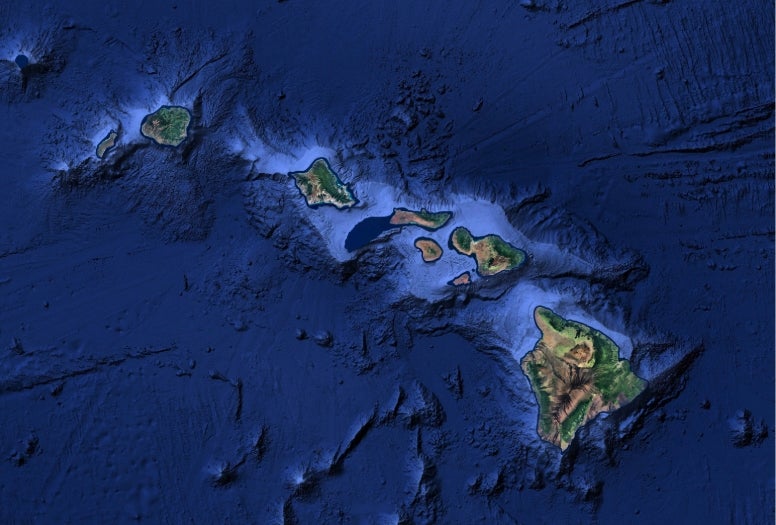
Rice geophysicists Richard Gordon and Daniel Woodworth report that the whole solid Earth reoriented against its spin axis 56 to 48 million years ago. The tilt reconciles two clashing records of Pacific plate motion from the years just before the Hawaiian-Emperor bend formed.
The Scientist · Science desk
What happened
- The bend in the Hawaiian-Emperor chain likely formed about 47 million years ago, and geologists dispute whether the plate moved over the hot spot or the hot spot moved beneath it.
- The pair's paleomagnetic analysis shows the Pacific plate jumping south over a geologically short interval just before the bend formed.
- Models of the forces that drive plates instead have the plate moving steadily north relative to the hot spots before 56 million years ago.
- The team also detected some small movements of the Hawaiian hot spot itself.
Compiled by The ScientistSomething wrong?How this is made
Why it matters
- constraint Plate reconstructions that hold the spin axis fixed to the solid Earth over the past 100 million years would misread the proposed tilt as Pacific plate motion.
- decision Explanations of the bend can no longer pick only between plate motion and hot spot motion; they also have to account for the solid Earth moving relative to the spin axis in the same interval.
- contradiction If the true polar wander reading fails, the magnetic record and the plate-force models go back to disagreeing about which way the Pacific plate moved before the bend.
The evidence comes from rock that records where magnetic north was. Magnetic stripes in slowly cooled magmas and lavas point toward the magnetic pole as they form. Once solid, they keep that direction while the plate carries them away [4]. In recent geologic history the magnetic pole has usually sat over the spin axis. A dated stripe's change in direction therefore tells researchers how the Pacific plate has moved relative to the spin axis since the stripe formed [4]. Gordon said the pair combined "a new paleomagnetic pole" with "a data set that had taken us decades to collect and create." [2] The results appear in JGR Solid Earth [3].
"Which means we had two data sets showing different movements," Woodworth said, comparing the magnetic record with the models of what drives plates [6]. A plate cannot travel in two directions at once [10]. So one of the reference frames had to be wrong. Woodworth said that "ultimately we had to reconsider the assumption that the spin axis was stationary relative to the solid Earth and its hot spots." [7]
Their answer is that between about 56 and 48 million years ago "the entire solid Earth reoriented relative to the spin axis, which gave us the jump found in the paleomagnetic record," Woodworth said [8]. On that reading, the southward jump was the globe tilting under a fixed axis, and the plate's own course need not have reversed [8][10]. Gordon said he thinks the shift was large enough to count as true polar wander [14]. "These data indicate that contrary to some current thought, substantial true polar wander could have happened," he said, placing it 48 to 56 million years ago [14].
The current thought he means goes back decades. "When I was a student, many geophysicists assumed that the solid Earth does not change its location relative to the spin axis," Gordon said. He added that "some geologists think that Earth's orientation relative to the spin axis hasn't significantly changed in the past 100 million years." [13]
The timing fits. The proposed tilt spans about 8 million years and ends roughly a million years before the bend's estimated age [12][11]. The phys.org account does not give the size of the reorientation in degrees, or say how much of the bend, if any, the tilt explains. Gordon's own phrasing is "could have happened." [14] The result also rests on one team's reconstruction. Untangling it took, Woodworth said, "a fair amount of cross-referencing with other geological records." [9]
What to watch
- Whether the JGR Solid Earth paper puts a size in degrees on the reorientation and says how much of the bend it attributes to it.
- Whether paleomagnetic poles from other plates for 56 to 48 million years ago show the same shift, as a whole-Earth reorientation would require.
- Whether models of Hawaiian hot spot motion reproduce the small movements the team detected.
Clarity's read
What the record supports and how the coverage leans. The claims behind it follow.
Reality
- Evidence55
- Adoption
- Insufficient
- Hype gap+10
- Incentives
- Insufficient
- Confidence50
Claim ledger
Ranked by verification strength, evidence, and original report placement.
- [1]
The Hawaiian-Emperor chain contains a bend likely formed approximately 47 million years ago; scientists are not certain whether it was caused by the Pacific plate moving over the hot spot or the hot spot moving under the Pacific plate.
- [2]
Gordon said: "My former student Daniel Woodworth and I were approaching it from a new angle, relying on a new paleomagnetic pole combined with a data set that had taken us decades to collect and create."
- [3]
Gordon and Woodworth's analysis was published in JGR Solid Earth; Woodworth is Gordon's former student and received his doctorate from Rice in 2022.
- [4]
The spin axis usually overlaps the magnetic pole in recent geologic history, so the magnetic pole is used as a proxy; magnetic stripes in slowly cooled magmas and lavas point toward the magnetic pole as they form, and their shift, with known age, shows how the Pacific plate moved relative to the magnetic pole/spin axis.
- [5]
Woodworth said: "Our paleomagnetic analysis shows that just before the bend formed, the Pacific plate jumped south over a geologically short time interval in what would be a relatively quick movement."
- [6]
Woodworth said the drivers of tectonic plate movement suggest that before 56 million years ago the plate was moving steadily north relative to the hot spots, and said: "Which means we had two data sets showing different movements."
- [7]
Woodworth said: "We did detect some small movements in the Hawaiian hot spot, but ultimately we had to reconsider the assumption that the spin axis was stationary relative to the solid Earth and its hot spots."
- [8]
Woodworth said their results indicate that around 56 to 48 million years ago "the entire solid Earth reoriented relative to the spin axis, which gave us the jump found in the paleomagnetic record."
- [9]
Woodworth said: "It took some time, and a fair amount of cross-referencing with other geological records, to untangle this."
- [10]
The Pacific plate appeared to move differently from the hot spot's point of view than from the spin axis's point of view, but the plate could not be moving in multiple directions at the same time.
- [11]
The proposed tilt window ends roughly 1 million years before the bend's estimated age of about 47 million years.
- [12]
The proposed reorientation spans about 8 million years.
- [13]
Gordon said: "When I was a student, many geophysicists assumed that the solid Earth does not change its location relative to the spin axis," and "Even today, some geologists think that Earth's orientation relative to the spin axis hasn't significantly changed in the past 100 million years."
ReportedContestedSource: Richard Gordon, quoted by phys.org2 sources— create a free account to open themView cited source - [14]
Gordon said he thinks the movement of the solid Earth relative to the spin axis was significant enough to be an example of true polar wander, and said: "These data indicate that contrary to some current thought, substantial true polar wander could have happened as recently as 48 to 56 million years ago."
ReportedContestedSource: Richard Gordon, quoted by phys.org2 sources— create a free account to open themView cited source
Sources
1 independent publisher whose own reporting we read for this story.
- phys.orgHawaiian hot spot study uncovers evidence of true polar wander
1 article · October 7, 2026
Topics and entities
Follow any of these and your For You feed starts watching them — no settings page required.
Topics
- True polar wanderFollow
- PaleomagnetismFollow
- Hotspot volcanismFollow
- Plate TectonicsFollow