Xiamen University reviewers tie deep eutectic solvent choice to enzyme stability and product quality
A Xiamen University review of deep eutectic solvents in biocatalysis cites a lipase whose half-life rose from 1 hour to over 9. The examples are cited studies of individual enzymes, so they show the effect exists but not how common it is.
The Scientist · Science desk
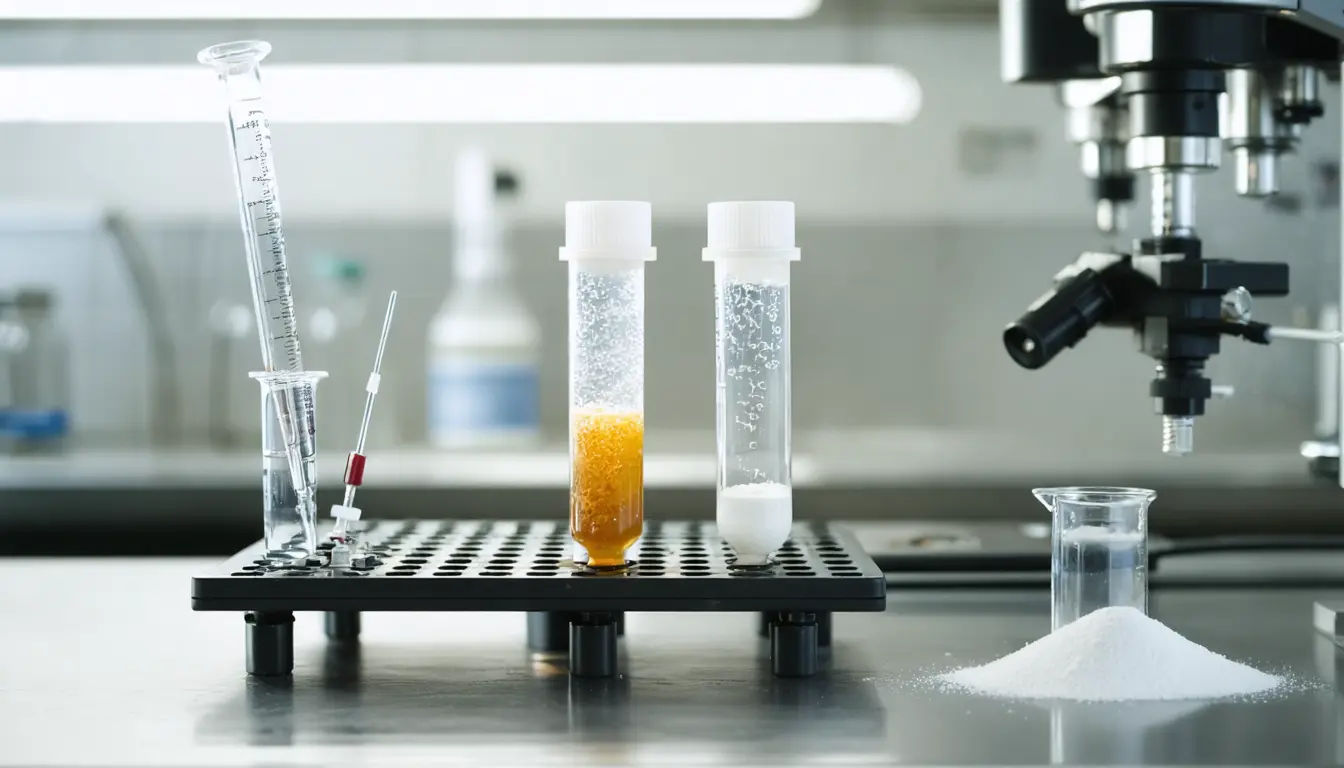
Before and after: Humicola insolens cutinase half-life rose from 22 minutes to 62 minutes, with the hydrogen bond acceptor the key determinant.
| Measure | Value | As of | Claim |
|---|---|---|---|
| Cutinase half-life, before | 22 minutes | 8 | |
| Cutinase half-life, after | 62 minutes | 8 |
What happened
- According to the review, changing the solvent's composition or water content alters its hydrogen-bond network, viscosity, diffusivity, polarity and solvent distribution around the protein surface.
- GEN adds that DES have raised titer and productivity against traditional catalysts, and that enzymes in DES stay thermally stable without protein engineering.
- In one cited study, baker's yeast converted arylpropanones mostly to the S form in water but predominantly to the R form in a DES.
Why it matters
- What it limits constraint The GEN report says solvent-modulated selectivity adds flexibility but demands tight quality control, so the solvent belongs in the product specification.
- Who has to decide decision GEN says tuning thermostability through the solvent is faster and more cost-effective than bioengineering the enzyme, so a solvent screen can come before an engineering campaign.
- Who's exposed exposure Manufacturers moving from aqueous to non-aqueous solvents, a transition the report calls slow, take on solvent choice as a new quality variable.
GEN's report on the review describes the solvent as a key process parameter with spillover effects that can even reach stereochemistry [14]. The support is a set of enzyme-by-enzyme examples.
Yuxuan Hou, a student, and professors Jinyu Meng, Binghui Chen, Jifeng Yuan and Shizhen Wang, all of Xiamen University, wrote the review [2]. Its thermostability section shows how little transfers between enzymes. "Accumulating evidence indicates that DES can enhance enzyme thermostability while preserving catalytic activity," the authors wrote [12]. Candida rugosa lipase went from a half-life of one hour to more than nine, a gain of more than ninefold [15], and the hydrogen bond donor was the determinant [7]. Humicola insolens cutinase went from 22 minutes to 62, about 2.8-fold [16], and there the hydrogen bond acceptor was the key [8]. Different solvent components decided the two cases, so a formulation that rescues one enzyme says little about the next.
Water content is a second variable, and it does not move in one direction. In the studies the authors cite, residual activity of cellulase and pectinase rose and then fell as water quantities increased [5]. In a hydrogenase/TiO2 photocatalytic system, more solvent reduced dioxygen transport, and more water raised activity [6]. "DES composition and water content shape the enzyme-specific microenvironment and thereby affect catalytic performance," the authors note [3].
The stereochemistry example carries the most weight for a process team, because arylpropanones are high-value intermediates used to make some active pharmaceutical ingredients [13]. It rests on a single cited study [9]. The GEN report does not include enantiomeric excess, yields, the DES compositions behind the half-life figures, or the number of studies the review covers. The thing this doesn't tell you is whether any of these gains hold outside the studies that reported them.
We think the narrow claim holds. For the enzymes cited, the solvent moved stability and selectivity by amounts large enough to matter to a process. How often that happens across enzymes is not established, and the report names the challenge as a lack of data regarding enzyme behavior in various solvents [11].
What to watch
- Whether the lipase and cutinase half-life gains reproduce with other DES compositions or at process scale.
- Whether enantiomeric excess and yield data appear for the baker's yeast switch from S to R product.
- Whether enzyme-by-solvent datasets of the kind the report says are missing begin to accumulate.
Clarity's read
What the record supports and how the coverage leans. The claims behind it follow.
Reality
- Evidence50
- Adoption
- Not scored
- Hype gap+20
- Incentives
- Not scored
- Confidence55
Claim ledger
Ranked by verification strength, evidence, and original report placement.
- [1]
Biomanufacturers are slowly transitioning from aqueous to non-aqueous solvents for biocatalysis, and deep eutectic solvents (DES) are getting more attention as sustainable, tunable options.
- [2]
The literature review was written by Xiamen University scientists Yuxuan Hou, a student, and professors Jinyu Meng, Binghui Chen, Jifeng Yuan and Shizhen Wang.
- [3]
"DES composition and water content shape the enzyme-specific microenvironment and thereby affect catalytic performance," the review authors note.
- [4]
Changing DES composition or water content affects the DES hydrogen-bond network, viscosity, diffusivity, polarity, and solvent distribution around the protein surface.
- [5]
The authors cited studies in which the residual activity of cellulase and pectinase rose and then fell as water quantities increased.
- [6]
In a cited hydrogenase/TiO2 photocatalytic system, increasing the solvent quantity reduced dioxygen transport, and increasing the water content increased activity.
- [7]
For Candida rugosa lipase, the hydrogen bond donor enabled the enzyme's half-life to increase from one hour to more than nine hours using DES.
- [8]
For Humicola insolens cutinase, the hydrogen bond acceptor was the key determinant, increasing half-life from 22 minutes to 62.
- [9]
Hou and colleagues cite one study in which baker's yeast converted arylpropanones; with water as solvent the products were largely the S version, but with DES the conversion was predominantly to the R version.
- [10]
GEN says solvent-modulated selectivity significantly enhances flexibility, but quality must be finely controlled to ensure the choice of solvent does not negatively affect the product.
- [11]
GEN says the challenge is a lack of data regarding enzyme behavior in various solvents.
- [12]
"Accumulating evidence indicates that DES can enhance enzyme thermostability while preserving catalytic activity," the authors write.
- [13]
Arylpropanones are high-value intermediates used to manufacture some active pharmaceutical ingredients.
- [14]
GEN says scientists are learning that the solvent itself is a key process parameter with spillover effects that can even affect stereochemistry.
- [15]
The lipase half-life gain from one hour to more than nine hours is more than ninefold.
- [16]
The cutinase half-life gain from 22 minutes to 62 minutes is about 2.8-fold.
- [17]
GEN says modulating thermostability through the solvent rather than through bioengineering is faster and more cost-effective.
- [18]
Research shows DES can increase titer and productivity compared to traditional catalysts, and enzymes catalyzed in DES are thermally stable without the need for protein engineering.
Get this ledger inside ChatGPT. Ask about any of our stories and the answer brings its figure, each claim’s verdict and the sources. Free, no account.
Sources
1 independent publisher whose own reporting we read for this story.
- genengnews.comFor Biocatalysis, Solvents are a Key Bioprocessing Parameter
1 article · October 14, 2026
Topics and entities
Follow any of these and your For You feed starts watching them — no settings page required.
Topics
- Deep eutectic solventsFollow
- BioprocessingFollow
- BiocatalysisFollow
Entities
- Genetic Engineering & Biotechnology NewsFollow
- Xiamen UniversityFollow