Science1 publisher2 min readPublished
Fluorescence loss lets a microplate reader screen thousands of BsPPS enzyme variants
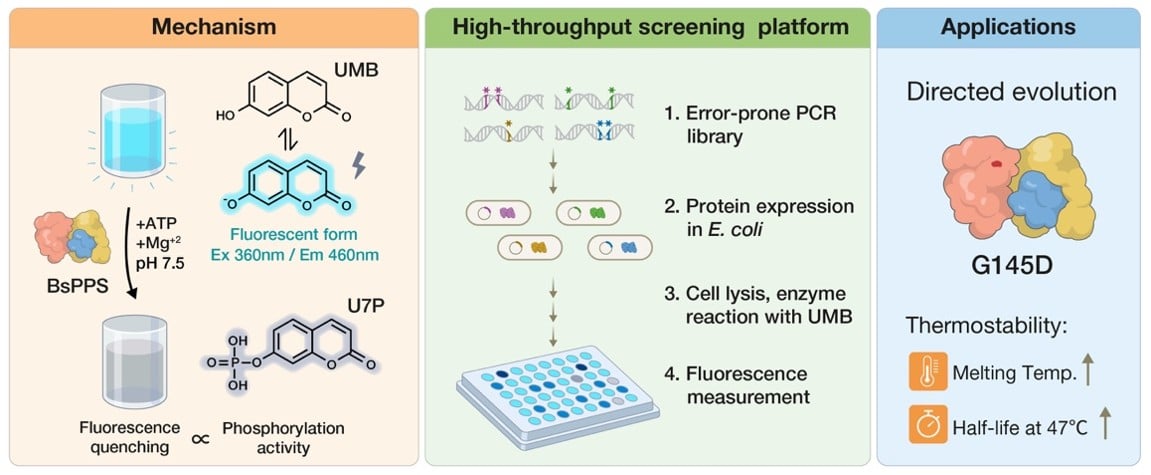
National Taiwan University researchers built a fluorescence assay that screens thousands of BsPPS enzyme variants on a standard microplate reader. It replaces slow HPLC during screening and flagged one heat-tolerant variant, G145D.
The Scientist · Science desk
What happened
- Umbelliferone fluoresces strongly until BsPPS adds a phosphate to make umbelliferone 7-phosphate, at which point the signal drops sharply, and that loss of light is what the assay reads.
- BsPPS, an enzyme first isolated from the bacterium Bacillus subtilis, attaches phosphate groups to a broad range of phenolic plant compounds.
- Many plant compounds carry promising health-related properties, but their poor water solubility limits how well the body can absorb and use them.
- The method appeared in the journal Food Chemistry, in work led by Sheng-Dong Chen.
Compiled by The ScientistSomething wrong?How this is made
Why it matters
- capability A standard microplate reader picks up the signal, so a lab without HPLC throughput can now run directed evolution on BsPPS across thousands of variants at once.
- constraint The readout reports activity on umbelliferone, a surrogate dye, not on the plant compounds a maker wants to phosphorylate, so the top-ranked variant may not be the best on a real target.
- decision Because fluorescence only estimates activity, teams still have to confirm their best variants on real substrates by HPLC before trusting them for production.
The signal measures something narrower than the goal. Fluorescence tracks what BsPPS does to umbelliferone, the indicator dye [5], not what it does to the phenolic compounds anyone actually wants to make water-soluble. The enzyme phosphorylates a broad range of phenolics [2], and the point of engineering it is to improve phosphorylated derivatives of plant bioactives [3]. A variant that dims the dye faster has only been shown to work faster on the dye. The fluorescence number does not tell you how that variant performs on a real substrate. Confirming that still takes HPLC, which measures the products accurately but too slowly to screen thousands [4][7].
The one engineering run reported bears that out. The team paired the assay with directed evolution, generating many variants and screening them for useful traits [8]. Out of thousands, they reported a single hit, G145D, which kept more of its activity after heating than the original enzyme while matching its catalytic performance [9]. The gain they demonstrated is in heat tolerance. Conversion did not improve. The paper does not quantify how much thermostability G145D gained, how many thousands of variants went through the screen, or how much faster the assay runs than HPLC [9].
Nan-Wei Su, the corresponding author and a professor of agricultural chemistry at National Taiwan University, framed the method as a throughput tool [11]. "By turning enzyme activity into an easily measurable fluorescence signal, we can examine thousands of enzyme variants much more efficiently, accelerate the development of improved biocatalysts and facilitate the exploration of phenolic compound-phosphorylating enzymes," said Su [12].
BsPPS is a newly characterized group of enzymes able to phosphorylate diverse phenolics [13], so the pool of candidates worth searching is large. The assay, reported in Food Chemistry, gives researchers a faster first-pass screen for that search [10].
What to watch
- Whether ranking variants by umbelliferone fluorescence holds up when the same variants are tested on the actual phenolic compounds destined for nutraceuticals.
- Whether a later engineering round improves how much product BsPPS makes, beyond how much heat it survives.
- Whether the same fluorescence-loss approach transfers to the other phenolic-phosphorylating enzymes Su wants to explore.