ScienceNot yet confirmed elsewhere1 publisher2 min readPublished
Australian researchers want recovery housing sites chosen in advance after 11 temporary flood villages
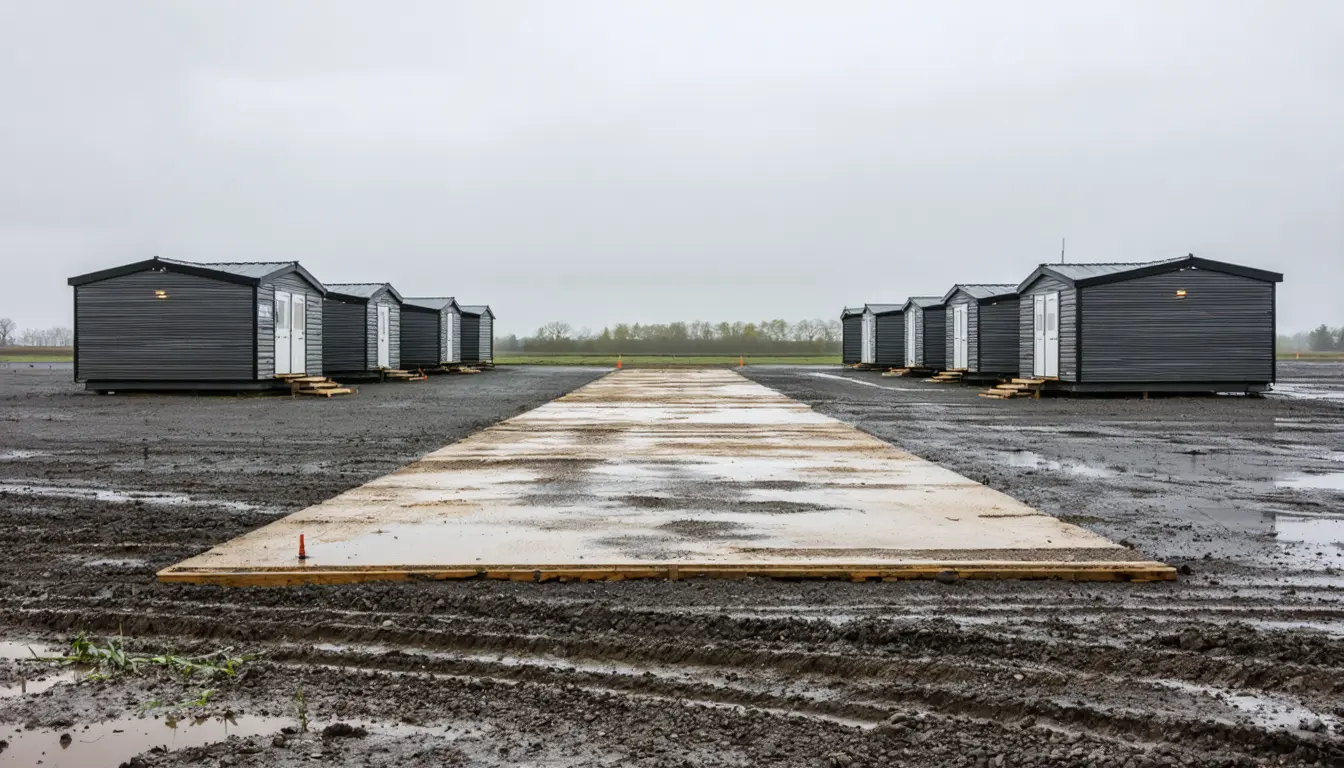
Australian researchers say the 11 temporary villages built after the 2022 floods are the kind of recovery housing to avoid. They want safe sites chosen in advance, as the authors warn a strengthening El Niño could bring extreme fire conditions this summer.
The Scientist · Science desk
What happened
- Villages were not a key feature of the Black Summer recovery, where individual housing pods were delivered to wildfire victims' own properties.
- The authors say many displaced people go to family and friends, while those who can afford it move into temporary lodging.
- For everyone else, they propose safe, equipped sites identified in advance and usable immediately, with existing RV and vacation parks as one option.
- Beyond shelter, they cite the NSW Reconstruction Authority's Recovery Centers, which bring services together so people need not deal with multiple organizations alone.
Why it matters
- constraint A planner weighing pods against villages is working from the authors' argument about delay and limbo, since the two were used after different disasters.
- decision Agencies that choose sites in advance, such as existing RV and vacation parks, commit land and infrastructure before they know where the next disaster will land.
- cost If advance siting and community recovery work fall to councils, the cost lands on bodies the authors say are already stretched, unless state and federal governments pay.
- exposure Households facing unaffordable or unavailable insurance, and renters who depend on landlords, are the groups the authors say need a different route, with cash assistance one option for renters.
The authors' target is narrower than "recovery housing" suggests. They object to large, expensive temporary villages with their own infrastructure, and say such housing is rarely quick to deliver and is "anything but temporary" [3]. They do not object to pods. Low-cost pods or retrofitted sheds are on their list of options, particularly where existing infrastructure lets people stay on their own land while rebuilding [13].
The comparison has no control. The Black Summer fires destroyed more than 3,000 homes [1]. The 2022 floods devastated hundreds of communities across multiple states [2]. One disaster is counted in homes and the other in communities, so pods in one and villages in the other [6] cannot be read as a trial of two designs. The thing this doesn't tell you is how many people lived in the 11 villages, what the villages cost, or how long they took to open. The authors say only that procuring housing, preparing sites and building can take months [4].
Their explanation for why villages get built anyway is political. Announcing high-quality temporary housing sounds good because decision-makers appear to be "doing something," they write, and once media interest has waned, residents are left in limbo [15]. This is reasoning about incentives, and it is plausible. They ask what happens to occupants when the short time frame for using the housing expires, and what happens to the housing when councils want the land back [16].
The El Niño warning frames the urgency. The authors open by saying Australia could face some of its most extreme wildfire conditions ever this summer because of an ever-strengthening El Niño [17]. Their housing findings come from their examination of the aftermath of the two past disasters [14], so nothing in them tests how a worse fire season would strain recovery housing.
In our view the advance-siting advice holds on the authors' own logic. A site that is identified and equipped before a disaster skips some of the months of procurement and preparation they describe [4]. It holds only if the sites are kept ready.
What to watch
- Whether the full study publishes costs, occupancy and delivery times for the 11 flood villages, which would turn the authors' argument into a measured comparison.
- Whether any state names pre-identified sites, such as RV or vacation parks, before this summer's fire season.
- Whether governments and insurers act on the authors' call to address rising or unavailable insurance for affected homeowners.
Clarity's read
What the record supports and how the coverage leans. The claims behind it follow.
Reality
- Evidence35
- Adoption
- Insufficient
- Hype gap+15
- Incentives
- Insufficient
- Confidence40
Claim ledger
Ranked by verification strength, evidence, and original report placement.
- [1]
The Black Summer wildfires of 2019-20 destroyed more than 3,000 homes.
- [2]
The 2022 major floods devastated hundreds of communities across multiple states and were the costliest insurance event in Australian history.
- [3]
The authors' first finding is that large-scale, expensive temporary housing villages with associated infrastructure should be avoided; they say such housing is rarely quick to deliver and is 'anything but temporary'.
- [4]
The authors say it can take months to procure temporary housing, prepare sites and build.
- [5]
Temporary villages were not a key feature of the Black Summer recovery; individual housing pods were instead delivered to wildfire victims' own properties.
- [6]
Temporary villages appeared after the 2022 floods, with the construction of 11 temporary villages, which the authors describe as a costly appearance.
- [7]
Many displaced people go to live with family and friends elsewhere, while those who can afford it may move into temporary lodging.
- [8]
For people who cannot afford temporary lodging, the authors say safe, well-equipped temporary housing sites should be identified in advance and ready for use immediately after a disaster; one option is to repurpose existing RV and vacation parks.
- [9]
The NSW Reconstruction Authority's Recovery Centers seek to bring services together so people do not have to navigate multiple organizations independently; the authors cite them as an example of coordinated support.
- [10]
Local councils are often expected to shoulder a significant recovery workload with limited resources; the authors say state and federal governments need to ensure local government has the capacity, funding and authority it needs.
- [11]
The authors say affected homeowners with insurance need speedy insurance support, but the cost of insurance is skyrocketing or, for some, becoming unavailable, and government needs to work with insurers on this.
- [12]
Many people rent their properties, which adds landlords to the complexity of recovery; the authors say cash assistance is one way to give renters some ability to exercise agency in recovery.
- [13]
The authors say there is a case for using relatively low-cost pods or retrofitted sheds, particularly where they can use existing infrastructure and allow people to remain on their own land while rebuilding.
- [14]
The authors' research examined the aftermath of the Black Summer fires and the 2022 floods: what worked best in meeting people's immediate housing needs and supporting longer-term housing recovery.
- [15]
The authors say announcing high-quality temporary housing sounds good politically because it appears decision-makers are 'doing something', but when media interest has waned people are left in limbo about what comes next.
- [16]
The authors ask what happens to people once the short time frame for using temporary housing expires, and what happens to the housing when councils want back the land on which it was built.
- [17]
The authors say Australia could face some of its most extreme wildfire conditions ever this summer because of the severity of an ever-strengthening El Niño.
ReportedInsufficientSource: Authors of the research, in a piece published on phys.orgView cited source
Sources
1 independent publisher whose own reporting we read for this story.
- phys.orgDisaster recovery in Australia exposes housing gaps and points to three priorities
1 article · October 13, 2026
Topics and entities
Follow any of these and your For You feed starts watching them — no settings page required.
Entities
- NSW Reconstruction AuthorityFollow
- Phys.orgFollow
- The ConversationFollow