ScienceNot yet confirmed elsewhere1 publisher2 min readPublished
Researchers name the Murray Mallee matchstick, a wingless grasshopper from western Victoria
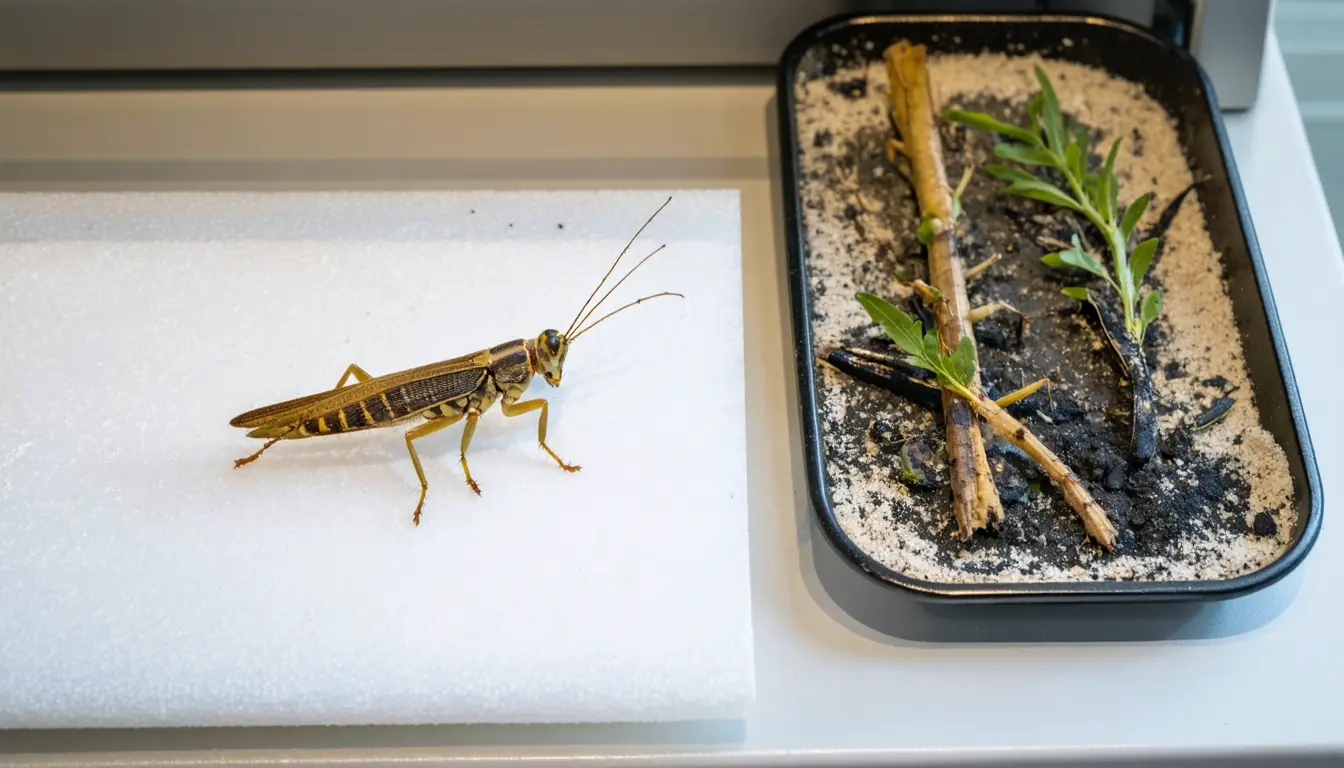
Researchers who named the Murray Mallee matchstick grasshopper say remnant reserves of under 100 hectares can be critical habitat. The insect has no wings, so in the authors' account a fire in one patch can wipe out a whole population.
The Scientist · Science desk
What happened
- The species belongs to Keyacris, the genus that includes the threatened Key's matchstick, and the authors describe it as rediscovered and previously undescribed.
- It is named for the region where Lake Bungunnia, a Pleistocene megalake, once existed.
- A study led by student Kim Kaufmann mapped the grasshopper's distribution across several sites.
- One Murray Mallee matchstick site was later found to hold the largest known population of the threatened Eltham copper butterfly.
- Translocated Larapuna grasshoppers, a related species, have surged at several revegetated sites near Melbourne.
Why it matters
- constraint The long dispersals the authors cite, to northern Tasmania and 2,200 kilometers across the Nullarbor, show what continuous habitat allows. A wingless species cut off in fragmented farmland has no other way of moving, they say.
- exposure The reserves that matter most are, by the authors' account, typically overlooked and often poorly managed, overrun by weeds or covered with trash.
- decision If the authors are right that grasshoppers persist wherever food plants do, managers weighing small patches against large ones face a lower bar, because the work need not be expensive or complex.
Everything here comes from the researchers' own account, published by The Conversation and republished by phys.org [10]. Their central claim is that small remnant reserves can be critical to the survival of smaller plants and animals [11]. It rests on two kinds of evidence, and they are not equally strong.
The genetic evidence is the better of the two. The authors say their findings suggest each population is distinct from the others [5]. That fits an insect that is wingless even when fully grown and does not typically travel far from where it was born [6]. In our view this half of the argument is the sturdier one. It follows from how the insect moves, and it does not depend on how many other reserves hold the species.
The indicator argument is thinner. The authors write that finding a matchstick grasshopper in a small remnant reserve could indicate high-quality habitat, home to other vulnerable species [12]. Their illustration is the butterfly record, which comes from a single site. The authors do not say how many sites were sampled, how many held the grasshopper, how many of those held other threatened species, or how large they were. The 100-hectare figure is the authors' description of what remnant reserves in the region may cover [1].
The management examples are practical but sit one step away from the new species. The Larapuna translocations and the Key's matchstick introduction at the Euroa arboretum in northeastern Victoria both involve other grasshoppers [16]. The authors' case for caring about the Murray Mallee matchstick is the food web: matchstick grasshoppers are eaten by small birds, spiders and other insects, notably in late winter and early spring, before most insects have hatched [9].
What to watch
- A published count of how many small reserves with matchstick records also hold other threatened species.
- Whether the Key's matchstick population at the Euroa arboretum persists through several seasons.
- Whether any reserve is actually managed for the Murray Mallee matchstick, since the translocation examples so far involve other species.
Clarity's read
What the record supports and how the coverage leans. The claims behind it follow.
Reality
- Evidence40
- Adoption
- Insufficient
- Hype gap+15
- Incentives30
- Confidence45
Claim ledger
Ranked by verification strength, evidence, and original report placement.
- [1]
In the crop-growing region of northwestern Victoria, remnant reserves may cover less than 100 hectares (247 acres).
ReportedSupportedSource: Authors of the study, writing in The Conversation (republished by phys.org)View cited source - [2]
The researchers rediscovered a previously undescribed species of the Keyacris genus of grasshoppers, which includes the threatened Key's matchstick.
- [3]
The new species was named the Murray Mallee matchstick (Keyacris bungunnia) after the region where the megalake Lake Bungunnia existed during the Pleistocene epoch.
- [4]
The study, led by student Kim Kaufmann, mapped the distribution of the grasshopper species across several sites.
- [5]
The authors say their findings suggest each population was genetically distinct from the others.
- [6]
Matchstick grasshoppers do not have wings even when fully grown, so they do not typically travel far from where they are born, though in places with continuous habitat they can spread slowly over generations.
- [7]
Research shows one matchstick species reached northern Tasmania from Victoria, while another traveled 2,200 kilometers (1,370 miles) across the Nullarbor Plain on the way from Kalgoorlie to Broken Hill. The authors say animals without wings have no other way of shifting to other places as landscapes become fragmented.
- [8]
One of the Murray Mallee matchstick sites was later discovered to support the largest known population of the threatened Eltham copper butterfly (Paralucia pyrodiscus lucida).
- [9]
Matchstick grasshoppers are a food source for other insects, spiders and small birds, especially in late winter and early spring when most insects have yet to hatch.
- [10]
The article was written by the researchers, published by The Conversation under a Creative Commons license, and republished by phys.org.
- [11]
The authors say their latest research reveals that small remnant areas can be critical to the survival of smaller plants and animals, and that such reserves are often undervalued and overlooked.
ReportedInsufficientSource: Authors of the study, writing in The Conversation (republished by phys.org)View cited source - [12]
The authors say finding a matchstick grasshopper in a small remnant reserve could indicate high-quality habitat, home to other vulnerable species.
- [13]
The authors say valuable remnant reserves are typically overlooked in conservation efforts and are often poorly managed, overrun by weeds or even covered with trash.
- [14]
The authors say conserving these areas for vulnerable animals does not have to be expensive or complex, because grasshoppers can survive as long as food plants are available, even in small patches of suitable habitat.
- [15]
Translocated populations of the Larapuna grasshopper (Vandiemenella viatica) have surged at several revegetated sites near Melbourne.
- [16]
Scientists have most recently successfully introduced the threatened Key's matchstick grasshopper into the Euroa arboretum in northeastern Victoria.
Sources
1 independent publisher whose own reporting we read for this story.
- phys.orgConservation parks don't have to be vast—as one tiny grasshopper reminds us
1 article · October 12, 2026
Topics and entities
Follow any of these and your For You feed starts watching them — no settings page required.