ScienceNot yet confirmed elsewhere1 publisher2 min readPublished
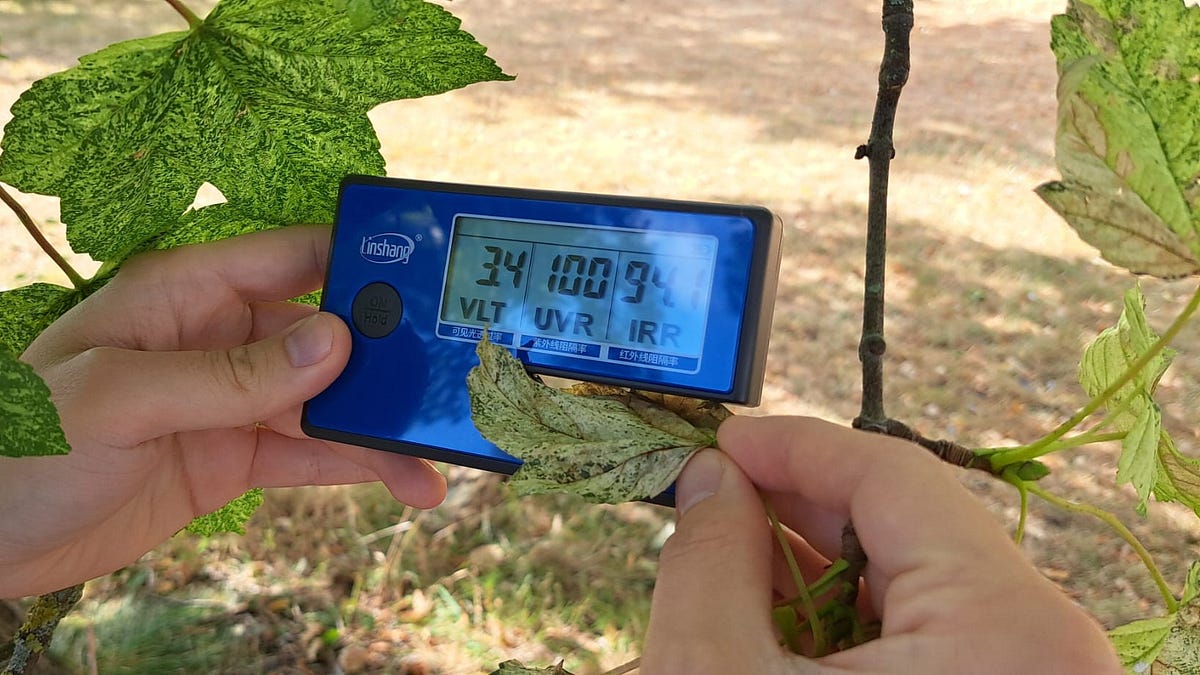
Rebuilt car window-tint meter reads leaf water in seconds for about £140
King's College London researchers turned a car window-tint meter into a £140 leaf-water sensor that explained at least 81% of variation across six species. The authors say each species needs its own calibration and readings weaken on badly dried leaves, limits that bite hardest in wildfire work.
The Scientist · Science desk
What happened
- The team swapped the meter's light sources for two LEDs, one at a wavelength water absorbs strongly and one that passes through water almost untouched.
- As a first test, the researchers simulated 1,000 virtual leaves with an established physics-based model of how light travels through plant tissue.
- Drying experiments at Rothamsted Experimental Farm from April to June 2026 tracked wheat, rapeseed, beech, birch, hazel and sycamore leaves over several days.
- The work lands in the UK's worst wildfire year on record, with 2026 passing 2025's full-year total of 1,017 wildfires by August, fire chiefs confirmed.
Why it matters
- cost The £140 covers hardware only; every new species needs a reference calibration, so anyone sampling mixed vegetation still spends laboratory time before the meter is useful.
- constraint Fire-danger checks need readings on the driest vegetation, the range where reliability drops, so fuel-moisture use needs more validation than irrigation use before agencies rely on it.
- capability A seconds-long reading that leaves the leaf intact lets the same leaf be measured again and again as it dries, a record that oven-drying ends at the first sample.
"At least 81%" is a floor, set by whichever of the six species fitted worst [4]. In that species roughly 19% of the variation in leaf water content went unexplained [19]. Across the set, the meter approached the performance of laboratory methods, and its readings closely tracked two standard measures of leaf water status used in agriculture and fire science [4][14]. The study's summary does not say which species gave the weakest fit [4].
The laboratory route is slow and destroys the sample. Leaves are picked, oven-dried and weighed over many hours [2]. "Water content tells you whether vegetation is healthy or ready to burn, but previously, to do this, you had to destroy the foliage you are measuring," said Luke Brown, the King's College London senior lecturer in Earth observation who led the study with Mark Danson of the University of Salford [8][7]. The meter skips the oven because, according to the team, comparing its two beams isolates the water inside the leaf from the leaf's structure [11].
On hardware cost the case is strong. The tint meter sells for £70 and the finished instrument costs about £140 to build from readily available parts, so the modifications roughly double the base price [9][3][20]. Comparable field instruments can cost many tens of thousands of pounds [2]. Even at a floor of £10,000, the gap is more than 70-fold [21]. "Environmental monitoring has long been rationed by the price of instruments," Brown said [17]. He added: "Bringing down that cost changes who is able to make these measurements, and that has potential to enable better management." [18]
The two validation stages answer different questions. The virtual leaves test whether a two-wavelength signal should separate water from structure across many leaf types. The Rothamsted drying runs test the built device on real tissue as it loses water [12][13]. Neither stage was a farm or fire-service trial on mixed vegetation [13].
The authors' two caveats fall hardest on wildfire use [16]. Leaf water content matters for fire because it indicates how easily vegetation could ignite [5]. Fire-danger readings are therefore needed most at the dry end, where the meter is weakest. Calibration also needs reference measurements, so some oven-and-scale work still has to be done for every species in a stand before the meter goes out.
The team also points to irrigation decisions [5], in a sector that accounts for about 70% of global freshwater use [6]. I think irrigation is the nearer use. A farmer deciding when to water reads leaves well before they reach the severe dryness where the meter weakens [16].
What to watch
- Whether species calibrations built at Rothamsted hold at other sites and in other seasons, or have to be rebuilt each time the meter moves.
- A field test by a fire service on mixed, dry vegetation, the range where the authors say the readings weaken.
- Which of the six species set the 81% floor, and how far above it the other five scored.
Clarity's read
What the record supports and how the coverage leans. The claims behind it follow.
Reality
- Evidence55
- Adoption
- Insufficient
- Hype gap+30
- Incentives
- Insufficient
- Confidence50
Claim ledger
Ranked by verification strength, evidence, and original report placement.
- [1]
Researchers at King's College London converted an off-the-shelf product, usually used to determine whether car window tint is legal, into a scientific instrument that can measure leaf water content in seconds.
- [2]
Comparable field instruments can cost many tens of thousands of pounds, while the standard laboratory approach requires leaves to be picked, oven-dried and weighed over many hours.
- [3]
The modified device costs about £140 in total to build from readily available components.
- [4]
The modified device approached the performance of laboratory methods across six plant species, explaining at least 81% of the variation in leaf water content.
- [5]
Leaf water content is a key indicator of how easily vegetation could ignite; the researchers note the meter could support fuel moisture monitoring as well as irrigation decisions in agriculture.
- [7]
The study was led by Dr. Luke Brown, senior lecturer in Earth observation in the Department of Geography at King's College London, working with professor Mark Danson of the University of Salford.
- [8]
"Water content tells you whether vegetation is healthy or ready to burn, but previously, to do this, you had to destroy the foliage you are measuring," says Brown.
- [9]
The instrument began life as a £70 meter sold to check whether car window tinting is legal; it measures how much light passes through whatever is slotted into it.
- [10]
The researchers replaced the meter's light sources with two precisely chosen LEDs, one at a wavelength that water strongly absorbs and one that passes through water almost untouched.
- [11]
Comparing the two readings isolates the water inside the leaf from its structure.
- [12]
The team first tested the design in theory, simulating 1,000 virtual leaves using an established physics-based model of how light travels through plant tissue.
- [13]
The team ran dehydration experiments between April and June 2026 at Rothamsted Experimental Farm in Hertfordshire, tracking leaves from wheat, rapeseed, beech, birch, hazel and sycamore as they dried out over several days.
- [14]
The meter's readings closely tracked two of the standard measures of leaf water status used in agriculture and fire science.
- [15]
The findings arrive amid the UK's worst wildfire year on record; fire chiefs confirmed in August that the number of wildfires in 2026 had already passed the previous record of 1,017, set across the whole of 2025.
- [16]
The authors caution that the meter requires calibration for each plant species and that its readings become less reliable once leaves are severely desiccated.
- [17]
"Environmental monitoring has long been rationed by the price of instruments," says Brown.
- [18]
"Bringing down that cost changes who is able to make these measurements, and that has potential to enable better management."
- [19]
In the weakest-fitting species, roughly 19% of the variation in leaf water content was not explained by the meter.
- [20]
The modifications add about £70 to the £70 base meter, roughly doubling its price.
- [21]
Taking £10,000 as a conservative floor for 'many tens of thousands of pounds', comparable field instruments cost more than 70 times the £140 meter.
Sources
1 independent publisher whose own reporting we read for this story.
- phys.orgScientists turn handheld car gadget into wildfire early-warning tool
1 article · October 8, 2026
Topics and entities
Follow any of these and your For You feed starts watching them — no settings page required.