Per kilogram leaked, R-32 refrigerant warms the climate about a third as much as R-410A
Leaked refrigerant accounts for roughly one-third of cooling's climate impact worldwide, according to scientists writing on phys.org. Electricity is responsible for the rest, so the refrigerant label is only part of a purchase decision.
The Scientist · Science desk
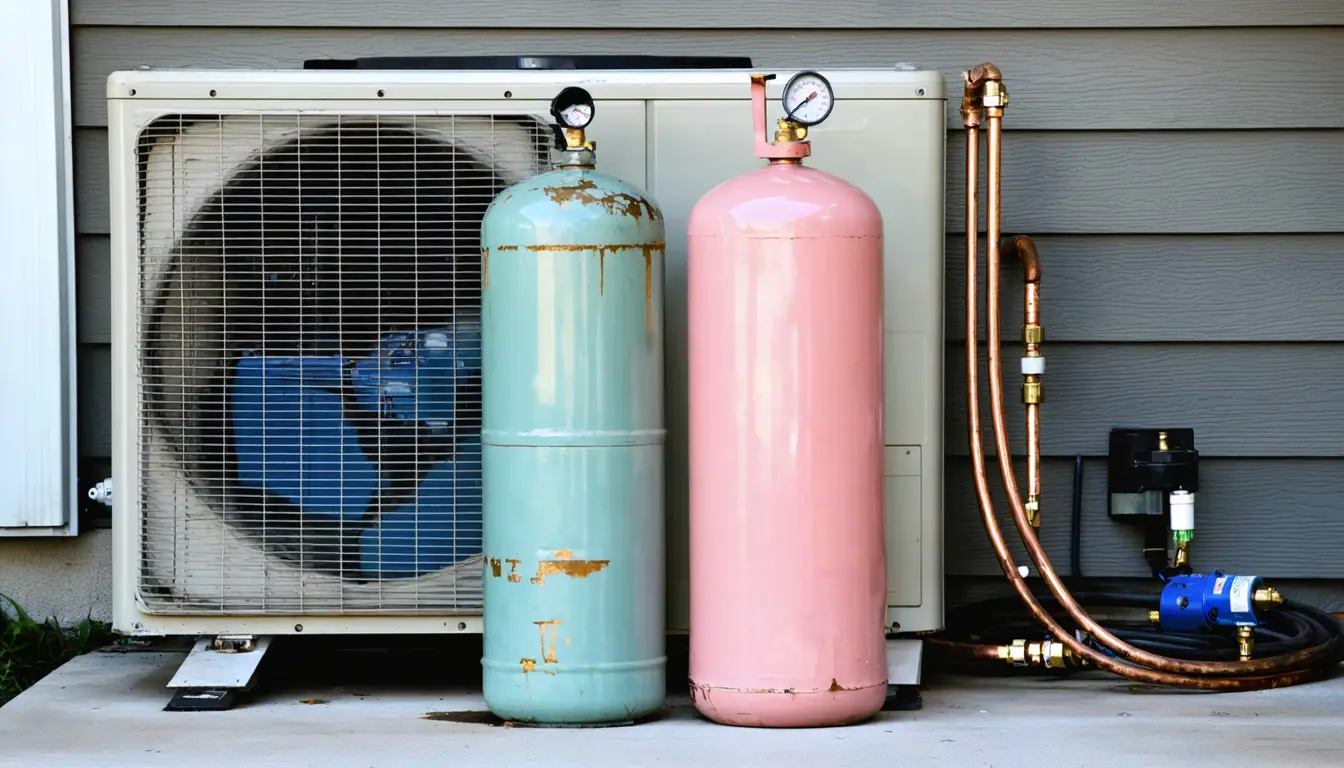
R-32 traps roughly 670 times as much heat as carbon dioxide per kilogram, against around 2,000 times for R-410A. Illustration only: if all leaked refrigerant were R-410A and were replaced kilogram for kilogram by R-32, total cooling climate impact would fall by about 22%.
| Figure | Value | Note | Claim |
|---|---|---|---|
| R-32 heat per kilogram vs carbon dioxide, roughly | 670 times | 15 | |
| R-410A per kg, around | 2,000 times | 2 | |
| Illustrative fall in total cooling climate impact, about | 22% | Only if all leaked gas were R-410A | 16 |
What happened
- Kilogram for kilogram, R-410A traps around 2,000 times more heat than carbon dioxide, and R-32 is about a third as warming as R-410A, the authors write.
- The Kigali Amendment, agreed on Oct. 15, 2016, was the first time the Montreal Protocol was used to control gases purely for their climate effect.
- Since January 2025, new small split air conditioners sold in the U.K. cannot use R-410A, and portable units have been barred from high-warming gases since 2020.
- Atmospheric data show HFC abundance has risen substantially in the last decade, but emissions growth has slowed and sits well below pre-Kigali projections.
- Without controls, HFCs could add 0.3 to 0.5 degrees C to global temperatures by the end of the century, against roughly 1.2 degrees C of warming caused by human activities.
Why it matters
- decision Operators with R-410A units in service face the same per-kilogram gap when those units are scrapped, so gas recovery at disposal belongs in any replacement plan.
- constraint For new small split units in the U.K., R-410A is no longer on the list, so regulation narrows the choice before any price comparison starts.
- exposure R-32 is itself an HFC, so a unit bought now sits in a regime where the EU aims to phase HFCs out almost entirely by 2050.
Taking the authors' two figures together, R-32 comes out at roughly 670 times carbon dioxide per kilogram, against about 2,000 for R-410A [15][2]. R-32 is still a potent greenhouse gas, by the authors' own description [2].
The scale of the gain depends on what share of the footprint the gas represents. Leaked refrigerant is roughly a third of cooling's climate impact worldwide, and electricity is the rest [1], which is about two-thirds [14]. Suppose, for illustration, that all of that leaked gas were R-410A and that R-32 replaced it kilogram for kilogram. The leakage share would fall by two-thirds, and total cooling impact by about 22% [16]. Both assumptions are ours. The one-third is a worldwide figure for all leaked refrigerants [1], not for R-410A alone.
The thing this doesn't tell you is how many kilograms a given unit holds, how fast it leaks, or when R-32 itself will be restricted. In our view, an operator comparing two quotes should weigh efficiency at least as heavily as the refrigerant, with one condition: the two-thirds is a global split, and a site with high leak rates would shift the balance.
The authors say the most direct test of whether the Kigali Amendment works is to measure the atmosphere [13]. Mace Head, on Ireland's windy west coast, has measured these gases continuously since 1987, at concentrations of a few parts per trillion [9]. In 2019 those readings helped pinpoint the source of renewed CFC production, and emissions dropped after a crackdown [10]. The HFC result the authors lean on is a comparison with a pre-Kigali projection, not with a control group [11]. The readings by themselves do not apportion the gap to Kigali.
A 2025 study projected that air conditioning's climate impact could match today's or come in below it, even if demand grows substantially [12]. The authors attach a condition to that outcome [12].
What to watch
- Whether Mace Head and the other long-running stations keep showing HFC emissions below the pre-Kigali projections as air-conditioner sales rise.
- Whether the EU's aim of a near-total HFC phase-out by 2050 produces a dated restriction on R-32 in new units.
- Whether regions beyond the U.K. adopt bans on R-410A in new small split units.
Clarity's read
What the record supports and how the coverage leans. The claims behind it follow.
Reality
- Evidence62
- Adoption
- Insufficient
- Hype gap−5
- Incentives
- Insufficient
- Confidence55
Claim ledger
Ranked by verification strength, evidence, and original report placement.
- [1]
Worldwide, leaked refrigerants account for roughly one-third of the climate impact of cooling, with electricity used to run the equipment responsible for the rest.
- [2]
Kilogram for kilogram, R-410A traps around 2,000 times more heat than carbon dioxide. R-32 is still a potent greenhouse gas, but only about a third as warming as R-410A.
- [3]
R-32 is a type of hydrofluorocarbon (HFC); R-410A is a blend of HFCs. Recently installed units probably say R-32; older units often say R-410A.
- [4]
Some refrigerant gas inevitably leaks out over an air-conditioning unit's working life and when it is scrapped.
- [5]
On Oct. 15, 2016, the parties to the Montreal Protocol agreed in Kigali, Rwanda to phase down HFC production in favor of gases with lower global warming potentials; for the first time the protocol was used to control gases purely because of their effect on the climate.
- [6]
Projections suggest that without controls HFCs could add 0.3-0.5 degrees C to global temperatures by the end of this century, a substantial fraction of the roughly 1.2 degrees C of warming caused by human activities.
- [7]
Since January 2025, new small split air conditioners (units that heat or cool a single room) sold in the U.K. can no longer use R-410A; portable units have been barred from using gases with high warming potential since 2020.
- [8]
The EU adopted rules to phase down HFCs in 2014, enabling Europe and the U.K. to meet their Kigali commitments, and now aims to phase out HFCs almost entirely by 2050.
- [9]
Mace Head, an atmospheric research station on the windy west coast of Ireland, has measured these gases continuously since 1987, and is one of a handful of stations measuring them at concentrations of just a few parts per trillion.
- [10]
In 2019, Mace Head measurements helped pinpoint the source of renewed global production of CFCs; after a crackdown on illegal CFC production for use in insulating foams, emissions dropped.
- [11]
Atmospheric data show the abundance of HFC compounds has increased substantially in the last decade, but overall growth in their emissions has slowed, and HFC emissions are substantially lower than those projected before the Kigali Amendment was agreed.
- [12]
A 2025 study projected that the climate impact of air conditioning could be similar to, or lower than, its impact today, even with a major increase in demand; the authors say this depends on meeting or exceeding commitments.
- [13]
The most direct test of whether the Kigali Amendment is working is to measure the atmosphere.
- [14]
Electricity accounts for about two-thirds of the climate impact of cooling.
- [15]
If R-410A is about 2,000 times carbon dioxide per kilogram and R-32 about a third as warming, R-32 comes out at roughly 670 times carbon dioxide per kilogram.
- [16]
Illustration only: if all leaked refrigerant were R-410A and were replaced kilogram for kilogram by R-32, total cooling climate impact would fall by about 22%.
Get this ledger inside ChatGPT. Ask about any of our stories and the answer brings its figure, each claim’s verdict and the sources. Free, no account.
Sources
1 independent publisher whose own reporting we read for this story.
- phys.orgAir conditioners contribute to climate change—this 40‑year‑old treaty aims to limit the harm
1 article · October 13, 2026
Topics and entities
Follow any of these and your For You feed starts watching them — no settings page required.
Topics
- Climate policyFollow
- Montreal ProtocolFollow
- RefrigerantsFollow
- Air conditioningFollow