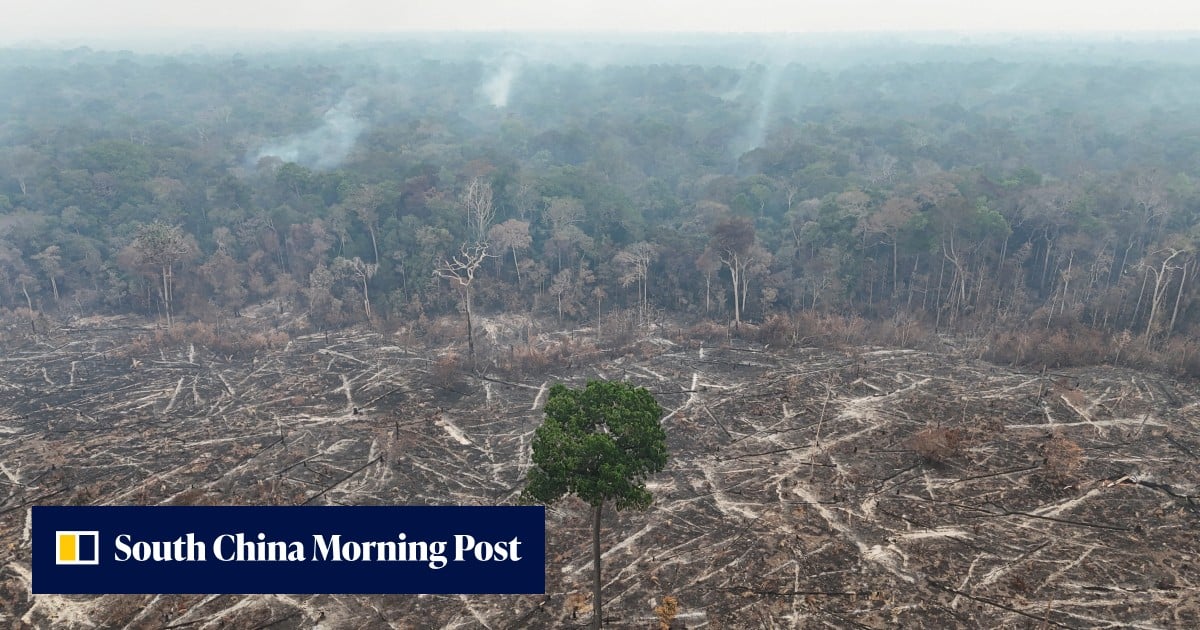
Seven million hectares of forest were permanently destroyed in 2025, 15% fewer than a year earlier
Researchers behind the Forest Declaration Assessment say 7 million hectares of forest were permanently destroyed in 2025, 15% less than the year before. They say that is not enough to meet the 2030 pledge to end deforestation.
The Scientist · Science desk
The fall in forest destruction in 2025 was about 1.2 million hectares. To meet the 2030 target, deforestation would have to fall by around one million hectares per year. Loss in 2024 was about 8.2 million hectares.
| Figure | Value | Note | Claim |
|---|---|---|---|
| Fall in forest loss in 2025, about | 1.2 million ha | 24 | |
| Yearly fall needed, around | 1 million ha | 4 | |
| Loss in 2024, about | 8.2 million ha | 23 |
What happened
- Latin America, historically the world's deforestation hot spot, saw a 33% drop, and the authors credit Brazil's deforestation action plan and stronger enforcement in its Amazon.
- Rainforest loss in the Congo basin reached 2.4 million hectares, near the Amazon's level of deforestation for the first time.
- The current El Nino emerged in June, is expected to peak later this year and is already shaping up to be the strongest ever observed.
- Brazil holds a presidential runoff on Oct. 25 between Luiz Inacio Lula da Silva, who has vowed to end illegal deforestation by 2030, and Sen. Flavio Bolsonaro.
Why it matters
- exposure Colombia and Peru, which recently elected hard-right presidents, join Brazil among the places where Amazon-basin progress could be threatened, according to the experts.
- precedent Matson noted a huge spike in tree cover loss during the last super El Nino in 2015-2016, the nearest precedent for the event now under way.
- cost Local and Indigenous communities carry the loss: Nguiffo says clearing hits their cultural identity and livelihoods and fuels conflict as the forest space available to them shrinks.
If 7 million hectares is 15% below the year before [1], then 2024 came in near 8.2 million [23] and the fall was about 1.2 million [24]. The 2030 target, agreed at COP26 in 2021, calls for deforestation to drop by around 1 million hectares per year [4]. So 2025 delivered roughly one year of the required cut, once. Both inputs are rounded, which makes 1.2 million an estimate. Erin Matson, a co-author and lead consultant at Climate Focus, said at a media briefing that the 2025 figure is "encouraging but so far it's the exception, not a new trajectory" [3].
We would call the Brazil link plausible and unproven. A drop that coincides with a policy does not by itself show the policy caused it, and one year of data cannot separate the two. The report says progress in the region "rests heavily on the choices of a small number of governments and remains highly vulnerable" to recent and upcoming elections across the Amazon basin [6]. Brazil has a recent example of the swing: deforestation surged under former president Jair Bolsonaro, father of the candidate in the runoff [8].
The Congo basin number is harder to size. The assessment was drafted by a coalition of research groups and nongovernmental organizations [2], and both outlets that ran the story used the same AFP report [19][20]. This account therefore rests on one wire summary, which does not include the 2024 Congo figure or the Amazon's. Against the global total, 2.4 million hectares would be about a third [25], but the wire describes the Congo figure as rainforest loss [10] and the global figure as permanent destruction [1]. Clearing for agriculture or mining remains the leading driver worldwide [21]. Sam Nguiffo, a lawyer and founder of the Centre for Environment and Development in Cameroon, said logging for timber, or felling trees for agriculture or mining, appears to prevail in forest management in Central Africa [22]. "Losing such a size of forest every year is a disaster," he said [11].
El Nino brings drought, and drought creates conditions for wildfires [18]. It has been associated with strong drought in Indonesia, where forest and plantations have burned in Borneo and South Sumatra for months [14]. The report says: "If projections of the historically strong 2026-27 El Nino materialise, drought and fire risks will intensify further across tropical forest regions" [15]. Matson's 2015-2016 comparison was to tree cover loss [16], while the 7 million figure counts permanent destruction [1], so her comparison shows the direction of risk and not its size. Her own expectation for 2026 is plain. "We can't fully predict the future but it's unlikely, I would say, that in 2026 we'll see the same kind of reductions (in deforestation) that we saw last year," she said [17].
What to watch
- The result of Brazil's Oct. 25 runoff, and whether the winner keeps the enforcement the authors credit for the Amazon drop.
- The assessment's next Congo basin and Amazon figures, which would show how large the 2025 Congo increase was.
- The 2026 global total, which Matson does not expect to show reductions like 2025's.
Clarity's read
What the record supports and how the coverage leans. The claims behind it follow.
Reality
- Evidence55
- Adoption
- Insufficient
- Hype gap+5
- Incentives
- Insufficient
- Confidence62
Claim ledger
Ranked by verification strength, evidence, and original report placement.
- [1]
Seven million hectares of forest were permanently destroyed in 2025, a 15% drop from the previous year, according to the annual Forest Declaration Assessment.
- [2]
The report was drafted by a coalition of research groups and nongovernmental organizations, and says the slowdown is not enough to keep the world from missing a pledge to end deforestation by 2030.
- [3]
Erin Matson, the study's co-author and lead consultant at Climate Focus, said in a media briefing that the 2025 figure is "encouraging but so far it's the exception, not a new trajectory".
- [4]
To meet the target, agreed at the UN's COP26 climate talks in 2021, deforestation would have to fall by around one million hectares per year.
- [5]
Last year's improvement was due in part to progress in Latin America, with a 33% drop in what has historically been the world's deforestation hot spot; the authors pointed particularly to Brazil's deforestation action plan and increased enforcement in the Amazon.
- [6]
Progress in the region "rests heavily on the choices of a small number of governments and remains highly vulnerable" to recent and upcoming elections across the Amazon basin.
- [7]
Brazil's leader Luiz Inacio Lula da Silva, who has vowed to end illegal deforestation by 2030, faces Sen. Flavio Bolsonaro in a runoff presidential election on Oct. 25.
- [8]
Deforestation had surged under the administration of Flavio Bolsonaro's father, far-right former President Jair Bolsonaro.
- [9]
Progress could also be threatened in Colombia and Peru, where hard-right presidents were recently elected, according to the experts.
- [10]
In the Congo basin, rainforest loss reached 2.4 million hectares, near the same level of deforestation as the Amazon for the first time.
- [11]
"Losing such a size of forest every year is a disaster," said Sam Nguiffo, a lawyer and founder of the Centre for Environment and Development in Cameroon.
- [12]
Nguiffo said deforestation has a "massive impact on the cultural identity and on the livelihood of local and Indigenous communities", and that "The erosion of the forest, both in size and in number of species, reduces the space available for communities and fuels conflicts."
- [13]
The current El Nino event, which emerged in June, is expected to peak later this year but is already shaping up to be the strongest ever observed.
- [14]
El Nino has been associated with strong drought in Indonesia, where tracts of forest and plantations have been burning in biodiverse Borneo and South Sumatra for months.
- [15]
"If projections of the historically strong 2026-27 El Nino materialise, drought and fire risks will intensify further across tropical forest regions," the deforestation report said.
- [16]
Matson noted that there was a "huge spike" in tree cover loss during the last "super" El Nino event in 2015-2016.
- [17]
"We can't fully predict the future but it's unlikely, I would say, that in 2026 we'll see the same kind of reductions (in deforestation) that we saw last year," Matson said.
- [18]
El Nino, the warming phase of a natural climate cycle, threatens progress because its effects include droughts, creating conditions for wildfires.
- [19]
The phys.org article is AFP wire copy (credited "2026 AFP").
- [20]
The Straits Times article is credited to AFP.
- [21]
Clearing forests for agriculture or mining operations remains the leading driver of deforestation.
- [22]
Logging for timber or felling trees for agriculture or mining appears to prevail in forest management in Central Africa, Nguiffo said.
- [23]
If 7 million hectares is a 15% drop, 2024 deforestation was about 8.2 million hectares.
- [24]
The 2025 fall was about 1.2 million hectares, roughly one year of the cut the 2030 target requires (inputs are rounded).
- [25]
Congo basin loss of 2.4 million hectares is about 34% of the 7 million hectare global figure, if the two measures are comparable.
Get this ledger inside ChatGPT. Ask about any of our stories and the answer brings its figure, each claim’s verdict and the sources. Free, no account.
Sources
1 independent publisher whose own reporting we read for this story.
- phys.orgGlobal deforestation slowed in 2025 but surged in Congo basin: Study
1 article · October 14, 2026
- scmp.comGlobal deforestation fell in 2025, but Congo Basin losses surged
1 article · October 13, 2026
- straitstimes.comGlobal deforestation slowed in 2025 but surged in Congo basin: Study
1 article · October 13, 2026
Topics and entities
Follow any of these and your For You feed starts watching them — no settings page required.
Entities
- Flávio BolsonaroFollow
- Sam NguiffoFollow
- Jair BolsonaroFollow
- AFPFollow
- Erin MatsonFollow
- Forest Declaration AssessmentFollow
- Luiz Inácio Lula da SilvaFollow
- Climate FocusFollow