Countdown pressure ahead of a gamble lowered loss aversion in a 61-person randomized experiment
Adults who solved arithmetic under a countdown and an observer weighted losses about 1.7 times gains in later gambles, against about 2.4 for controls. The difference would not survive a stricter check for multiple outcomes, and the stress induction worked unevenly, so the result is tentative.
The Scientist · Science desk
Two bars. The pressure group gave losses roughly 1.7 times the weight of gains; the control group gave losses about 2.4 times the weight of gains.
Weight of losses relative to gains, 59 analyzed participants In times weight of gains
| Item | Value | Claim |
|---|---|---|
| Pressure group, roughly | 1.7 times weight of gains | 5 |
| Control group, about | 2.4 times weight of gains | 5 |
What happened
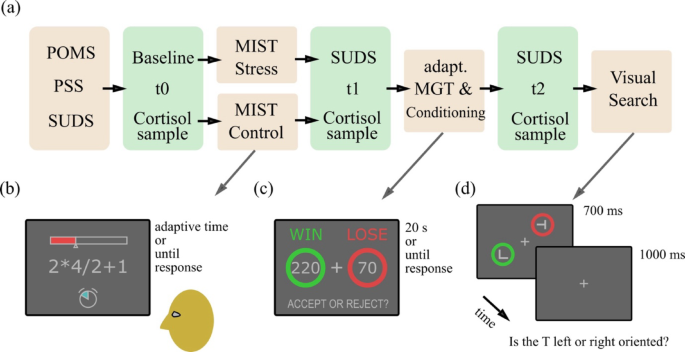
- Both groups solved arithmetic problems, but one also faced a countdown, sounds, close observation and a progress bar showing a potential bonus.
- Right afterward, everyone accepted or rejected 64 gambles with an equal chance to gain or lose points, and selected bets set a monetary bonus.
- Heart rates rose during the arithmetic in the pressure group, the one physiological sign that the manipulation did something.
- In a later attention task, colors once tied to winnings gave slightly faster responses, but the pressure group showed no detectable extra advantage.
Why it matters
- contradiction The paper's title says stress reduces loss aversion, yet self-rated stress and cortisol did not clearly separate the groups, so the causal label leans on a heart-rate rise in one group.
- constraint A 2016 ice-water study of 120 participants found no effect on loss aversion, so a countdown result and a cold-water result answer different questions and cannot simply be pooled.
- constraint Heart rates had returned to baseline by the attention test and the sample was modest, so the null on attention rules out only large effects.
Both groups still weighted losses more than gains [6]; the finding concerns how much more. On the ratio reported, the pressure group sat 0.7 below the controls [19], about 29% lower [20]. Those figures come from 59 people, not 61, because two participants' choices could not be analyzed [21]. The write-up does not report how many people sat in each group.
De Tommaso and colleagues, of the University of Milano-Bicocca, published the work in Motivation and Emotion [1]. They assigned participants at random [2], so differences in temperament or appetite for risk should be spread across the two groups by chance. Random assignment cannot isolate the ingredient, though. The pressure condition bundled several elements into one manipulation [3], and the researchers said as much: "The countdown, auditory feedback, and bonus display could in principle enhance effort or competitiveness," they wrote [11]. In our view the experiment tests that package, and "stress" is one name for what the package did.
We would also not carry a 1.7-versus-2.4 difference from healthy adults doing a lab task [2] to decisions made under a real deadline with real money. The study did not test that.
The thing this doesn't tell you is what participants attended to while they were choosing. The attention test came afterward, using colors that had been paired with possible wins and losses during the gambles [8]. According to the phys.org write-up, tracking attention during the decisions themselves would show whether pressure changes which information people notice, how heavily they weigh it, or both [17].
What to watch
- A larger replication that names a single primary outcome in advance, which would remove the multiple-outcomes problem.
- A version that separates the countdown, sounds, observer and bonus display, to show which element moves loss aversion.
- Attention tracking during the gambles themselves, the test the phys.org write-up says would settle noticing versus weighing.
Clarity's read
What the record supports and how the coverage leans. The claims behind it follow.
Reality
- Evidence35
- Adoption
- Insufficient
- Hype gap+10
- Incentives
- Insufficient
- Confidence45
Claim ledger
Ranked by verification strength, evidence, and original report placement.
- [1]
Matteo De Tommaso of the University of Milano-Bicocca and colleagues describe the experiment in a paper published in Motivation and Emotion.
- [2]
The researchers randomly assigned 61 healthy adults to two groups.
- [3]
Both groups solved arithmetic problems, but one faced a countdown, sounds and close observation, along with a progress bar showing a potential bonus.
- [4]
Immediately afterward, participants accepted or rejected 64 gambles, each offering an equal chance of gaining or losing specified amounts of points; selected bets would determine a monetary bonus.
- [5]
Among the 59 participants whose choices could be analyzed, the pressure group gave losses roughly 1.7 times the weight of gains, compared with about 2.4 times in the control group.
- [6]
Losses still carried more weight than gains in both groups; the difference was in how much.
- [7]
The difference passed the study's conventional threshold but would not survive a stricter check that would account for its multiple outcomes.
- [8]
During the gambles, possible wins and losses appeared inside differently colored rings so each color became associated with a prospect; those colors returned in a later attention task, surrounding letters on a screen.
- [9]
In the later attention task, responses were slightly faster when the target appeared inside the color previously associated with winnings, but the researchers found no detectable increase in this advantage among people from the pressure group.
- [10]
Heart rates rose during the arithmetic problem-solving within the pressure group.
- [11]
"The countdown, auditory feedback, and bonus display could in principle enhance effort or competitiveness," the researchers write.
- [12]
A 2016 study involving 120 participants used immersion in ice-cold water to induce stress and found no effect on loss aversion.
- [13]
By the time the later attention test was conducted, heart rates were no longer elevated above baseline in the pressure group.
- [14]
The modest sample size could have missed smaller attention effects.
- [15]
The paper is titled "Stress reduces loss aversion without increasing reward-cue attentional salience."
- [16]
The results are tentative, partly because the attempt to induce stress produced an uneven response.
- [17]
The experiment leaves open what participants focused on while choosing their bets; tracking attention during those decisions would show whether pressure changes which information people notice, how heavily they weigh it, or both.
- [18]
Participants' stress ratings and levels of the stress hormone cortisol did not clearly differ between the groups.
- [19]
The pressure group's loss-aversion ratio sat about 0.7 below the control group's.
- [20]
The pressure group's ratio was about 29% lower than the control group's.
- [21]
Two of the 61 randomized participants were not in the analysis of choices.
Get this ledger inside ChatGPT. Ask about any of our stories and the answer brings its figure, each claim’s verdict and the sources. Free, no account.
Sources
1 independent publisher whose own reporting we read for this story.
- phys.orgMath under pressure may make a gamble's downside seem smaller
1 article · October 14, 2026
Topics and entities
Follow any of these and your For You feed starts watching them — no settings page required.