Science1 publisher2 min readPublished
CERN starts pulling the LHC's original focusing magnets to make room for 11.3-tesla replacements
CERN crews have begun dismantling the LHC around ATLAS and CMS to swap its focusing magnets for niobium-tin ones about 40% stronger. The first replacement quadrupole is not due in the tunnel until the start of 2029.
The Scientist · Science desk
What happened
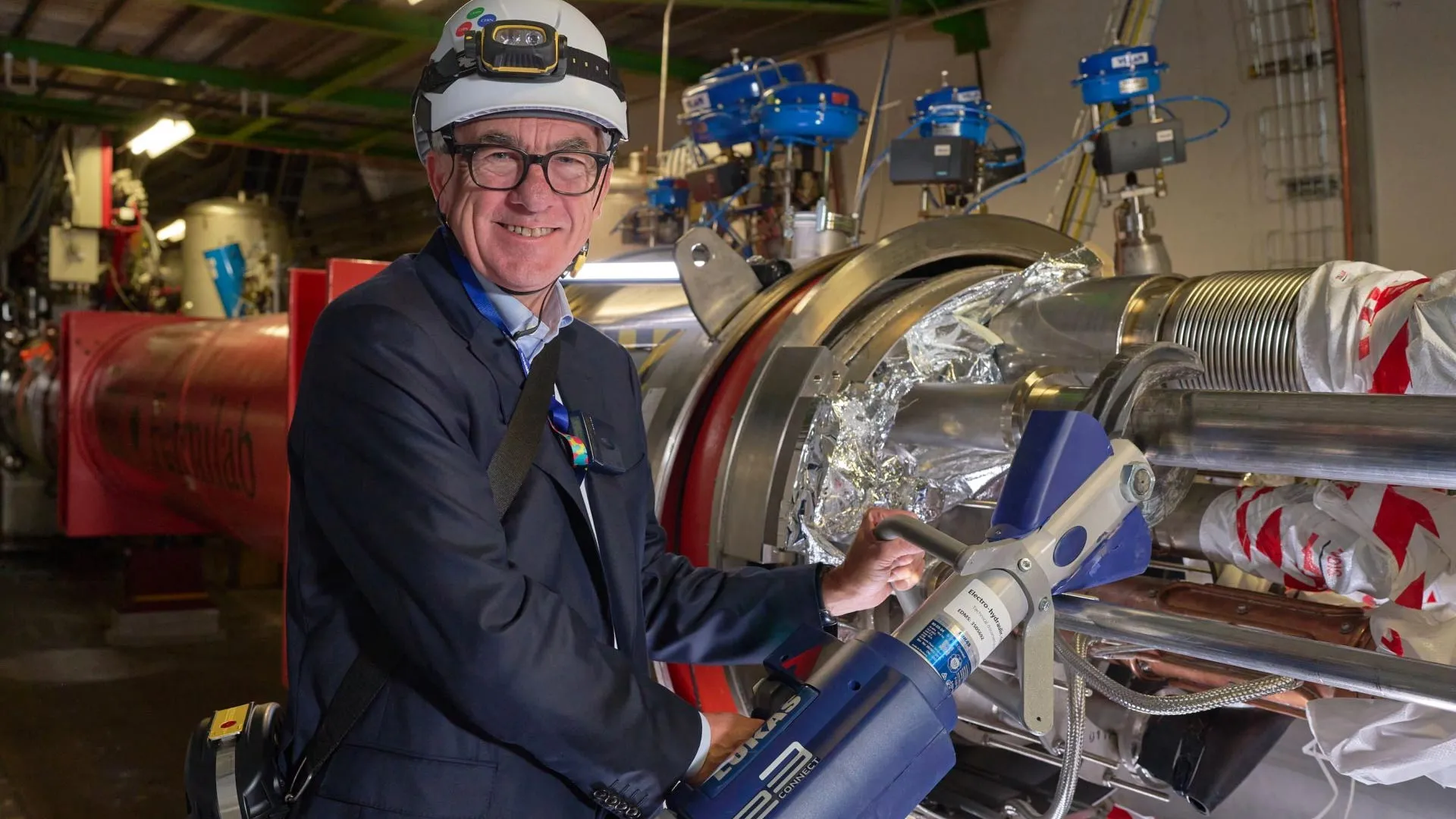
- Crews cut the first magnet interconnection during the LHC's third long shutdown, formally starting the replacement, and Director-General Mark Thomson visited Point 1 at ATLAS.
- Since September 7, CERN teams have been dismantling sections on either side of ATLAS and CMS to remove 28 superconducting magnets, including the inner triplets.
- The new inner triplets use niobium-tin coils reaching 11.3 tesla, about 40% stronger than the niobium-titanium magnets the LHC runs on now.
Compiled by The ScientistSomething wrong?How this is made
Why it matters
- constraint ATLAS and CMS can gain nothing from the stronger focusing before the first new quadrupole reaches the tunnel, about 28 months after dismantling began.
- capability Once installed, the stronger fields let CERN squeeze beams tighter at ATLAS and CMS, raising the chance that particles collide and so the data those detectors can record.
- decision CERN is reserving the new triplets for the experiments that need higher instantaneous luminosity; ALICE and LHCb keep their existing triplets, which will still be upgraded.
The 40% describes the magnetic field. The new coils reach 11.3 tesla [6]. Taken at face value, the percentage puts the magnets now in the machine at roughly 8 tesla [13]. Both generations are superconducting: CERN counts the hardware coming out as 28 superconducting magnets [5]. The change is in the conductor, with niobium-tin replacing niobium-titanium [6]. CERN attributes the step to years of research and development [16].
Inner triplets are groups of three quadrupole magnets on both sides of each of the LHC's four main experiments. They squeeze the beams as tightly as possible just before the particles meet inside the detectors [2]. The tighter the squeeze, the greater the chance of a collision. Luminosity is the number of collisions in a given period of time [3]. On that basis, CERN says the stronger magnets should produce far more collisions for ATLAS and CMS to analyse [12]. The thing this doesn't tell you is how many more: the release does not include a luminosity target, and a 40% gain in field should not be read as a 40% gain in data.
So far, the work has all been removal. Crews have been dismantling sections of the collider on either side of ATLAS and CMS since September 7 [5]. The first replacement quadrupole is not expected in the tunnel until the start of 2029 [7], about 28 months later [14]. "In total, 16 cryostats and 28 cryo-assemblies will be installed - a major undertaking," said Jean-Philippe Tock, who heads the LS3 coordination team [8].
The magnets leaving the tunnel are the machine's originals. "The current inner triplets date back to the LHC construction phase and were installed in the machine between 2005 and 2007. After nearly twenty years of operation, they will give way to a new generation of even more powerful magnets," said Markus Zerlauth, the HiLumi LHC project leader [11].
What to watch
- Whether the first niobium-tin quadrupole reaches the tunnel on the start-of-2029 schedule Tock gave.
- A published CERN luminosity target for ATLAS and CMS, the figure needed to turn a 40% field gain into a collision count.
- Completion of the removal of all 28 superconducting magnets on either side of ATLAS and CMS.