Science1 publisherNot yet confirmed elsewhere2 min readPublished
P. aeruginosa plugs its pilus channels with two proteins to keep antibiotics out
Researchers in Korea found Pseudomonas aeruginosa uses two proteins, SlkA and SlkB, to plug the channels its pili pass through and block antibiotics. They say disrupting the plugs could be a way to make existing antibiotics work against a hard-to-treat superbug.
The Scientist · Science desk
What happened
- A team led by Hongbaek Cho at Sungkyunkwan University and Jeong Min Chung at the Catholic University of Korea produced the finding.
- The channels are part of the type IV pilus machinery, the threadlike fibers P. aeruginosa extends to attach to host cells.
- The researchers used cryo-electron microscopy to resolve high-resolution three-dimensional structures of the two proteins lodged inside the channel.
- The plugs do their work in the vulnerable stage before a pilus is fully assembled, keeping the outer-membrane barrier sealed.
Compiled by The ScientistSomething wrong?How this is made
Why it matters
- capability Blocking the plugs could overcome P. aeruginosa's multidrug resistance and make antibiotics that currently fail against it effective again.
- precedent The outer-membrane barrier the plugs reinforce is common to gram-negative bacteria, so a plug-blocking adjuvant could help beyond this one species and seed next-generation antimicrobials.
- constraint P. aeruginosa's outer membrane is a strong barrier to antibiotics, so beating the resistance means getting a drug through that barrier.
To infect a host, P. aeruginosa opens channels through its surface, and until this study it was unclear how the cell keeps the channels it needs open while still keeping antibiotics out [7]. It is a genuine design conflict, because the opening the cell relies on is also an opening a drug could slip through. The authors describe their answer as a new mechanism of resistance in a superbug that is already extremely difficult to treat [1].
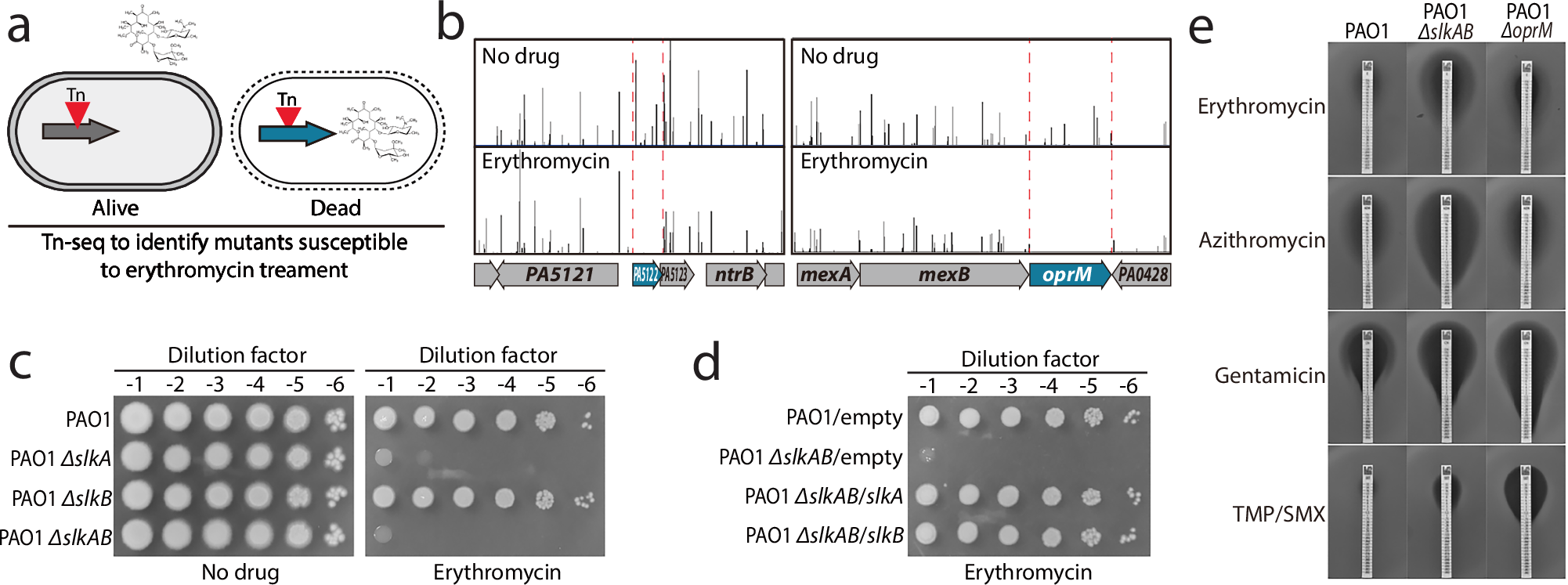
For years the assumption was that the channel's own narrow geometry did the filtering, a hole shaped to pass a pilus but not a drug [11]. The new work hands that job to two dedicated proteins that sit inside the channel and reinforce the barrier from within [12]. The paper, in Nature Communications, is titled 'Secretin-interacting plug proteins prevent antibiotic influx during type IV pilus assembly in Pseudomonas aeruginosa' [2][13].
The reassignment is the substance of the finding. The channel was thought to filter by its narrow shape; the real work falls to a protein the cell makes and places inside it [12]. That also explains why the geometry alone only ever accounted for part of this resistance [11].
The paper stops short of a drug. No molecule yet pries SlkA or SlkB out of the channel, and the authors have not shown that removing the plugs lets an antibiotic kill a bacterium it currently cannot [9]. P. aeruginosa causes pneumonia, sepsis and health care-associated infections [3].
What to watch
- A small molecule that keeps SlkA or SlkB out of the channel and lets antibiotics back in.
- Tests of whether blocking the plugs makes standard antibiotics kill P. aeruginosa in infection models.
- Whether the same plug proteins exist in other gram-negative pathogens the approach would target.