ProductNot yet confirmed elsewhere1 publisher3 min readPublished
Oxford physicists recreate the Aharonov-Bohm effect on a two-qubit trapped-ion loop
Oxford physicists used a hybrid trapped-ion quantum computer to stop a simulated particle tunneling with a magnetic flux it never crossed. Their setup is one loop of two qubits and two oscillators, a first building block for simulations that get harder for classical machines as they grow.
The Product Desk
What happened
- Aharonov and Bohm predicted the effect in 1959, and experiments with real electrons later confirmed it.
- The study authors began developing their lattice gauge theory experiment in 2022.
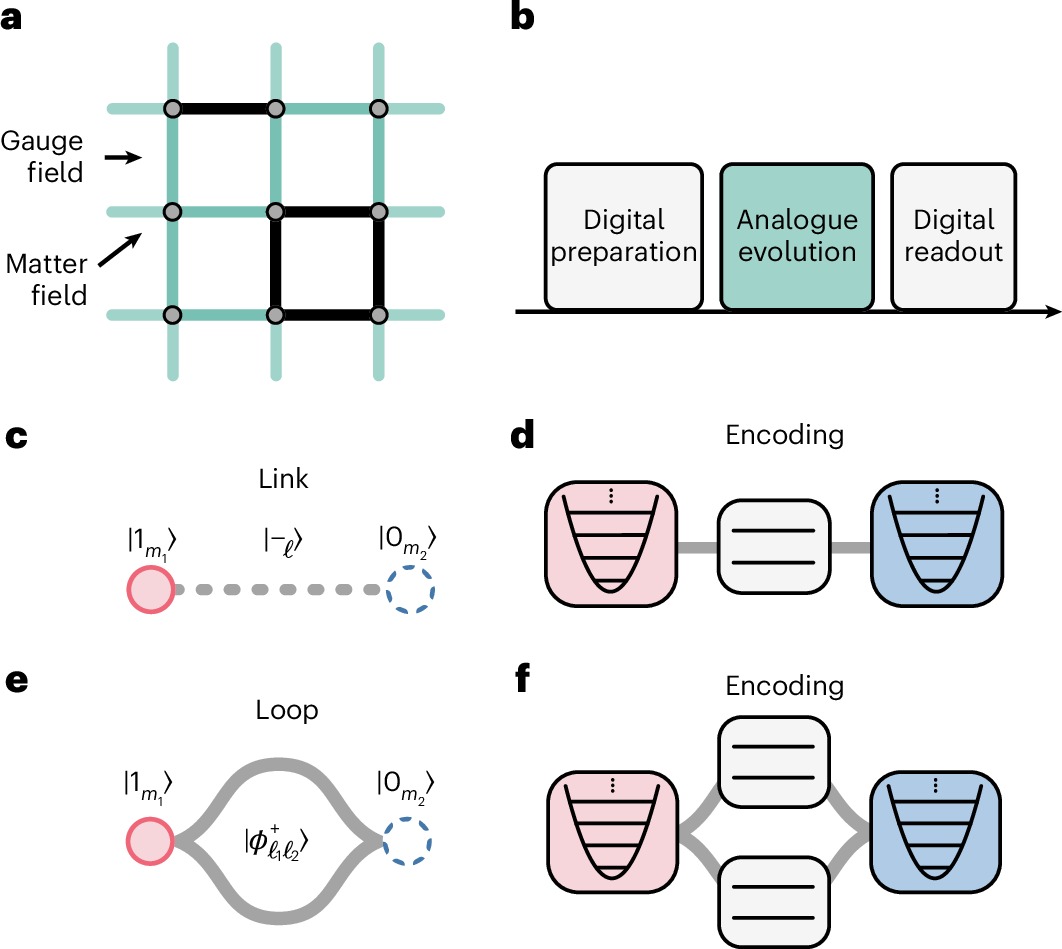
- Qubits held in the ions' internal electronic states stood in for gauge fields, while the ions' vibrations stood in for matter.
- Digital operations prepared and measured the system, and analog quantum evolution simulated the interactions between matter and field.
Why it matters
- constraint Any claim that these machines out-model classical computers depends on lattices larger than this single loop, because the source ties classical difficulty to growing system size.
- capability With the flux held in qubits that evolve with the matter, researchers can study field behavior that a fixed-background simulation leaves out.
- decision Anyone briefing a team on quantum simulation can treat this four-component run as a method check and hold advantage claims until a multi-loop lattice reports a classical comparison.
The simulated particle ends where it began. With no flux threaded through the loop, it tunneled freely between its two sites. Once flux was added, its two possible paths interfered destructively and cancelled the tunneling, leaving the system in its starting state [3]. The particle's phase shifts because of flux in a region it never passes through [2].
The pitch, in Interesting Engineering's account, looks ahead: the findings could help scientists simulate fundamental interactions that are increasingly difficult to model on conventional computers [15]. The experiment itself is smaller. It is one loop, which the article calls an elementary building block of the theory [7], and it has four quantum components in total [14]. The same article ties the classical difficulty to scale, saying calculation gets harder as these lattice systems grow [5]. The report does not claim that the one-loop run outpaced a conventional computer.
The new capability came out of a hardware limit. According to the article, representing the flux as an entangled pair of qubits [8] started as a practical workaround, because the hardware could not supply the interaction needed to add the flux as a fixed background [9]. Product teams tend to relabel a constraint as a design choice after launch. This account says up front that the hardware forced the choice, and that the workaround let the field evolve alongside the matter it acted on [9].
"For us, the exciting step was to encode the magnetic flux in a gauge field that was itself dynamical. Rather than having matter evolve in a fixed background, the matter and gauge field become part of the same quantum dynamics," said Sebastian Saner, the lead researcher and a postdoc at Oxford [10].
Quantum simulation works by building a physical system that obeys the same rules as the model, then watching how it behaves [12]. So the first thing to check on any claim is size. We think a two-by-two sorts these results well. One axis asks whether the system is large enough that the source itself says classical calculation struggles. The other asks whether the simulation does something a fixed-background setup could not, such as letting field and matter evolve together. A small system with nothing new is a demo. A small system with a new capability is a method that works and still needs scale. Large with nothing new is a capacity claim to test against classical benchmarks. Large with a new capability is what the write-up expects "with further development" [16].
On the evidence in this report, Oxford's loop sits in the second box [14] [10]. We would count it as proof that the hybrid method handles dynamical fields, and hold any advantage claim until a multi-loop lattice runs with a classical comparison. The cost of that caution is time. A lab needs a working method before it builds bigger, and the article describes the larger runs as further development [16].
What to watch
- A multi-loop or larger lattice run on the same hybrid trapped-ion hardware, published with a stated comparison against classical calculation.
- Hardware that can apply the flux as a fixed background, letting the team compare fixed and dynamical fields in the same setup.
Clarity's read
What the record supports and how the coverage leans. The claims behind it follow.
Reality
- Evidence55
- Adoption
- Insufficient
- Hype gap+20
- Incentives
- Insufficient
- Confidence50
Claim ledger
Ranked by verification strength, evidence, and original report placement.
- [1]
Physicists at the University of Oxford recreated the Aharonov-Bohm effect using a hybrid quantum computer, demonstrating it in a simulated quantum system.
- [2]
The Aharonov-Bohm effect occurs when a particle traveling around a region containing magnetic flux experiences a change in its quantum phase, even though it never passes through the magnetic field itself.
- [3]
Without magnetic flux, the particle tunneled freely between the two locations; when flux was introduced, the two possible paths interfered destructively, canceling the tunneling and leaving the system in its starting state.
- [4]
Yakir Aharonov and David Bohm predicted the effect in 1959, and experiments with real electrons later confirmed it.
- [5]
In lattice gauge theories, matter occupies points on a grid while gauge fields connect those points; as these systems grow, calculating their behavior on conventional computers becomes increasingly difficult.
- [6]
Qubits encoded in the internal electronic states of trapped ions represented the gauge fields, while quantum oscillators corresponding to the ions' vibrations represented matter.
- [7]
The researchers connected two oscillators, representing matter at two locations, using two qubits representing the fields between them, forming a loop that is an elementary building block of the theory.
- [8]
The researchers prepared the two qubits in an entangled state, which in the simulation represented magnetic flux passing through the loop.
- [9]
Encoding the flux this way was initially a practical workaround because the hardware could not provide the interaction needed to introduce the flux as a fixed background; the approach also allowed a gauge field that could evolve alongside the matter it interacted with.
- [10]
"For us, the exciting step was to encode the magnetic flux in a gauge field that was itself dynamical. Rather than having matter evolve in a fixed background, the matter and gauge field become part of the same quantum dynamics," said Sebastian Saner, lead researcher and a postdoc researcher at Oxford University.
- [11]
Beginning in 2022, the study authors developed an experiment to simulate a lattice gauge theory.
- [12]
Quantum simulation means building a physical system that follows the same underlying rules as the model under study, then observing its behavior.
- [13]
The team used digital operations to prepare and measure the system, while analog quantum evolution simulated the interactions.
- [14]
The simulated loop had four quantum components in total.
- [15]
The findings could help scientists simulate fundamental interactions that are increasingly difficult to model using conventional computers.
- [16]
With further development, similar simulations could help researchers investigate more complex interactions that are difficult to model.
Sources
1 independent publisher whose own reporting we read for this story.
- interestingengineering.comScientists stop a quantum particle using a magnetic field it never crossed
1 article · October 11, 2026
Topics and entities
Follow any of these and your For You feed starts watching them — no settings page required.
Topics
- Quantum SimulationFollow
- Lattice gauge theoryFollow
- Trapped-ion quantum computingFollow
- Aharonov–Bohm effectFollow
Entities
- University of OxfordFollow
- Sebastian SanerFollow
- Yakir AharonovFollow
- David BohmFollow
- Nature PhysicsFollow