ScienceNot yet confirmed elsewhere1 publisher2 min readPublished
Oxygen isotopes in one Queensland snail shell line up with cyclones Marcia and Debbie
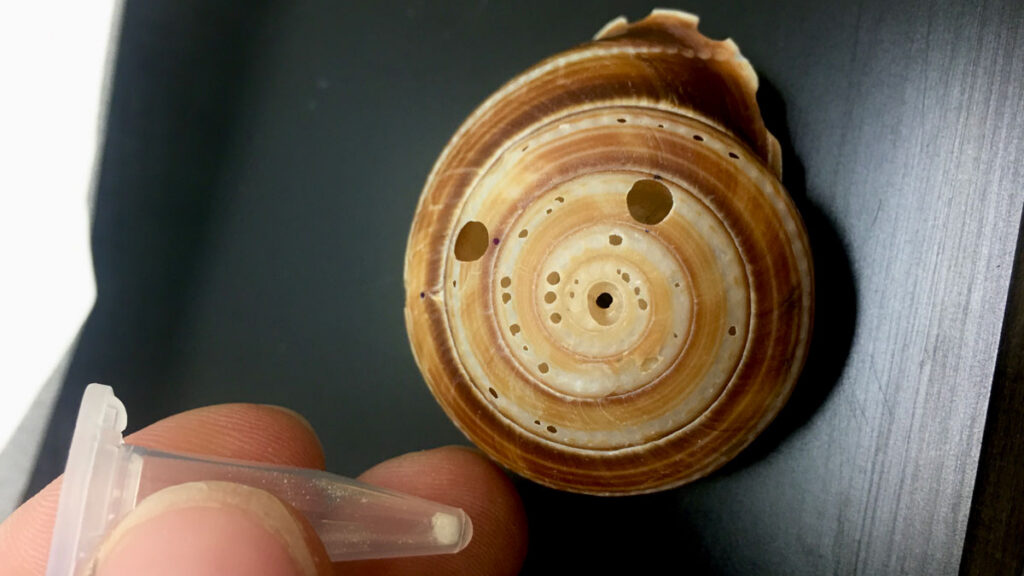
Researchers matched oxygen isotopes in one Biggenden banded snail's shell to ex-tropical-cyclone rain across about 4.5 years of its life. It is one shell from a limestone-free park, so use at other sites is a projection.
The Scientist · Science desk
What happened
- The snail, about 55 millimeters across, was found with body tissue still in the shell, so it likely died a week or two earlier.
- Researchers drilled samples along the shell's growth path, from the apex to the opening, and sampled eight locations for radiocarbon dating.
- Queensland satellite and climate data on rain, storms and vegetation moisture were matched to the shell, and the timeline tied its isotopes to Severe Tropical Cyclone Marcia in 2015 and Tropical Cyclone Debbie in 2017.
Why it matters
- constraint The first test came on basalt. Limestone country is the hard case for the age model, and this study does not show how the method copes with it.
- capability If the result holds up, Vendetti says a land snail shell could give a several-year rainfall picture before the animal's death, including for South America thousands of years ago.
- constraint A shell records only its owner's lifetime, about 4.5 years here, so a record much longer than that would need overlapping shells.
The age model had an anchor. Nicholas Patton, a Quaternary scientist at Idaho State University and the study's lead author, said of the snail: "We know when it passed away, but we don't know how old it was." [5][14] Radiocarbon dates from eight drilled locations, taken from the apex to the opening, supplied the ages [9], and an age-growth model turned them into a lifespan of about 4.5 years [10]. Queensland satellite and climate data then supplied the weather to compare against [12].
Eight dates across about 4.5 years is 1.8 per year [15]. That is enough to place sections of shell in a given year. Whether it separates one storm from the wet season around it depends on how finely the isotopes were sampled, and the Eos report does not say how many isotope samples were taken. Eos describes the storm link as suggestive: the timeline connected the oxygen isotopes to Marcia in 2015 and Debbie in 2017, which suggests the snail's growth responded to the storms and not only to the seasons [12]. The slowest growth ran from 2015 to 2017 [11], the same years that bracket the two named storms.
The site was favourable in ways that may not transfer. The park sits on volcanic basalt [7]. Jason Rech, a Miami University geologist in Ohio who had no role in the study, said the lack of limestone was key for an accurate result, and added: "Most land snails will ingest limestone to get at the calcium." [7] Old carbon taken in that way can make a shell date older than it is [8]. Patton described the twin lakes, which fill seasonally and periodically dry out, as "a big rain trap." [6]
Jann Vendetti, an associate curator of malacology at the Natural History Museum of Los Angeles County who was not involved, said: "The implications of this paper are that this technique could be used with other land snails, from other sites around the world." [16]
In our view that is a fair projection with conditions attached. One shell shows the technique can work where the calcium source is clean and the death date is known to within a week or two [4]. Eos describes a single shell [13]. Whether a second snail from the same park would record the same storms is untested. And a fossil shell would arrive without a known death date, so we'd expect the age model to be the harder part there.
What to watch
- A second shell from Coalstoun Lakes showing the same Marcia and Debbie signal would answer the single-animal problem.
- Results from snails living on limestone, where ingested old carbon can push radiocarbon ages too old.
- The paper's methods in The Holocene, for how many isotope samples were taken along the shell.
Clarity's read
What the record supports and how the coverage leans. The claims behind it follow.
Reality
- Evidence45
- Adoption
- Insufficient
- Hype gap+10
- Incentives
- Insufficient
- Confidence40
Claim ledger
Ranked by verification strength, evidence, and original report placement.
- [1]
A Biggenden banded snail in Coalstoun Lakes National Park, Australia, lived from 2013 to 2018.
- [2]
Researchers used radiocarbon dating and oxygen isotopes to establish when sections of the shell formed, and connected changes in the shell to ex-tropical cyclone rainfall during the snail's lifetime.
- [4]
The team found a large (about 55 millimeters in diameter), recently deceased snail with remnants of body tissue still inside the shell; Patton said it likely died in the past week or two.
- [5]
"We know when it passed away, but we don't know how old it was," said Nicholas Patton.
- [6]
Approximately 600,000 years ago a volcanic eruption created twin lakes at the park that fill seasonally and periodically dry out; Patton said, "Essentially, it's a big rain trap."
- [7]
The area around Coalstoun Lakes is volcanic basalt; Jason Rech, a geologist at Miami University in Ohio who was not part of the study, said the lack of limestone was key for an accurate snail study: "Most land snails will ingest limestone to get at the calcium."
- [8]
If a snail consumes too much limestone or other calcium sources, old carbon can be absorbed into the shell and interfere with radiocarbon dating by making the shell appear older than it actually is.
- [9]
Researchers drilled samples along the shell's growth path from the apex to the opening and sampled eight locations for radiocarbon dating.
- [10]
Radiocarbon dating and an age-growth model showed the snail lived approximately 4.5 years.
- [11]
The snail grew fastest during the first and last years of its life, with the slowest growth recorded between 2015 and 2017.
- [12]
Researchers used Queensland satellite and climate data to identify periods of heavy rainfall and storms and changes in vegetation moisture at the park; these were captured in the shell's chemistry, and the timeline connected the shell's oxygen isotopes to Severe Tropical Cyclone Marcia in 2015 and Tropical Cyclone Debbie in 2017, suggesting the snail's growth was in response to those storms rather than just seasonal patterns.
- [13]
Eos describes the analysis of a single Biggenden banded snail shell found at Coalstoun Lakes National Park.
- [14]
Nicholas Patton is a Quaternary scientist at Idaho State University and the study's lead author.
- [15]
Eight radiocarbon sampling locations over a roughly 4.5-year life is about 1.8 dates per year.
- [16]
"The implications of this paper are that this technique could be used with other land snails, from other sites around the world," said Jann Vendetti, associate curator, malacology, at the Natural History Museum of Los Angeles County, who was not involved in the study.
ReportedInsufficientSource: Jann Vendetti, Natural History Museum of Los Angeles County2 sources— create a free account to open themView cited source - [17]
Vendetti said that to learn the likely rainfall pattern in part of South America thousands of years ago, or in the deserts of the U.S. Southeast, researchers could use land snail shells to get a picture of rainfall over several years prior to the snail's death.
ReportedInsufficientSource: Jann Vendetti2 sources— create a free account to open themView cited source
Sources
1 independent publisher whose own reporting we read for this story.
- eos.orgReading Rainfall in a Snail’s Shell
1 article · October 13, 2026
Topics and entities
Follow any of these and your For You feed starts watching them — no settings page required.