Science3 publishers3 min readPublished Updated
Burned Gallic wall under a Paris hospital courtyard strengthens the case for Lutetia on the Île de la Cité
Carbon-14 on the wall's timbers returns 200 to 10 B.C.E., a window wide enough to hold the 52 B.C.E. burning Caesar described and much else besides, and the officials quoted say function and chronology still need verifying.
The Scientist · Science desk
What happened
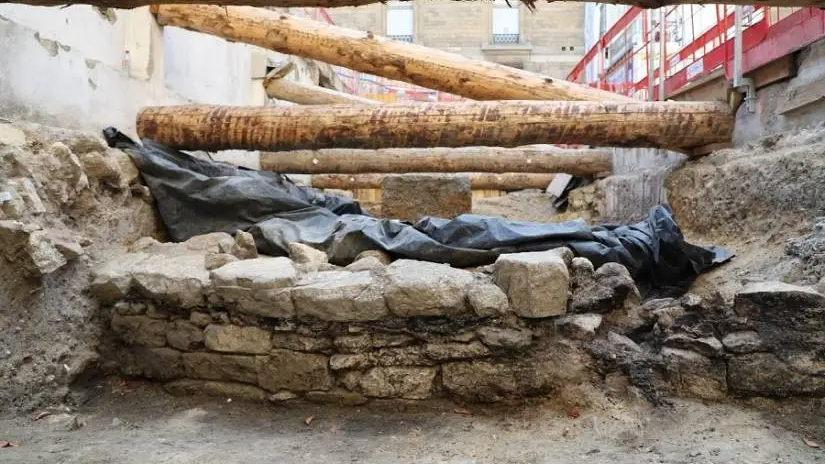
- Archaeologists working under a courtyard of the Hotel-Dieu hospital, on the Ile de la Cite steps from Notre-Dame, exposed 20 metres of stone and timber wall carrying traces of fire.
- Alongside the wall the team recovered burned seeds and a Gallic spearhead, which lay at the foot of the structure.
- The dig opened in February 2026 ahead of the hospital's restructuring, led by David Couturier of the City of Paris archaeology department with support from Inrap.
- Initial carbon-14 dating of the wall's wooden elements returned a range between 200 and 10 B.C., according to heritage curator Dorothee Chaoui-Derieux.
- France's Territorial Commission for Archaeological Research declared the find of exceptional importance in mid-September.
Compiled by The ScientistSomething wrong?How this is made
Why it matters
- constraint A radiocarbon window this wide cannot pin the burn layer to Caesar's campaign year, so the identification with 52 B.C.E. rests on the pottery, the spearhead and the architectural reading holding up under review.
- decision Because the wall cannot stay where it is, anyone re-examining the claim later works from a mould, a 3D record and a rebuilt section. The excavation archive becomes the primary evidence.
- precedent The Nanterre alternative was proposed because the island had no tangible remains, and that premise weakens now that the island has a Gallic-type fortification. No reassessment of the Nanterre material has been published.
The initial radiocarbon window on the wall's timbers is 190 years wide, and 52 B.C.E. sits 148 years after its early bound and 42 years before its late one [19][20]. A window that wide can hold the destruction described in the Gallic Wars without dating the fire. The excavators also report pottery from the site dating to Caesar's era [5]. Caesar wrote that the Parisii town stood on an island in the Seine [13]. In his account the Gauls burned Lutetia and cut its bridges as his lieutenant Labienus advanced, and their commander Camulogenus died in the battle that followed [14].
How the wall was built is what led the team to call it Gallic. "The wall's architecture, with its large blocks and interlocking beam system, immediately led us to believe it was a wall of Gallic tradition," said Dorothée Chaoui-Derieux, a heritage curator at the DRAC Île-de-France [7]. Fire blackened the outer face and destroyed a wooden building standing just in front of it [12]. The excavators think the wall may have protected an oppidum, a fortified centre of power and trade that controlled travel routes [18].
Before the dig, the case for Lutetia on the Île de la Cité rested on the town's name and on Caesar's description of an island joined by bridges in a bend of the Seine [10]. "For centuries, the location of Lutetia has been debated. Lacking tangible evidence on the Île de la Cité, some had even suggested a location in Nanterre," said Stéphane Deschamps, regional curator of archaeology at the DRAC Île-de-France [8]. The island now has a Gallic-type fortification of its own. Nanterre comes up only inside Deschamps's remark, and no re-examination of the material there has been published [23].
The two accounts pitch the result at different levels of confidence. Live Science reported that the finds "provide solid archaeological evidence that Lutetia was indeed centered on the island in the Seine and that its occupants burned it down, as Caesar noted in his Gallic Wars" [16]. The culture minister, Catherine Pégard, quoted in the press release by Discover magazine, added a caveat: "We may be looking at one of the most important remains ever discovered for understanding Gallic Lutetia. Scientific caution dictates that its function and chronology still need to be verified, but the convergence of evidence is particularly remarkable" [9]. The commission's declaration came about seven months after the courtyard was opened [21].
The fire left the remains extremely fragile, and they lie too deep to keep in place under the hospital's building plans [15]. The team will record the wall in 3D, take a mould, and rebuild a section with the original stones for eventual display in a Paris museum [15]. Live Science reported that the replica will be made using 3D photogrammetry [22].
What to watch
- Digging beneath the two-metre sand and gravel platform could date the wall's construction and abandonment separately from the burn layer.
- A tighter radiocarbon or stratigraphic result that separates a 52 B.C.E. destruction from an earlier fire on the same face.
- Publication of the DRAC and Inrap findings alongside a direct comparison with the Nanterre evidence.