ScienceNot yet confirmed elsewhere1 publisher2 min readPublished
Scoring 10 neighborhood features at once, a New Zealand study links place to youth mental health
University of Canterbury researchers linked neighborhood mix to mental health in 957,381 New Zealanders aged 10 to 24 followed from 2013 to 2018. The clearest pattern was higher odds of emotional disorders in areas dominated by fast-food, alcohol and gaming outlets.
The Scientist · Science desk
What happened
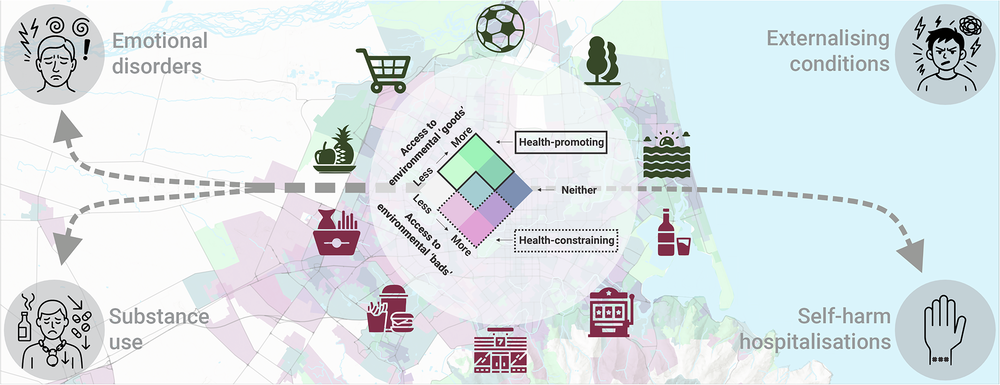
- The Healthy Location Index combines 10 features of the built and natural environment into one measure of the surroundings a young person lives in.
- Supermarkets, places for physical activity, parks and reserves, and rivers, lakes and coastlines count as health-promoting features in the index.
- Better mental health outcomes went with access to natural settings, especially a combination of green and blue spaces.
- Hobbs also reported some evidence of higher odds of substance use and self-harm hospitalizations in predominantly health-constraining environments.
- The work was led from the University of Canterbury and published in the Journal of Exposure Science & Environmental Epidemiology.
Why it matters
- capability A ten-feature score lets researchers compare whole areas, where most earlier work looked at a single factor such as parks or alcohol outlets.
- constraint The university says environments "may be linked" to mental health. A cohort association of that kind does not show that rebuilding a neighborhood would change a young person's outcomes.
- decision Marek calls the evidence a baseline for future research using more recent data, so a planner acting on it would, in our view, still want current local figures.
Deprivation and access to health care are the two adjustments we would look for first in a study like this. The team made both, along with age, gender and ethnicity [10]. The university's account says the findings suggest the built and natural environment has an important role to play even after those adjustments [15].
The denominator is where the account is thin. Hobbs, who described the emotional-disorder result as the clearest pattern [7], said young people in areas with less access to constraining features "had lower odds of emotional disorders" [8]. The account does not report odds ratios, confidence intervals, the number of young people with an emotional disorder, or which groups differ in what counts as better. The thing this doesn't tell you is how big the difference is. Higher odds could mean a few extra cases per thousand or a doubling, and the 957,381 people in the cohort [2] cannot settle that on their own.
Marek's own caveat is about meaning. "People who experience better environments tend to have better mental health, but what a better environment means can be different for different people," he said [11]. The index sorts its features into health-promoting and health-constraining groups [4][5]. He added: "It is not always as simple as saying build more of one thing. The question is whether people use those spaces, whether they feel accessible, and what else is around them." [12]
In our view, an area score of this kind describes a place and says little about one person's outcome.
On planning, Marek said: "We are building an evidence base that can be very localized." [17] He said it can support mental health research, environmental research and "potentially spatial planning of places" [18].
What to watch
- Whether the paper's tables report odds ratios and confidence intervals for emotional disorders, substance use and self-harm hospitalizations.
- Follow-up work using more recent data, which Marek describes as the next use of this baseline.
- Any local analysis showing which groups of young people differ in what a better environment means.
Clarity's read
What the record supports and how the coverage leans. The claims behind it follow.
Reality
- Evidence50
- Adoption
- Insufficient
- Hype gap+8
- Incentives
- Insufficient
- Confidence45
Claim ledger
Ranked by verification strength, evidence, and original report placement.
- [1]
The study was led by the University of Canterbury and published in the Journal of Exposure Science & Environmental Epidemiology.
- [2]
The study used data from 2013 to 2018 to follow 957,381 young people aged 10 to 24 in New Zealand.
- [3]
The Healthy Location Index (HLI) brings together 10 features of the built and natural environment.
- [4]
The health-promoting features in the HLI include supermarkets, places for physical activity, green spaces such as parks and reserves, and blue spaces such as rivers, lakes and coastlines.
- [5]
The health-constraining features in the HLI include fast-food outlets, alcohol outlets and gaming venues.
- [6]
Access to natural environments, particularly a mix of green and blue spaces, was associated with better mental health outcomes.
- [7]
Hobbs said the clearest pattern was that greater exposure to health-constraining environments was associated with poorer mental health, particularly emotional disorders.
- [8]
"Young people living in areas with less access to those health-constraining features had lower odds of emotional disorders, while living in predominantly health-constraining environments was associated with higher odds."
- [9]
There was also some evidence of higher odds of substance use and self-harm hospitalizations in predominantly health-constraining environments.
- [10]
The study adjusted for factors known to strongly influence mental health, including deprivation, access to health care, age, gender and ethnicity.
- [11]
"People who experience better environments tend to have better mental health, but what a better environment means can be different for different people."
- [12]
"It is not always as simple as saying build more of one thing. The question is whether people use those spaces, whether they feel accessible, and what else is around them."
- [13]
Most research tends to look at one environmental factor in isolation, such as access to parks or proximity to alcohol outlets.
- [14]
The university's account says the environments young people live in "may be linked to their mental health over time."
- [15]
Even after accounting for the adjusted factors, the findings suggest the built and natural environment has an important role to play.
- [16]
"The evidence could support more localized planning decisions and provides an important baseline for future research using more recent data," Marek said.
- [17]
"We are building an evidence base that can be very localized."
- [18]
"It can support mental health research, environmental research and potentially spatial planning of places."
Sources
1 independent publisher whose own reporting we read for this story.
- phys.orgStudy links environment and youth mental health
1 article · October 12, 2026
Topics and entities
Follow any of these and your For You feed starts watching them — no settings page required.
Topics
- Geospatial epidemiologyFollow
- Youth Mental Health and Clinical ObservationFollow
- Environment and mental healthFollow
- Urban planning and public healthFollow