Nottingham Trent team says four blended lanthanide liquids make UV codes for anti-counterfeiting tags
Nottingham Trent researchers made four room-temperature lanthanide liquids that mix into distinct UV light signatures. Each new code then comes from a new mix of the same four liquids, though the tests so far were on paper.
The Scientist · Science desk
Bar comparison of the desk's count of combinations of four liquids, counting only which liquids are present: 4 single liquids, 6 pairs, 4 triples and 1 four-way blend, 15 combinations in all.
Desk count, by which of the four liquids are present In combinations
| Item | Value | Claim |
|---|---|---|
| Single liquids | 4 combinations | 15 |
| Pairs | 6 combinations | 15 |
| Triples | 4 combinations | 15 |
| Four-way blend | 1 combinations | 15 |
What happened
- Each lanthanide gives its own characteristic pattern of wavelengths under ultraviolet light, so each liquid has its own optical fingerprint.
- Blends of two lanthanides, and more complex ones of three or four, produced increasingly complex light signatures.
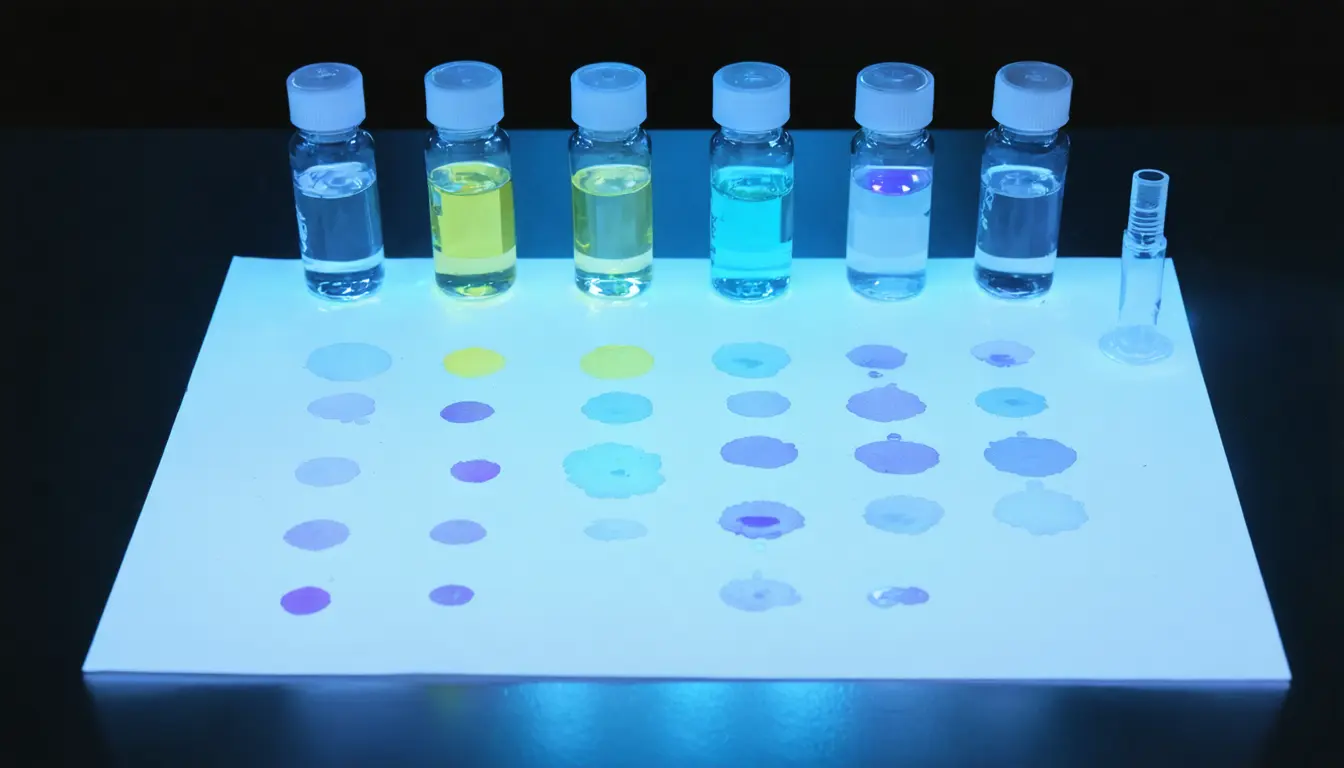
- On paper, different lanthanide liquids and mixtures gave different optical responses under ultraviolet light at different wavelengths.
- The University of Liverpool and the University of Manchester also took part in the study, which appears in RSC Advances.
Why it matters
- What's now possible capability Senior author Anthony Fitzpatrick says manufacturers could tailor optical tags or identification systems to an application without synthesizing a new material each time.
- What it limits constraint The authors say further research is needed before real-world performance is established, so the result is a demonstration of potential.
- Who has to decide decision A security printer weighing the liquids would have to check the researchers' printing-compatibility claim on its own processes before relying on it.
A mark made with one of the liquids could look ordinary under normal conditions and show its pattern only under ultraviolet light [14]. Blending turns that into a code. The blends kept the characteristic emissions of their components [8], so in principle a pattern can be read back as a list of ingredients.
Phys.org's account says a small number of base materials can give a much larger range of signatures without further chemical synthesis [9]. We can put a floor under that range. Counting only which of the four liquids are present, there are 15 combinations: four single liquids, six pairs, four triples and one four-way blend [15]. The account also says the liquids could be combined in different proportions [5], and proportions would add codes beyond that count.
Dr. Anthony Fitzpatrick, the senior author, said: "Creating a more complex security signature does not require creating more complicated materials. Instead, different luminescent liquids can be combined to produce new signatures." [12]
The liquid state is the other selling point. Ph.D. student Annie Prasad said: "A key feature is that the new materials remain liquid at room temperature, making them easier to mix and formulate than materials that need to be processed as solid compounds." [16]
We think the mixing scheme is a sound design for a tagging problem, because the code space grows with the number of base liquids while the synthesis effort stays fixed. That is a claim about design, though, and the evidence so far is a bench demonstration.
The reported work does not show whether anyone who can read a signature can also reproduce it, how many signatures a reader outside a lab could separate, or how long a printed mark keeps its glow. A security feature is judged on those three. The 15-combination count is our own calculation from the number of liquids, and the paper's own count of usable codes may be higher or lower.
What to watch
- Follow-up tests of printed marks on real packaging, since the reported demonstration was on paper.
- Any report of how many mixing ratios a reader can reliably tell apart outside the lab.
- Whether anyone tests if the signatures can be copied by someone with access to similar lanthanide liquids.
Clarity's read
What the record supports and how the coverage leans. The claims behind it follow.
Reality
- Evidence50
- Adoption
- Not scored
- Hype gap+15
- Incentives
- Not scored
- Confidence60
Claim ledger
Ranked by verification strength, evidence, and original report placement.
- [1]
Researchers at Nottingham Trent University developed room-temperature liquids containing chemical elements that produce distinctive patterns of light, which they say could offer a flexible approach to optical tagging and anti-counterfeiting.
- [2]
The materials are ionic liquids, salts that remain liquid at relatively low temperatures, combined with lanthanide elements.
- [3]
Lanthanides are a group of 15 metallic elements, several with distinctive light-emitting properties; under ultraviolet light each produces its own characteristic pattern of wavelengths, giving the material a unique optical fingerprint.
- [4]
The team developed four different glowing liquids, which can be easily mixed together, each containing one of the lanthanide elements.
- [5]
Rather than developing a completely new material for every security code, it would be possible to combine the different glowing liquids in different proportions.
- [6]
The study also involved the University of Liverpool and the University of Manchester, and is published in the journal RSC Advances.
- [7]
The researchers demonstrated mixtures containing two different lanthanides, as well as more complex combinations of three or four, and the mixtures produced increasingly complex light signatures.
- [8]
The mixtures retained the characteristic emissions of the individual components.
- [9]
A relatively small number of basic materials can be combined to create a much larger range of optical signatures without requiring additional chemical synthesis.
- [10]
The team demonstrated the materials on paper, showing that different lanthanide liquids and mixtures produced different optical responses under ultraviolet light at different wavelengths.
- [11]
The initial work has demonstrated the potential of the materials, although further research would be required to fully establish how they might perform in real-world applications.
- [12]
"Creating a more complex security signature does not require creating more complicated materials. Instead, different luminescent liquids can be combined to produce new signatures." -- Dr. Anthony Fitzpatrick, senior author, Nottingham Trent University School of Science and Technology.
- [13]
Fitzpatrick said the approach could potentially allow manufacturers to create tailored optical tags or identification systems without having to synthesize a new material for every application.
- [14]
A security marking made with one of the liquids could look ordinary under normal conditions but reveal a distinctive pattern when examined under ultraviolet light.
- [15]
Four liquids give 15 combinations when counting only which liquids are present: 4 singles + 6 pairs + 4 triples + 1 four-way blend. This is a desk count, not a figure from the paper.
- [16]
"A key feature is that the new materials remain liquid at room temperature, making them easier to mix and formulate than materials that need to be processed as solid compounds." -- Annie Prasad, Nottingham Trent University Ph.D. student.
- [17]
The researchers say the materials are compatible with existing processing and printing technologies.
Get this ledger inside ChatGPT. Ask about any of our stories and the answer brings its figure, each claim’s verdict and the sources. Free, no account.
Sources
1 independent publisher whose own reporting we read for this story.
Topics and entities
Follow any of these and your For You feed starts watching them — no settings page required.
Entities
- Nottingham Trent UniversityFollow
- Anthony FitzpatrickFollow
- RSC AdvancesFollow
- LanthanidesFollow