Science1 publisher2 min readPublished
Laser twists liquid crystals to retune a silicon metasurface after fabrication
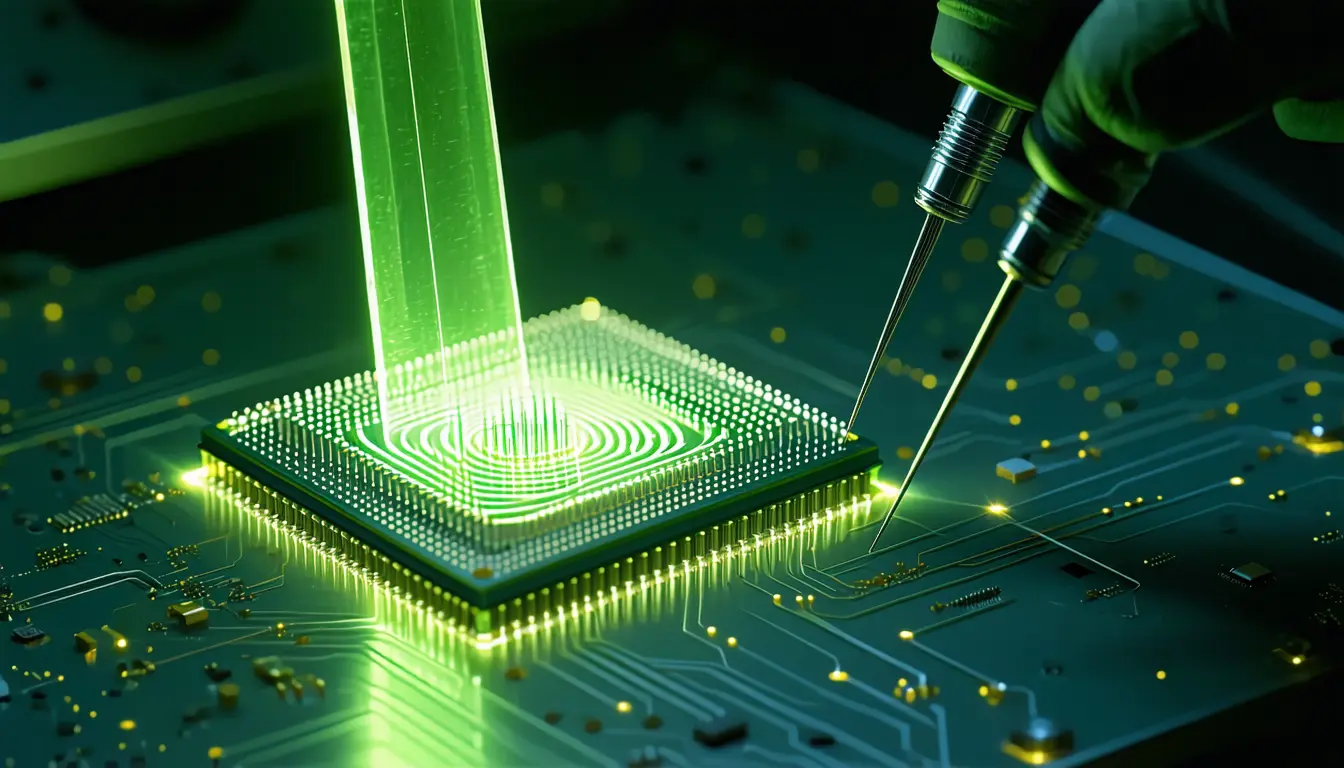
Researchers led by the Australian National University used a laser to twist liquid crystals around a silicon metasurface and retune it without electrodes. The Science Advances result points to optical parts that light can reset after manufacture.
The Scientist · Science desk
What happened
- The metasurface is a thin layer of silicon structures, each smaller than a human hair is wide, set in the same kind of liquid crystals used in electronic displays.
- Light has been used to move liquid crystals since the late 1990s, Yang said, but the change was small and hard to observe until a metasurface was added.
- The team also used the device to turn infrared light into visible green-yellow light by third-harmonic generation, and the laser shifted the resonance in that process as well.
- The work was led by the ARC Center for Transformative Meta-Optical Systems with Nottingham Trent University in the UK and Friedrich Schiller University Jena in Germany.
Compiled by The ScientistSomething wrong?How this is made
Why it matters
- capability A single fabricated metasurface could be set to different optical responses on demand, with the control arriving as light instead of through contacts wired onto the device.
- constraint Because the control signal is a laser beam, a part built this way needs light delivered to each region being tuned. Steering beams becomes the engineering problem that wiring used to be.
- precedent Using a metasurface to amplify a weak light-on-liquid-crystal effect is a design other groups can apply to their own nanostructures when testing optical control.
"With a static metasurface, you cannot change its response or its function after you fabricate it," Yang said [7]. In electronic displays, liquid crystal molecules are turned by electricity delivered through electrodes [6]. The group led from the Australian National University wanted to know whether light could do that job by itself [1]. "Our question was whether light could directly tune or program the function of the metasurface, without needing contact electrodes," Yang said [8].
The laser does it with optical torque, a small twisting force that rotates the liquid crystal molecules [4]. Rotating them changes the optical conditions around the silicon structures, and the metasurface responds differently [4]. It is also the metasurface that makes the change easy to see. "The metasurface works as a platform, or even as an amplifier," Yang said. "It makes these changes much easier to observe." [10]
The first effect the team measured was a shift in resonance, the wavelength at which the metasurface interacts most strongly with light [11]. Moving the resonance changes which wavelengths get the strong response [11]. Yang said the most interesting result came in nonlinear optics, where very intense light produces effects that ordinary lighting does not [15]. The green-yellow harmonic signal is that result, and the laser moved the resonance there too [12].
The thing this doesn't tell you is whether the effect is fast enough, or lasts long enough, to build a component on. The report does not give the laser power used, the switching time, the size of the resonance shift, the harmonic conversion efficiency, or how long the retuned state holds once the beam is off. Any case for the computing, imaging and telecommunications uses the report raises depends on those figures [13].
I think the result is sound physics at an early engineering stage. It shows light can be the control input for a metasurface of this design, and it turns an effect known since the late 1990s into one that is easy to measure [9]. Yang put the gain in plain terms: "But by shining light on the liquid crystal, we have another way to tune that function without fabricating the device again." [14]
What to watch
- Measured switching time and laser power for rotating the crystals, which would show whether light tuning can compete with electrode-driven liquid crystal devices.
- Whether the retuned state holds or relaxes after the beam is removed, and over how many switching cycles the device survives.
- A demonstration of patterned light setting different regions of one metasurface to different responses at the same time.