Science1 publisher2 min readPublished
Researchers grew a dye adsorbent inside the polluted water it was meant to clean
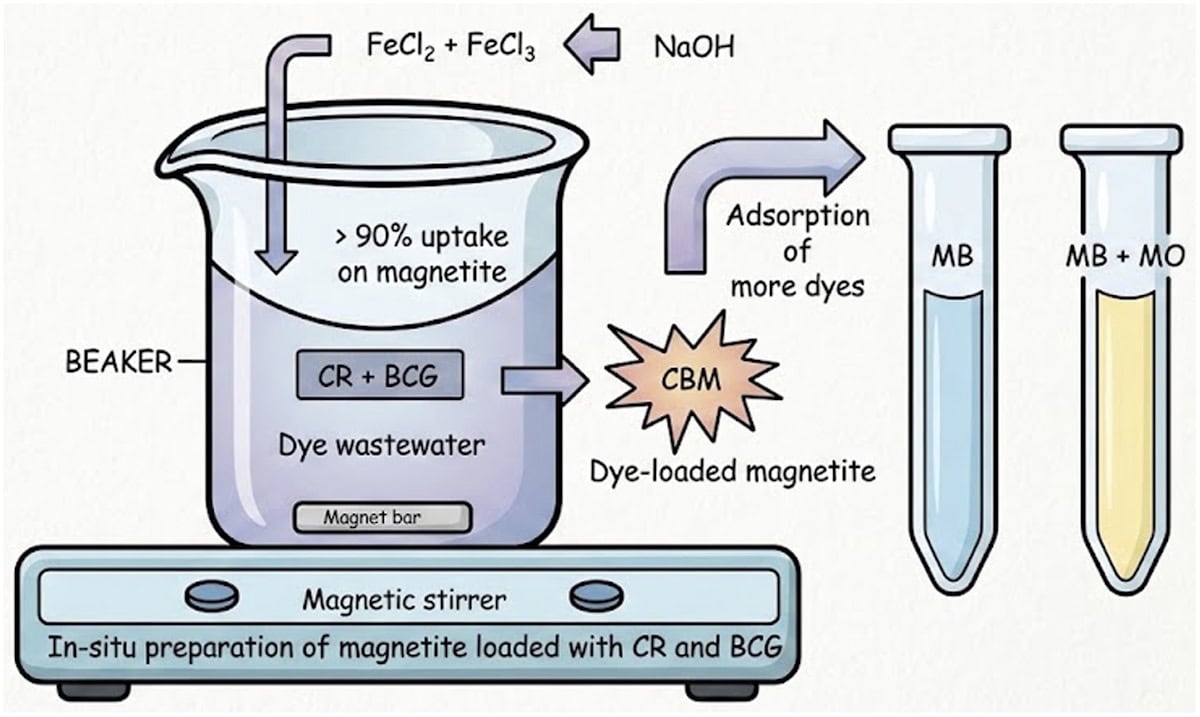
Magnetite nanoparticles formed in dye-laden water took up more than 90% of two dyes as they crystallised, and the same loaded particles later captured almost 80% of a third dye in a single-dye test reported in RSC Advances.
The Scientist · Science desk
What happened
- A team in Egypt and the US, led by Hebatullah Hassan Farghal at The American University in Cairo, grew magnetite nanoparticles inside dye-polluted water so the crystals took up dye as they formed.
- More than 90% of the two dyes present during synthesis, congo red and bromocresol green, stuck to the particles, and the loaded particles measured about 34 nm against 26 nm for plain magnetite.
- Those already dirty particles then removed almost 80% of methylene blue from a single-dye solution in about three hours, and just over 50% when methyl orange shared the water.
- An alcohol rinse pulled the methylene blue back off through four cycles with no measured drop in performance and no leakage of the dyes loaded during synthesis.
Compiled by The ScientistSomething wrong?How this is made
Why it matters
- cost A plant adopting this would be paying for fewer synthesis steps. Four cycles was already the established figure for washed magnetic adsorbents, so the economics rest on the production run a plant no longer has to do.
- capability If a dye-loaded batch still captures an unrelated dye, spent adsorbent does not have to be regenerated before its next duty. That changes what counts as spent.
- constraint Real dye effluent is a mixture, and mixing is where this material weakens most: one additional dye took roughly 37% off the methylene blue capture. That figure is the ceiling on what a two-dye lab result can promise a mill.
- decision The evidence supports running the in-situ route at pilot scale on real effluent. It does not support specifying it: removal percentages from prepared solutions do not tell an engineer how much dye a kilogram of particles will hold.
Magnetic adsorbents were already reusable. In the established route the nanoparticles are made, washed, dried and treated, then added to the water, pulled back out with a magnet, washed and used again for up to four cycles [4]. Farghal's group moved the synthesis into the contaminated water, so the crystals take up dye while they are still growing [5]. The four ethanol cycles the paper reports on methylene blue are the same number already established for washed-and-reused magnetite [23]. The saving is the separate make-wash-dry-treat production run that no longer happens [8].
Farghal dates the experiment to a breakfast. "The idea for this paper came exactly one or two days after my PhD defence," she said. "While I was having breakfast, I realized adsorbent synthesis requires time and cost...I then went to the lab and started my experiments to find that it was successful." [9]
Chemisorption builds new chemical bonds; physisorption is weaker, forms no permanent bond, and lets the molecule come off relatively easily [16]. Infrared spectroscopy of the particle surface, along with other lab measurements, pointed to physisorption for congo red, bromocresol green and methylene blue [17]. That weak binding is why an ethanol rinse can strip the blue dye back off without damaging the particle [17]. Density functional theory on a single dye molecule on an ideal magnetite surface found all the dyes binding with similar strength [18]. The calculation also put electrons flowing toward the surface from the two negatively charged dyes and outward from the surface toward methylene blue [19]. The researchers note that the calculation and the bench work can only be compared qualitatively, not quantitatively [20].
Methylene blue removal was almost 80% on its own after about three hours [12] and just over 50% once methyl orange was added [13], a relative fall of roughly 37% from one extra dye [21]. Uptake was also strongest at high pH, where the particles carry a negative charge and methylene blue is positively charged [15]. Methyl orange is the dye that resists standard biological and chemical treatment and has been linked to cancer and DNA damage [3].
The target is large. About 5000 tonnes of dye reach industrial wastewater each year [1]. The paper reports removal percentages from prepared dye solutions, with no milligrams of dye held per gram of particle and no head-to-head between the loaded particles and fresh magnetite on methylene blue [24]. The particles did visibly change: about 34 nm once loaded against 26 nm for plain magnetite [11], roughly 31% wider [22].
What to watch
- Whether the four ethanol cycles hold at higher dye loadings, when each pass leaves more dye on the surface.
- Performance at neutral pH, given that methylene blue uptake was strongest in alkaline conditions.
- Whether the in-situ loading route reproduces on real textile effluent. These tests used prepared dye solutions.