Science1 publisher2 min readPublished
Max Planck lasers find pure water evaporates at the same rate in light and dark
Max Planck researchers report in PNAS that sunlight-strength lasers had no measurable effect on how fast pure water evaporates. The extra evaporation seen in earlier gel and droplet experiments now needs a different cause.
The Scientist · Science desk
Drafted by a language model from the sources cited here and checked against its claim ledger before publication. How we use AISend a correction
What happened
- The proposed 'photomolecular effect' held that visible light knocks water molecules directly free from the surface without heating the water first.
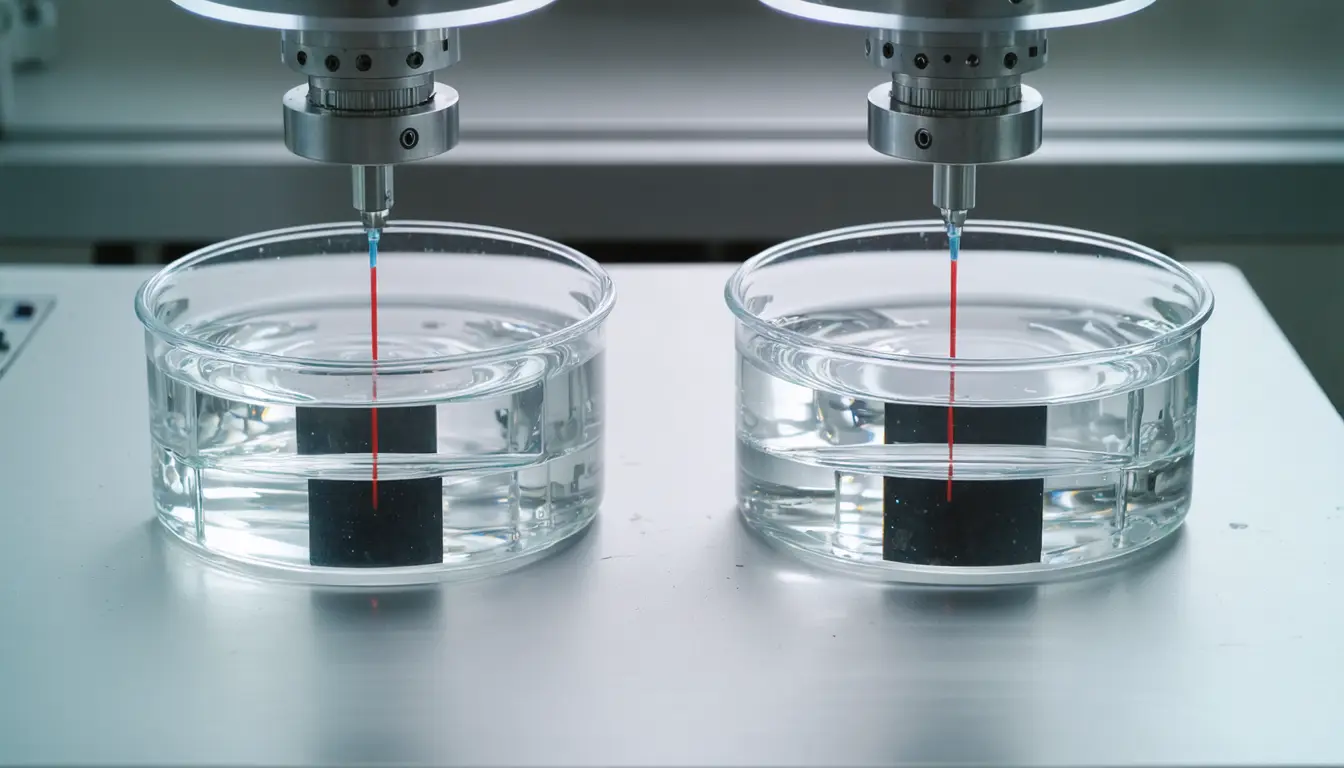
- Mischa Bonn's team lit a flat pool of pure water with blue, green and red lasers at sunlight-like brightness across several humidities, timing the sinking surface with light on and off.
- A probe sensitive only to the top two or three molecular layers found the surface molecules vibrating the same way under illumination as without it.
- The team's alternative causes are gels warming as they absorb light, heat spreading through the material, vapor gathering near the surface, the push of light itself, and droplet and pore shapes.
Compiled by The ScientistSomething wrong?How this is made
Why it matters
- decision Engineers building light-powered water purifiers will need to trace any extra output to their own materials, since pure water showed no light-driven boost at sunlight-like brightness.
- constraint Models of evaporation from oceans and clouds gain no new light-driven term from this work, at least for pure water at the colors and brightnesses tested.
- precedent Later claims of light-driven evaporation now have a pure-water, light-on versus light-off baseline that any reported speedup will be measured against.
The simplest place to test the idea is a flat layer of pure water. The earlier anomaly came from hydrogels and tiny droplets [1]. The open question was whether light was acting on the water molecules themselves, or whether the materials and measuring techniques produced the result [12]. A gel can absorb light and warm up, and the team counts the shapes of droplets and gel pores among the possible causes [11]. A flat surface of neat water removes the gel and the droplet together. Comparing light-on and light-off periods in the same sample gives every run its own control [5].
Each measurement asks a separate question. Tracking how fast the surface sinks gives the net evaporation rate, and it came out exactly the same with the light on or off [8]. The surface-vibration probe asks something finer: whether light loosens the bonds holding the top molecules together [6]. If light were knocking molecules free from the surface, as the photomolecular proposal holds [2], that is where you would expect to see a mark.
The pulse experiment is the one I admire most. Bursts lasting around a trillionth of a second reached peak brightness more than 10 billion times that of conventional lasers, and they were too short to heat the water [7]. That pushes intensity far past sunlight while keeping heat, the obvious confound, out of the measurement. The bonds between surface molecules were undisturbed [10].
The thing this doesn't tell you is how small an effect could have slipped through. A finding of no measurable effect has a floor set by the instrument. The published summary of the work does not give the sensor's detection limit. The tests also covered neat water only, as the paper's title states [16]. They show that visible light at these brightnesses does not pull molecules off a clean air-water interface. They do not repeat the gel experiments. Three of the team's five candidate explanations sit in the gel or the geometry, the parts of the system this design took out [1].
In my view the result is strong on its own terms and narrow in reach. At the pure-water surface, under red, green and blue light near sunlight brightness, the photomolecular effect has no measurable support [4]. The faster drying in the gel and droplet experiments is still an observation without a confirmed cause, pointing to an influence on evaporation that has yet to be found [15].
What to watch
- A repeat of the hydrogel experiments using the same light-on, light-off surface-height method, to see whether the extra evaporation survives when measured this way.
- Direct measurements of gel temperature and of water vapor near the surface under illumination, two of the team's candidate causes.
- The detection limit reported in the PNAS paper itself, and whether it is tight enough to exclude a speedup of the size the earlier experiments implied.