Science1 publisherNot yet confirmed elsewhere2 min readPublished
Damaged dune patches lose their sand to denser neighbours once marram grass drops below a threshold
Utrecht and NIOZ ecologists report in PNAS that young dunes grow by absorbing smaller ones and that patches below a marram grass threshold do not recover. For coastal schemes that build with nature, a dune field can stay healthy while single patches are lost for good.
The Scientist · Science desk
What happened
- Berghuis tracked marram grass and sand across whole dune fields in aerial photographs taken over time, treating the landscape as one self-organising system.
- Where marram grass grows densely, a dune keeps growing at its neighbours' expense, while small dunes fall behind or vanish and large ones merge.
- That coarsening fits a theory from co-author Koen Siteur that likens some ecosystems to phase separation, the process that splits oil from vinegar in a dressing.
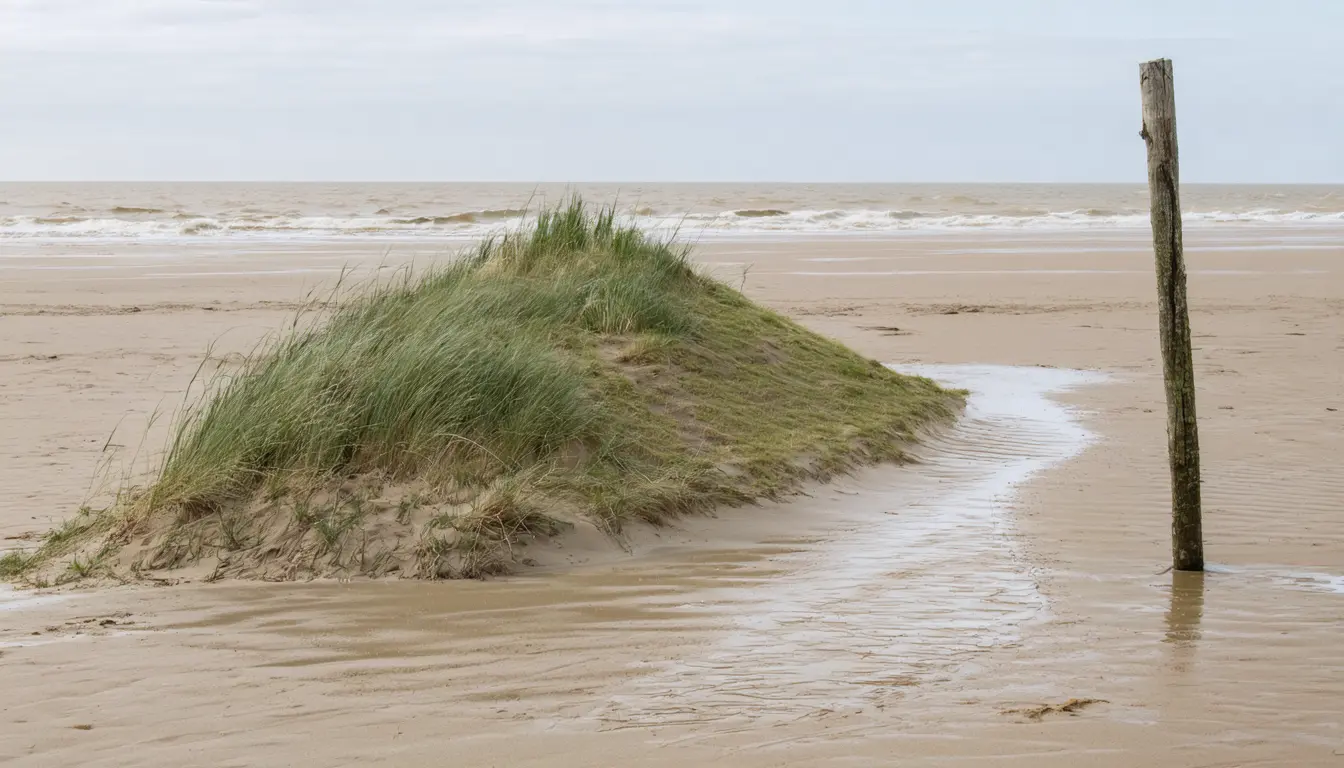
- Sand from a trampled spot or a small wind-scoured pit drifts to more densely vegetated dunes elsewhere instead of refilling the gap.
Compiled by The ScientistSomething wrong?How this is made
Why it matters
- decision A survey that totals sand across a whole field could report a healthy system while patches are being lost, so grass density patch by patch is the figure managers would need to track.
- capability Because dunes carry the phase-separation fingerprint, the theory's existing predictions about how such systems respond to disturbance can now be applied to coastal dunes.
- constraint Restoring a patch past the threshold means working against natural dune growth, the same process building-with-nature schemes rely on elsewhere on the coast.
Paul Berghuis, a spatial ecologist at Utrecht University and NIOZ, chose the scale of his study to fit his question [1]. "Quite a lot is already known about individual plants and processes, but how does such a complex system of sand and vegetation fit together as a whole? That question influenced the scale on which we researched the dunes and what we learned," he said [5]. Aerial photographs taken over time let him follow whole dune fields, where earlier work had looked at single plants [2].
The pattern he found is fixed in the sense that it is not random [4]. It still has no set scale. In mussel beds and savanna vegetation, patches settle at roughly one size, with similar gaps between them [6]. Dunes do not [7]. "There is no fixed size. Sand is moved by the wind again and again before it settles somewhere, and where marram grass plants are growing closely together, the sand is best retained," Berghuis said [7].
Siteur's theory says a system that coarsens this way leaves a specific statistical fingerprint. Berghuis said "we found that fingerprint in the dunes" [17]. "The distribution of dune sizes, the way in which dunes merge, even the rate at which that merging slows down: It is all in line with what the process of phase separation predicts," he said [10].
Three separate signatures agreeing with one theory is a harder test than a single fitted curve, and I find the match persuasive. Berghuis takes it further. "This means that we now know not only how dunes behave, but also why they do this," he said [11]. The paper's title, "Density-dependent aggregation underlies spatial self-organization in coastal dunes," makes the same causal claim [3]. The evidence is a sequence of photographs [2]. It shows dunes behaving as phase separation predicts. A field test that thinned marram grass on chosen plots and tracked where the sand went would test the cause directly.
The threshold is the result coastal engineers can use. Building with nature relies on natural processes to make coasts more resilient to sea level rise [16]. "According to the theory, damage to the pattern does not heal itself once it exceeds a critical threshold value," Berghuis said [12]. "Our measurements show exactly such a threshold value in the amount of marram grass," he said [14]. The news account of the paper does not give that value, the sites studied, or the years the photographs cover.
What to watch
- Publication of the threshold value in marram grass cover, and whether it shifts between sites with different winds and sand supply.
- A field manipulation that thins or tramples marram grass on chosen plots and tracks whether the sand leaves as the theory predicts.