Science1 publisher2 min readPublished
NASA tests new probes to measure supercooled large drops in Glenn's icing tunnel
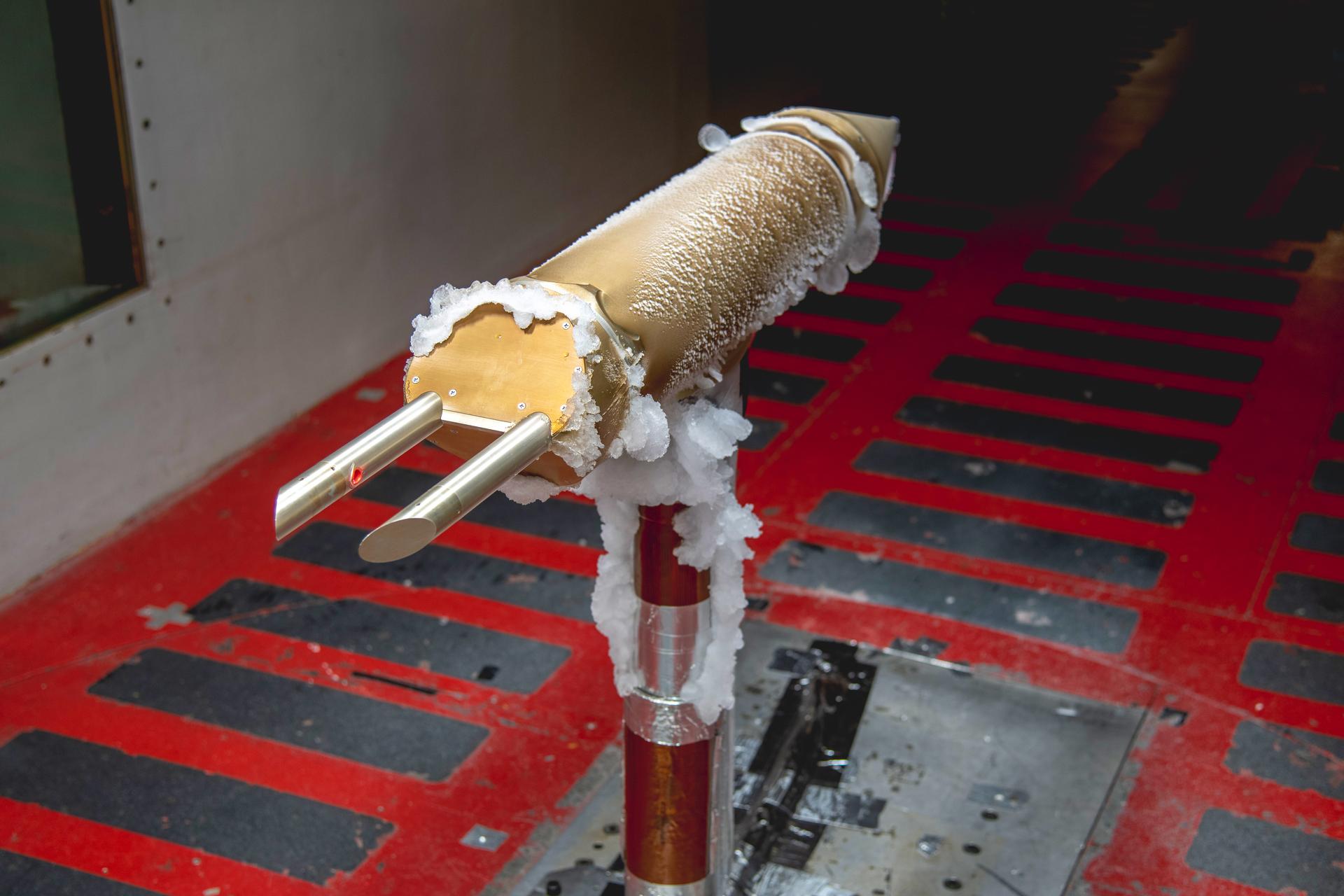
NASA is testing probes in Glenn's Icing Research Tunnel that size supercooled drops larger than 45 microns in real time. Measuring the tunnel's full drop spectrum has to come before design tools can be checked against rare drops as large as 2,000 microns.
The Scientist · Science desk
Drafted by a language model from the sources cited here and checked against its claim ledger before publication. How we use AISend a correction
What happened
- Aircraft are designed for typical icing clouds whose droplets measure 2 to 100 microns across, against a human hair of about 70 microns.
- Supercooled large drops can hit or splash toward the rear of an aircraft, reaching areas behind conventional ice protection systems.
- NASA says current engineering design tools work well for typical clouds, but engineers have questions about how well they capture large-drop physics.
- A separate probe measures drops smaller than 45 microns, and NASA will join the two records to obtain the tunnel's complete droplet size spectrum.
- Detailed analysis of the data is continuing, and NASA says it will share results with the wider aerospace community once it is complete.
Compiled by The ScientistSomething wrong?How this is made
Why it matters
- capability If the real-time probes agree with image post-processing, tunnel operators could confirm a large-drop cloud during a run without waiting on slow image analysis.
- constraint No design tool can be judged against large-drop tunnel ice until the cloud itself is measured across its full size range, so any verdict on those tools waits on this calibration.
- exposure Surfaces aft of conventional ice protection are where large drops land, so ice predictions for those areas lean hardest on the tools engineers are still questioning.
A 2,000-micron drop is 20 times the diameter of the largest droplet aircraft are built to handle [13]. Volume goes with the cube of diameter, so that drop holds about 8,000 times the water of a 100-micron one [14]. Anyone caught in freezing rain has met drops of this kind at ground level [2]. Supercooled water is common in clouds. Droplets can sit below 32 degrees Fahrenheit and stay liquid until they meet dust or another particle to freeze around [11].
A tunnel can only test a design tool if its operators know what cloud they made. So the instrument work comes first. NASA's new probes detect drops larger than 45 microns and analyse their sizes in real time [6]. NASA will compare those readings with post-processed droplet image data from the tunnel, a technique its own account calls laborious [7]. That comparison is the control. The fast new method gets checked against the slow established one before anyone relies on it.
The join between the new probes and the small-drop probe sits at 45 microns. That is inside the 2-to-100-micron band of ordinary icing clouds [15]. The large-drop instruments therefore also cover the upper part of conventional icing conditions, where tunnel clouds are already well understood.
The thing this doesn't tell you is whether the tunnel can make drops near 2,000 microns, or hold such a cloud steady through a run. NASA says it is enhancing the equipment that generates experimental clouds as well as the equipment that measures them [5]. Its account does not state a largest drop size, and it does not mention certification. NASA describes the tests as helping U.S. industry better understand the phenomenon [12]. Growing ice on a test article and comparing it with tool predictions would be a later step.
In my view this is the correct order of work, and the result to wait for is whether the real-time probes agree with the image analysis. NASA counts the campaign as a milestone for its Subsonic Flight Demonstrator project, part of the Research and Technology Mission Directorate [9].
What to watch
- NASA's published analysis, in particular whether the real-time probe sizes match the post-processed image data from the tunnel.
- A statement of the largest drop size the Icing Research Tunnel can generate and hold steady in a test cloud.
- Whether industry design tools are run against the measured large-drop clouds, and whether their predictions for aft surfaces need revision.