Science1 publisherNot yet confirmed elsewhere3 min readPublished
European sorghum yields rise 13 to 27% in INRAE and AgroParisTech warming simulations
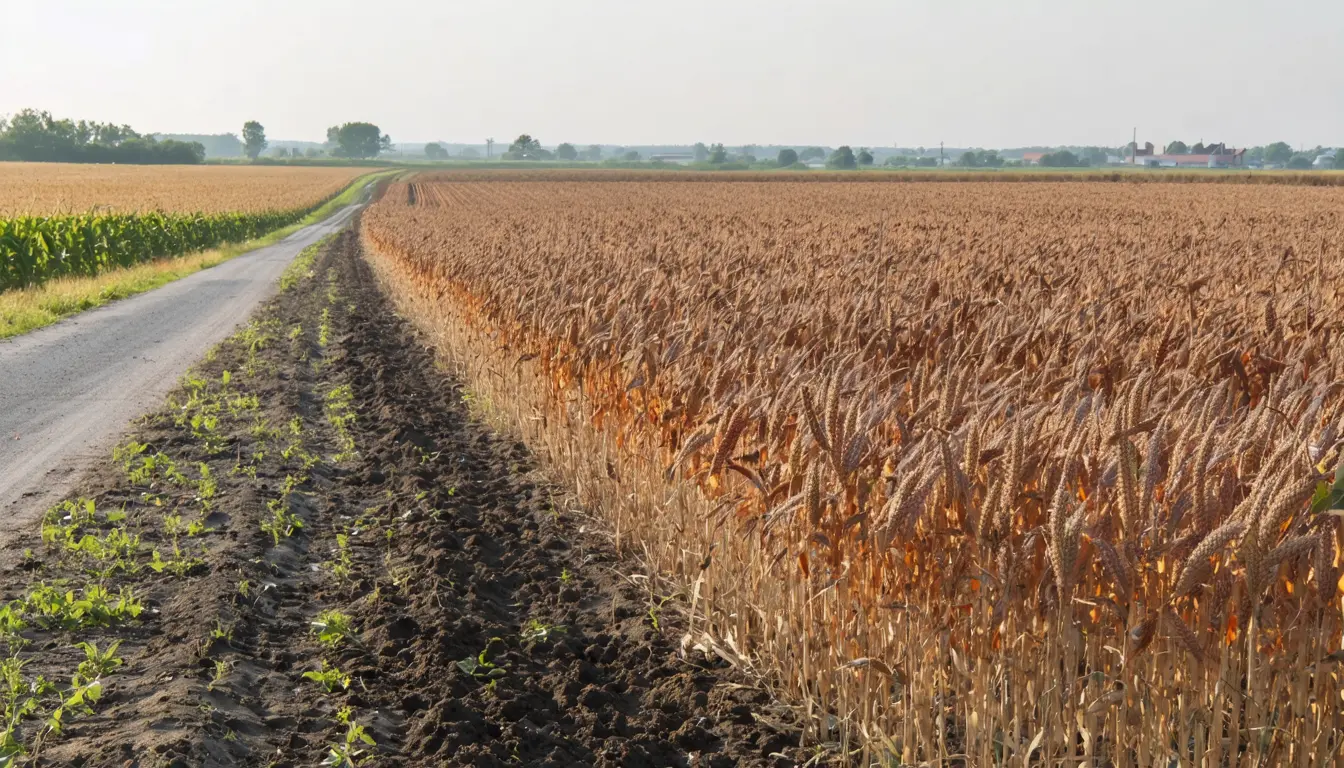
INRAE and AgroParisTech simulations project mean European sorghum yields rising from 3 to 3.4-3.8 tonnes a hectare by 2050-2100. The crop already suits far more land than the 0.1% of cropland it occupies, so whether it replaces maize in feed depends on what farmers plant and what livestock producers put in feed rations.
The Scientist · Science desk
Drafted by a language model from the sources cited here and checked against its claim ledger before publication. How we use AISend a correction
What happened
- The projected gains come in northern Europe, while southern Europe sees sorghum yields slightly below today's.
- If sorghum were grown one year in three, the researchers estimate it could replace about 90% of the maize now used in livestock feed.
- The study arrives in a year when EU maize yields fell to a relative all-time low, according to the phys.org report.
Compiled by The ScientistSomething wrong?How this is made
Why it matters
- constraint Since the model already rates about 220 times more land suitable than grows sorghum, adding suitable land through warming will not by itself change what goes into feed rations.
- decision French water managers now have a Europe-wide yield case for treating a sorghum rotation as a way to free irrigation water from maize for other feed crops.
- exposure Southern European growers get no yield boost from warming in these projections, so any case for sorghum there has to rest on its lower water needs.
The yield figures come from a two-step design. The team trained a machine-learning model on historical grain sorghum yields, so it learned how harvests track climate inputs such as relative humidity, temperature and precipitation [8]. They then ran it on climate data for the middle and late decades of this century, drawn from 20 scenarios built with five climate models [9]. Using that many scenarios spreads the uncertainty about future weather. The range in the projected yields is the range across those scenarios [2]. Against today's 3 tonnes a hectare, it is a rise of roughly 13% to 27% [15].
A model trained on past harvests can learn only from the places and seasons where sorghum was grown, and in Europe the crop covers 0.1% of cropland [6]. The phys.org account of the paper, published in Earth's Future [1], does not report how many sites or years went into training, or how well the model predicted harvests it had not seen. The 20 scenarios measure uncertainty in the climate inputs, but one yield model sits under all of them [8], so any error in that model would show up in every scenario.
The model's own map also says something about the present. Under today's climate it rates 22% of cropland as giving high and stable yields [4], about 220 times the area that grows sorghum now [17]. On those numbers, something other than climate limits how much sorghum Europe plants. The extra 7 to 12 percentage points of suitable land that warming adds by century's end [16] leave that limit where it is. The 90% feed estimate assumes sorghum goes into rotations one year in three [5]. The model does not simulate rotation choices like that: its inputs are climate variables [8].
The water argument is strongest in France. Corn is the main cereal in livestock feed [10], and in France it takes up 38% of irrigated cropland [11]. The researchers say water saved by growing sorghum instead could go to other crops and make France more self-sufficient in feed [12]. That case rests on sorghum's tolerance of heat and low water availability [13]. The projections themselves are of yield per hectare [2].
The study looks ahead to 2050-2100 [2], decades past this year's low maize yields [7]. I think it makes a solid case that sorghum will grow well on more of Europe as the continent warms, since mean yields rise in every scenario [2]. According to the phys.org report, it is also the first look at the question across the whole continent: neither the crop's response to climate change nor its use in livestock feed had been studied for Europe as a whole [14].
What to watch
- Field trials of grain sorghum in northern Europe that test whether measured harvests match the model's projected gains.
- A French water budget that puts a figure on the irrigation a one-in-three sorghum rotation would free from maize.
- Livestock producers changing feed rations toward sorghum, the step the 90% replacement estimate assumes and the climate-driven model does not simulate.