Science1 publisher2 min readPublished
INRAE rebuilds ten ancestral plant genomes to shortlist wheat and barley climate genes
INRAE and CNRS teams rebuilt ten ancestral genomes older than 200 million years, then read 10,000 years of selection across 1,420 wheat and barley varieties to arrive at about a hundred candidate variants.
The Scientist · Science desk
What happened
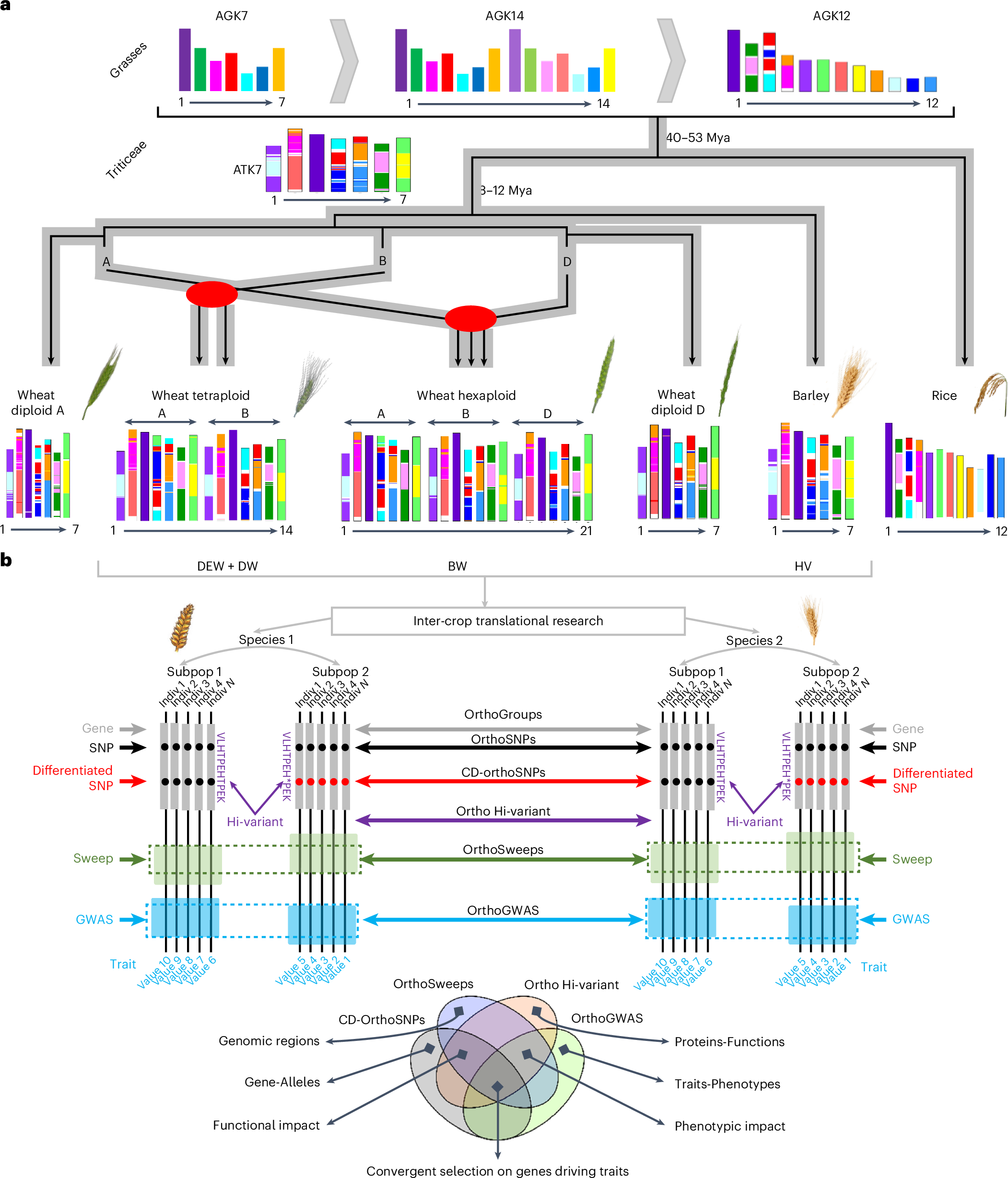
- Teams at INRAE, the University of Clermont Auvergne and the CNRS reconstructed ten ancestral plant genomes more than 200 million years old from 84 modern flowering-plant genomes representing cultivated species worldwide.
- Comparing 1,420 modern wheat and barley varieties, plus remains of ancient wheat, they identified around a hundred gene variants that helped the two cereals adapt to climate change during domestication.
- In wheat, the team validated the roles of three genes already known from other species: one affecting yield, one affecting flowering date, and one implicated in epigenetic regulation.
- Two free, open-access software tools came out of the work for scientists and private breeders, the first of them called AGR, for ancestral genome reconstruction.
Compiled by The ScientistSomething wrong?How this is made
Why it matters
- capability A breeder chasing flowering date in one cereal can now check whether a gene already characterised in a different species sits in the same ancestral context, using software that costs nothing to download.
- constraint The method finds adaptation routes both lineages kept, so a solution wheat evolved on its own, or one barley abandoned, stays invisible to this comparison by construction.
- precedent The 84-genome panel covers cultivated plants well beyond the two cereals, so the next crop pair to get this treatment needs a comparison run rather than a fresh sequencing campaign.
What the teams set out to test was narrower than climate adaptation. They asked whether what is known about a gene in one species can be carried over to another species a breeder cares about [18]. The design turns on two crops that went through the same history at the same time. Wheat and barley are among the earliest domesticated crops, more than 10,000 years ago in the Fertile Crescent [6]. INRAE describes their historical timelines and the environmental conditions humans grew them in as closely parallel [7]. A variant retained in both lineages under similar climate pressure is a better candidate than one retained in only one. The ancient wheat sample dates to roughly the midpoint of that 10,000-year window [15].
The two halves of the work run on very different clocks. The reconstructed ancestral genomes predate the domestication window by a factor of about 20,000 [13]. The teams state the bridging criterion directly. A gene that has kept the same ancestral genomic context and the same biological function could still contribute to the same traits or processes in a different modern species [10]. The reconstruction produced ten ancestral genomes out of 84 modern ones, 8.4 modern genomes for each ancestral one [14].
Three genes is what has been checked inside wheat, against about a hundred variants flagged by the comparison [9][3]. The INRAE announcement does not report effect sizes for those variants or results from trials [17]. A selection signal marks a locus whose frequency changed under pressure. It does not say how much water stress a plant carrying the variant tolerates, or how much grain it sets under water limitation.
That distinction matters less for the software than for the gene list. Ancestral reconstructions are testable output: another group can take the same 84-genome panel, add genomes, and see whether the inferred ancestors and the conserved-context calls hold.
The reconstruction also produced a chronology of plant evolution. That includes the timing of the emergence of the major botanical families, and the divergences between aquatic and terrestrial plants, herbaceous and woody species, C3 and C4 species, and modulator and non-modulator species [11]. Drought tolerance and flowering date are the traits INRAE names as agronomic targets [12]. The two papers appeared in Molecular Plant and Nature Plants [5].
What to watch
- Whether any of the roughly hundred variants is tested in near-isogenic lines under water limitation, with a grain-yield difference reported.
- Whether the second of the two open-access tools is named and documented publicly alongside AGR.
- Whether an independent group re-runs the ancestral reconstruction with additional genomes and gets the same conserved-context calls.