Science1 publisher2 min readPublished
Wageningen and Leiden researchers grow rice on wet Dutch peat to test a fix for sinking land
Wageningen and Leiden researchers have grown the Netherlands' first rice on 0.6 hectares of peat to test whether a wet crop can stop the land sinking. Whether the swap helps the climate depends on how much methane the wet fields give off compared with grassland, and the team is still measuring that.
The Scientist · Science desk
What happened
- Roughly a tenth of the Netherlands is peatland, which farmers drain so grass can grow to feed their dairy cattle.
- Drained peat dries out, releasing millions of tonnes of carbon dioxide and sinking by up to several centimeters a year in the worst-hit areas.
- Wageningen University estimates that Dutch peat soils produce around 2 to 3 percent of the country's greenhouse gas emissions.
- The team is trialling about 30 rice cultivars from Russia, China, Japan and Uzbekistan to find which grows best in the Dutch climate.
- Organizers hope the pilot plot will yield around three tonnes of short-grain rice suitable for sushi or risotto.
Compiled by The ScientistSomething wrong?How this is made
Why it matters
- capability A crop that can be harvested from wet ground would let peat farmers keep water levels high, the known fix for subsidence, without taking fields out of production.
- constraint Until the rice-versus-grassland gas measurements are published, the trial cannot be credited with reducing peat-soil emissions at all.
- decision Switching from milk to rice means building a new market, and interest from local restaurants in premium Dutch rice is the only demand signal reported so far.
- precedent A favourable gas balance would make the method relevant in Germany, Belgium and the Baltic states, where Helfenstein says peat faces the same problem.
On Dutch peat, the water level and the crop are set together. Grass for dairy cattle needs the peat drained, and the draining is what makes it dry out and sink [6][7]. Keeping the fields wet stops the loss. Until now it also left farmers with nothing to grow there [9].
Julian Helfenstein of Wageningen University and Research, who runs the pilot with colleagues from Leiden University [10], made the case in two parts. "Rice is an opportunity for this part of the world to adapt to climate change, so to grow something that previously wasn't possible," he said [11]. "But also to mitigate climate change because it stops this peat from degrading and emitting all the CO2 because you can keep it wet." [12] The first part already holds. A warmer climate has let Dutch farmers make wine and now try rice, the report says [3].
The second part is the real experiment, and it has the right control. The team is measuring carbon dioxide and methane from the rice against grassland, to make sure the cure is not worse than the illness [13]. Methane is the gas that could cancel out the carbon dioxide saved by keeping the peat wet [13]. "So far the results are promising," Helfenstein said [14]. The report does not include the measurements, so the size of any saving, and whether one survives once methane is counted, is not yet public.
The scale is small. The plot's hoped-for three tonnes [4] works out to about 5 tonnes per hectare [1]. I'd treat that as a target for one season on one plot until the harvest is weighed. The thing this doesn't tell you is whether that yield, or a favourable gas balance, would hold across the country's peat. The variety question is narrowing. The grain harvested now, from northern Japan, seems best adapted to Dutch conditions, said Guusje van der Vossen of the Wij Land association [22].
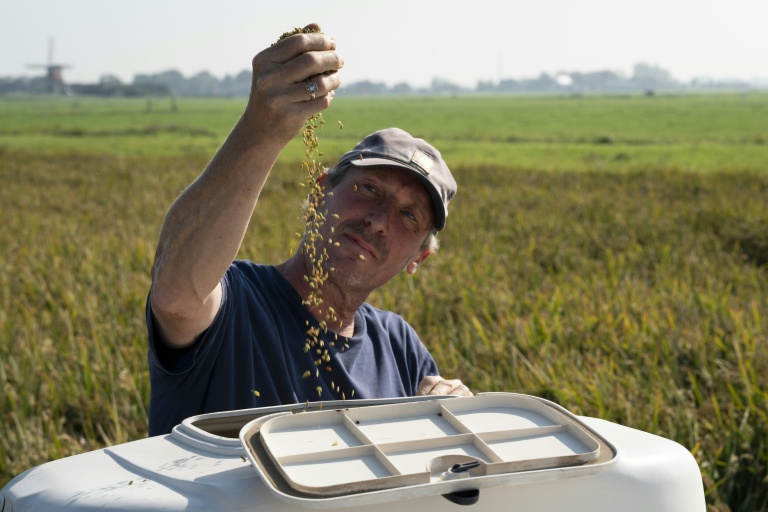
Sander Roeleveld, the farmer driving the harvester [1], put the aim plainly. "My goal is to show that more things are possible on wetland than just grass," he said [16]. He also named the obstacle. "Of course, when you have had cows for 600 years, it's really hard to imagine that you want to do something else than having milk from your cow," he said [17].
Philippe Terheggen chairs the Land van Ons association, which provided the fields [18]. "It's extraordinary," he said [19]. "But it's also scary because it tells you what is possible ... now the climate has changed." [20]
What to watch
- Publication of the team's CO2 and methane measurements for the rice plot against grassland, with methane put on a comparable footing to the carbon dioxide avoided.
- The weighed yield from the 0.6-hectare plot against the roughly three-tonne target, and whether the northern Japanese grain performs again in a second season.
- Whether peat farmers other than Roeleveld commit land to rice on rewetted fields.