ScienceNot yet confirmed elsewhere1 publisher2 min readPublished
Mississippi State model tests how copper and zinc may affect amyloid-beta clumping
Mississippi State's Shantia Yarahmadian built a model of copper and zinc effects on amyloid-beta clumping that reproduced patterns in laboratory measurements. The university presents it as a promising tool for guiding future laboratory studies.
The Scientist · Science desk
What happened
- The work appears in the Bulletin of Mathematical Biology and builds on Yarahmadian's ongoing effort to use mathematics to understand Alzheimer's biology.
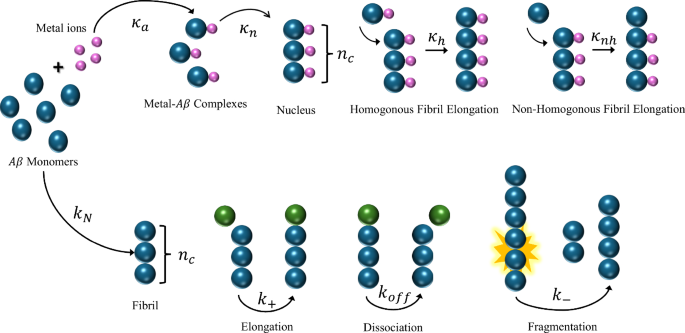
- The framework simulates the chemical reactions that occur when metals such as copper and zinc interact with amyloid-beta, a protein that can clump into plaques.
- It also lets researchers explore two potential therapeutic approaches designed to interfere with that aggregation.
- To evaluate the framework, Yarahmadian and his collaborators compared its output with laboratory measurements obtained through atomic force microscopy.
Why it matters
- capability Scientists can use the simulations to test how changes in metal-protein interactions might affect plaque formation, and to pick directions before committing lab work.
- constraint No treatment claim follows from this work, since the findings do not establish an effective therapy and the agreement covers only the conditions studied.
- contradiction The account's heading calls the agreement a prediction, while its body says only that the model reproduced observed patterns, and it does not say which.
Agreement with data is the first test a model passes, and here the data came from atomic force microscopy [6]. That technique uses an extremely fine probe to examine structures at the microscopic scale. It lets researchers study tiny clusters of proteins and other materials [10]. The comparison is therefore with protein clusters. The model reproduced the patterns seen in those experiments, and the account says that suggests it captures important aspects of how amyloid-beta aggregates under the conditions studied [7].
The university's account does not say how closely the model matched the measurements, or which two interference approaches the model examines [15].
Amyloid-beta proteins can stick together, and over time the clusters can contribute to plaques, a characteristic feature of Alzheimer's disease [4]. The model examines how metal ions, the electrically charged forms of metals, may influence that buildup [5]. Its author is an associate professor in Mississippi State's Department of Mathematics and Statistics [1].
Alzheimer's involves numerous interacting biological processes that are difficult to study individually [11]. Modeling lets researchers test how different factors influence a process and predict what might happen when conditions change [12]. Yarahmadian is explicit about the limits of that. "Mathematics does not replace laboratory or clinical research; it complements it by helping us understand the larger system, identify the most influential mechanisms and guide future experiments," he said [9].
In our view the earned claim is narrow: a simulation that agrees with one imaging method under the conditions studied [7].
What to watch
- The paper's own fit details: how closely the simulation matched the microscopy, and whether its parameters were set from the same measurements.
- Whether the two interference approaches are named and whether any laboratory tests either one.
- Whether other groups reproduce the clumping patterns with this model under different conditions.
Clarity's read
What the record supports and how the coverage leans. The claims behind it follow.
Reality
- Evidence50
- Adoption
- Insufficient
- Hype gap+20
- Incentives55
- Confidence55
Claim ledger
Ranked by verification strength, evidence, and original report placement.
- [1]
Shantia Yarahmadian is an associate professor in Mississippi State University's Department of Mathematics and Statistics.
- [2]
Yarahmadian created a mathematical framework that simulates the chemical reactions involved when metals such as copper and zinc interact with amyloid-beta, a protein that can clump together and form plaques linked to Alzheimer's disease.
- [3]
The research was published in the journal Bulletin of Mathematical Biology and builds on Yarahmadian's ongoing efforts to use mathematics to understand the biological processes involved in Alzheimer's.
- [4]
Amyloid-beta proteins can stick together in a process known as aggregation, and over time the clusters can contribute to the formation of plaques, one of the characteristic features of Alzheimer's disease.
- [5]
The model examines how metal ions, which are electrically charged forms of metals, may influence amyloid-beta buildup.
- [6]
To evaluate the framework, Yarahmadian and his collaborators compared its results with laboratory measurements obtained through atomic force microscopy.
- [7]
The model reproduced the patterns observed in the experiments; the agreement suggests the framework captures important aspects of how amyloid-beta proteins aggregate under the conditions studied.
- [8]
The findings do not establish an effective Alzheimer's treatment, but they offer a promising tool for guiding future laboratory studies.
- [9]
"Mathematics does not replace laboratory or clinical research; it complements it by helping us understand the larger system, identify the most influential mechanisms and guide future experiments," Yarahmadian said.
- [10]
Atomic force microscopy uses an extremely fine probe to examine structures at the microscopic scale, allowing researchers to study tiny clusters of proteins and other materials.
- [11]
Alzheimer's disease involves numerous interacting biological processes that are difficult to study individually.
- [12]
Mathematical modeling lets scientists test how different factors influence a process and predict what might happen when certain conditions change.
- [13]
Scientists can use the simulations to investigate how changes in the metal-protein interactions might affect plaque formation and to identify promising directions for further research.
- [14]
The account's section heading reads 'Mathematical Predictions Match Laboratory Results'.
- [15]
The model enables researchers to explore two potential therapeutic approaches designed to interfere with amyloid-beta aggregation; the account does not name them.
Sources
1 independent publisher whose own reporting we read for this story.
- sciencedaily.comThe hidden math of Alzheimer's could point to new treatments
1 article · October 11, 2026
Topics and entities
Follow any of these and your For You feed starts watching them — no settings page required.