ScienceNot yet confirmed elsewhere1 publisher3 min readPublished
Superconductivity returns above 0.9 tesla in a two-dimensional oxide interface
A RIKEN-led team was mapping critical fields in a LaTiO3/KTaO3 heterostructure when a resistive peak split the superconducting state in two. The accident shows how thinly the phase competition in 2D has been mapped.
The Scientist · Science desk
What happened
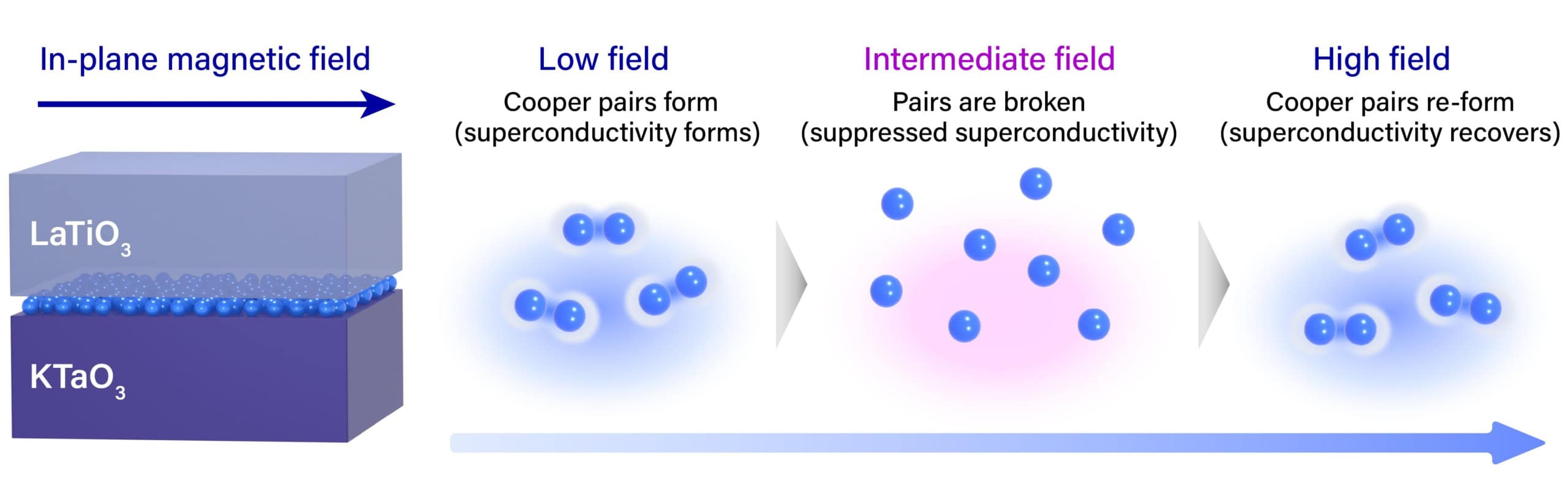
- A RIKEN-led international team reports the first sighting of re-entrant superconductivity in a two-dimensional unconventional superconductor, an interface built from LaTiO3 grown on KTaO3.
- The signature is a resistive cusp at 0.9 tesla, with zero resistance measured at both lower and higher applied fields, so the peak sits between two superconducting regions.
- That cusp field held still when the researchers changed temperature and when they swept charge carrier concentration using a gate voltage across the interface.
- Denis Maryenko says the group only set out to see how the critical field varies with temperature, and the resistive peak emerged at a rather low field while they were doing it.
- Re-entrance had been seen before in three-dimensional systems, among them CeRh2As2 and organic superconductors, and possibly in heavy fermion compounds such as UTe2.
Why it matters
- constraint A single upper critical field no longer summarises what this class of interface does inside a magnet, because a resistive window now sits between two zero-resistance ones.
- decision Any surviving model has to produce a characteristic field that stays put while temperature and carrier density move, which prunes the candidate mechanisms the team was weighing.
- capability Because carrier density at this interface is set electrically rather than by chemistry, the ferromagnetic and superconducting competition can be walked through on a single sample.
- precedent A narrow feature turned up in a sweep aimed at something else, which makes finer field steps on oxide interfaces already measured a cheap way to find more of them.
The mechanism on offer begins in the band structure. Ab initio calculations by Igor Maznichenko and Sergey Ostanin at Martin Luther University, with Arthur Ernst at Johannes Kepler University, identified a Van Hove singularity at the interface, a momentum region where the electronic density of states runs very high [13]. Vitalii Dugaev at Rzeszow University of Technology and Evgeny Ya Sherman at the University of the Basque Country then built a spin-orbit coupling model on top of that calculation and on symmetry arguments [14]. With no field applied, the bands are symmetric under p to -p, so electrons of opposite momentum sit at the same energy, a pair drawn from them carries zero total momentum, and spin-singlet pairing forms easily [15]. Turn a field on, that symmetry goes, pairing efficiency drops, and the onset temperature falls with it [16].
That is the half of the model that explains the death, and it is the half I can trace. The account available to me stops short of how the zero-resistance state returns above 0.9 T, so that part goes untold here. What I can report is the shortlist the researchers weighed: Zeeman splitting, orbital effects, and the Jaccarino-Peter effect, in which internal and external magnetic fields compensate and cancel out [12].
What carries weight here is the stubbornness of that field, more than its 0.9 T value. B* did not move with temperature, and it did not move when the carrier concentration was tuned by a gate voltage across the interface [6]. Those are the first two knobs an experimentalist reaches for, and a feature that ignores both looks more like something set in the band structure than something set by thermal or doping energy scales. That is a reading rather than a result, and it is why the Van Hove singularity is doing work in the explanation [13].
The reason to want this in two dimensions is the upper critical field. In MoS2, band structure and spin-orbit coupling hold electron spins perpendicular to the sample surface, and that locking greatly raises the maximum field superconductivity can survive [10]. In conventional superconductors, field suppresses superconductivity either by breaking Cooper pairs or by admitting flux whose motion introduces resistance [9], so a 2D system that blunts the first channel is worth having. Superconductivity had already been seen at KTaO3 interfaces, which is why the team grew LaTiO3 on top of it for the lattice match [11]. The caution this result adds is that a resistive band now sits between two zero-resistance ones [5], and one ceiling number does not describe that.
Five institutions in five countries were needed to read one cusp: RIKEN in Japan, Martin Luther in Germany, Johannes Kepler in Austria, Rzeszow in Poland, and the University of the Basque Country in Spain [17]. A transport peak was grown in one country and its band structure computed in two others. That division of labour is the measure of how loosely the 2D ferromagnetic and superconducting competition was pinned down [8]. A group sweeping critical field against temperature had no reason to expect anything at 0.9 T, and Denis Maryenko says the sighting was extremely surprising [3].
What to watch
- Whether a second group reproduces the 0.9 T cusp in an independently grown LaTiO3/KTaO3 sample, or whether it tracks a growth detail.
- The full published treatment of the high-field side, and whether Jaccarino-Peter compensation is ruled out rather than set aside.
- Whether other KTaO3 interface systems show a similar cusp once field is swept in finer steps on samples already measured.
Clarity's read
What the record supports and how the coverage leans. The claims behind it follow.
Reality
- Evidence58
- Adoption
- Insufficient
- Hype gap+12
- Incentives38
- Confidence52
Claim ledger
Ranked by verification strength, evidence, and original report placement.
- [1]
An international team of physicists led by Denis Maryenko of Japan's RIKEN Center for Emergent Matter Science observed re-entrant superconductivity for the first time in a two-dimensional unconventional superconductor.
- [2]
Writing in Science Advances, the physicists describe magnetotransport measurements on LaTiO3/KTaO3 heterostructures under increasingly large applied magnetic fields.
- [3]
Maryenko told Physics World: "We did not look for the RSC, and it was extremely surprising that we saw that."
- [4]
Maryenko said the group only wanted to see how the critical magnetic field behaves as a function of temperature, but suddenly began seeing a resistive peak at a rather low field that seemed to separate two superconducting regions.
- [5]
The cusp appears at a magnetic field B* of 0.9 T, with zero resistance measured at both lower and higher applied fields.
- [6]
In this experiment B* is independent of temperature and of the concentration of charge carriers, which the researchers controlled experimentally by tuning a gate voltage across the interface.
- [7]
Re-entrant superconductivity had previously been observed in three-dimensional ferromagnetic materials such as CeRh2As2, in organic superconductors, and possibly in heavy fermion compounds such as UTe2.
- [8]
In a few unconventional materials, competition between ferromagnetic ordering and superconducting ordering can lead to re-entrant superconductivity, where an applied field first destroys superconductivity and a further increase in field brings it back.
- [9]
In conventional superconductors, applied magnetic fields suppress superconductivity either by breaking up Cooper pairs or by introducing magnetic flux whose motion through the material introduces resistance.
- [10]
In MoS2, the electronic band structure and spin-orbit coupling combine to keep electron spins pointing perpendicular to the sample surface, and this locking greatly increases the upper critical field, the maximum field at which superconductivity can persist.
- [11]
Because 2D superconductivity had previously been observed at interfaces between KTaO3 and other materials, the RIKEN team used that as a starting point and grew LaTiO3, which has good lattice matching to KTaO3, beneficial for epitaxial growth.
- [12]
The researchers considered several possible explanations for the re-entrant superconductivity, including Zeeman splitting, orbital effects, and the Jaccarino-Peter effect, in which internal and external magnetic fields compensate for each other and cancel out.
- [13]
Igor Maznichenko and Sergey Ostanin of Martin Luther University in Germany and Arthur Ernst of Johannes Kepler University in Austria performed ab initio calculations of the interface band structure and identified a Van Hove singularity, where for certain momenta electrons have a very high density of states.
- [14]
Vitalii Dugaev of Rzeszow University of Technology in Poland and Evgeny Ya Sherman at the University of the Basque Country in Spain developed a spin-orbit-coupling-based model drawing on symmetry arguments and the ab initio band structure calculations.
- [15]
In the absence of an applied field the model finds a p to -p symmetry in the bands, so electrons with opposite momenta have the same energy, a Cooper pair formed from them has zero total momentum, and the system favours spin-singlet pairs that form easily.
- [16]
Applying a field breaks the p to -p symmetry, reducing Cooper pairing efficiency and decreasing the critical temperature for the onset of superconductivity.
- [17]
Five institutions in five countries are named as contributing to the result: RIKEN Center for Emergent Matter Science (Japan), Martin Luther University (Germany), Johannes Kepler University (Austria), Rzeszow University of Technology (Poland) and the University of the Basque Country (Spain).
Sources
1 independent publisher whose own reporting we read for this story.
- physicsworld.comMagnetic field first kills superconductor, then brings it back to life
1 article · August 28, 2026
Topics and entities
Follow any of these and your For You feed starts watching them — no settings page required.
Topics
Entities
- Denis MaryenkoFollow
- RIKEN Center for Emergent Matter ScienceFollow
- LaTiO3/KTaO3 heterostructureFollow
- Science AdvancesFollow
- Martin Luther UniversityFollow
- Johannes Kepler UniversityFollow
- Rzeszow University of TechnologyFollow
- University of the Basque CountryFollow
- Arthur ErnstFollow
- Igor MaznichenkoFollow
- Sergey OstaninFollow
- Vitalii DugaevFollow
- Evgeny Ya ShermanFollow