Science1 publisher3 min readPublished
Silencing mouse V1 for 150 milliseconds shows which signals its neighbour holds on to
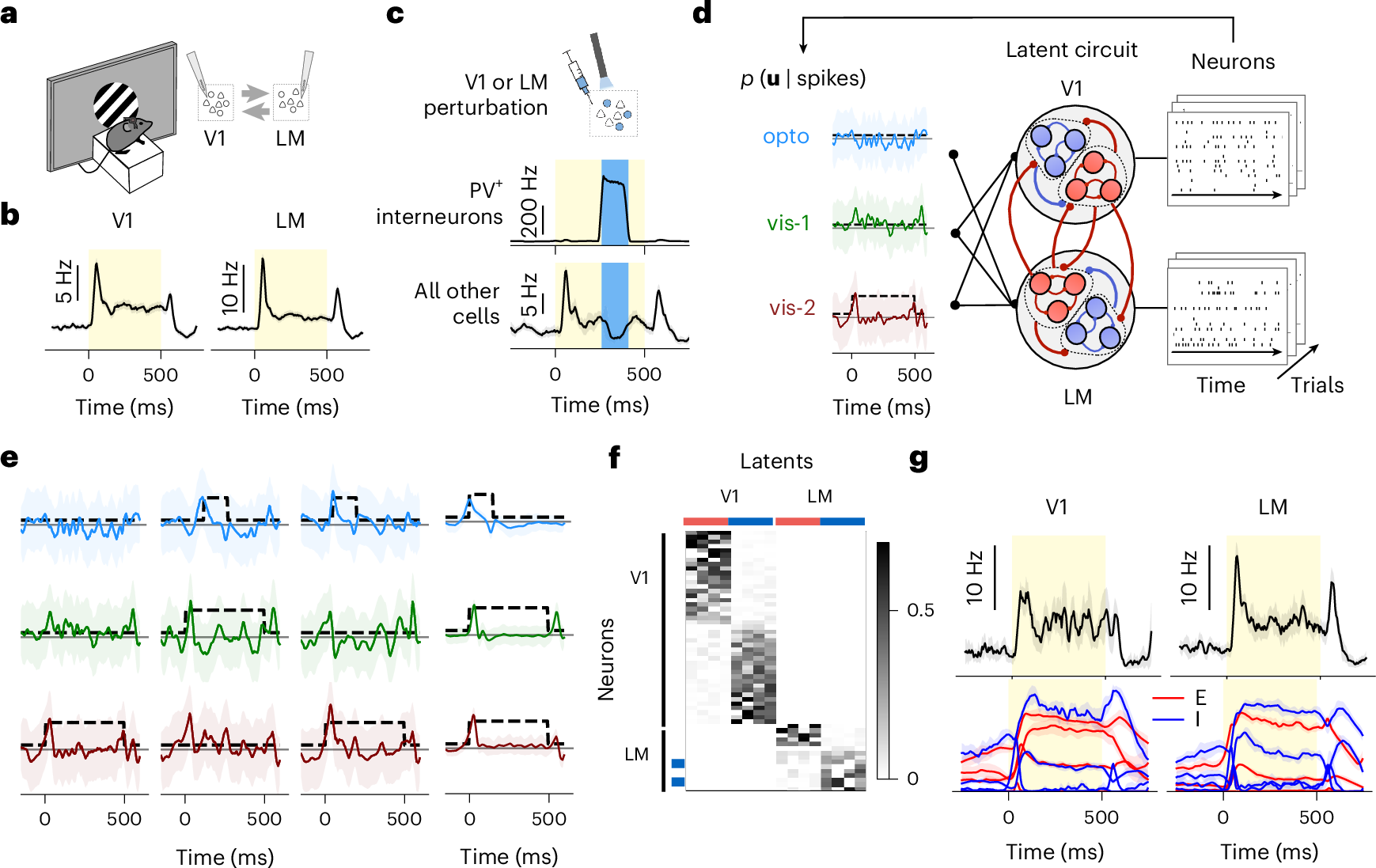
Recordings from 422 neurons in two mouse visual areas, and a network model fitted to them, indicate that reciprocal loops sustain activity the two areas share and let mismatched activity decay within a fraction of a second.
The Scientist · Science desk
What happened
- Mice discriminated drifting gratings tilted at opposing angles in a go/no-go task while the team recorded 194 neurons in the primary visual cortex and 228 in the neighbouring LM area at the same time.
- Activity patterns the two areas shared were sustained over extended timescales, while patterns that conflicted between the areas decayed within a fraction of a second.
- In the account the authors give, the reciprocal excitatory connections between the two areas act as an approximate line attractor, slowing congruent activity and speeding the collapse of incompatible states.
Compiled by The ScientistSomething wrong?How this is made
Why it matters
- capability A silencing window lasting a fraction of a second lets one trained animal supply its own control trial after trial, so the same protocol can be aimed at other reciprocally connected pairs of cortical areas.
- constraint Anyone wanting this as an account of perception still needs the behavioural half: the decay of mismatched activity has not been tied to the errors the mice made.
- decision For modellers, the line attractor arrives attached to a fitted nonlinear network, so borrowing the mechanism means inheriting the assumptions of that fit.
- precedent A circuit-level answer to how two specialized areas stay consistent sets up the identical measurement in non-visual cortex, where the same specialization question applies.
In the fitted model, the reciprocal excitatory connections between V1 and LM pick out one direction through the combined activity of both areas: activity along that direction decays slowly, and activity off it decays fast. That asymmetry is what the authors call an approximate line attractor. No element of the circuit compares one area's pattern against the other's and adjudicates; the connections themselves set which combinations persist, and the term Javadzadeh uses for the result is consensus building: "We find that over time, these types of connections between areas implement a mechanism we call consensus building," she said.
The causal language rests on the perturbation. Correlated firing in two connected areas leaves open which one is driving, and the perturbation is what settles the direction. So the team drove parvalbumin-positive inhibitory interneurons in a single area for roughly 150 milliseconds and watched the other, then reversed the direction. Roughly 150 milliseconds is itself a fraction of a second, the same range as the decay being probed, so the intervention and the dynamics under study sit on one timescale.
The question behind the design is older than the tools for it. "We are trying to understand how you can have such a high level of specialization between these different blocks, yet always have a consistent holistic outcome," Javadzadeh said. V1 takes the raw low-level stream from the thalamus, and LM handles contextual and patterned scenes. The two are in two-way contact continuously.
Two numbers define the dataset: 194 neurons in V1 and 228 in LM, 422 in all. The Cold Spring Harbor release leaves out how many mice they came from, and whether the trials with slowly decaying mismatches were the trials the animals got wrong.
That release opens with a coat rack in a dark hallway briefly looking like an intruder, and describes conflicting signals as pruned before they register in conscious awareness. What was recorded is population activity in two mouse visual areas while the animal discriminated drifting gratings tilted at opposing angles. Those gratings are a clean, controlled stimulus pair, which is why the population geometry is legible at all; an ambiguous hallway would be a different experiment.
The attractor is a property of a nonlinear artificial neural network fitted to the recordings, not a quantity read off an electrode. That is a reasonable way to work, and the constraint is a real one: the model has to reproduce how each area behaved when its partner was knocked offline. But the geometry comes with the model class, and in my view the useful next test is whether a differently parameterised fit to the same 422 neurons puts the slow direction in the same place. The paper is in Nature Neuroscience, from Javadzadeh's group at Cold Spring Harbor Laboratory with collaborators at the University of Cambridge and University College London.
What to watch
- Whether the Nature Neuroscience paper gives the number of animals and ties mismatch decay to error trials.
- Whether the same 150-millisecond silencing protocol produces the same congruent-versus-conflicting split outside visual cortex.
- Whether a different model class fitted to the same recordings places the slowly decaying direction where this one does.