ScienceNot yet confirmed elsewhere1 publisher2 min readPublished
A botched surgery in one mouse turned memory editing into a deliberate research program
Steve Ramirez's 2013 mouse result turned on an injection that missed its target, and the book he has written since names PTSD and dementia as goals, which puts the question of who authorizes an edit ahead of the evidence.
The Scientist · Science desk
What happened
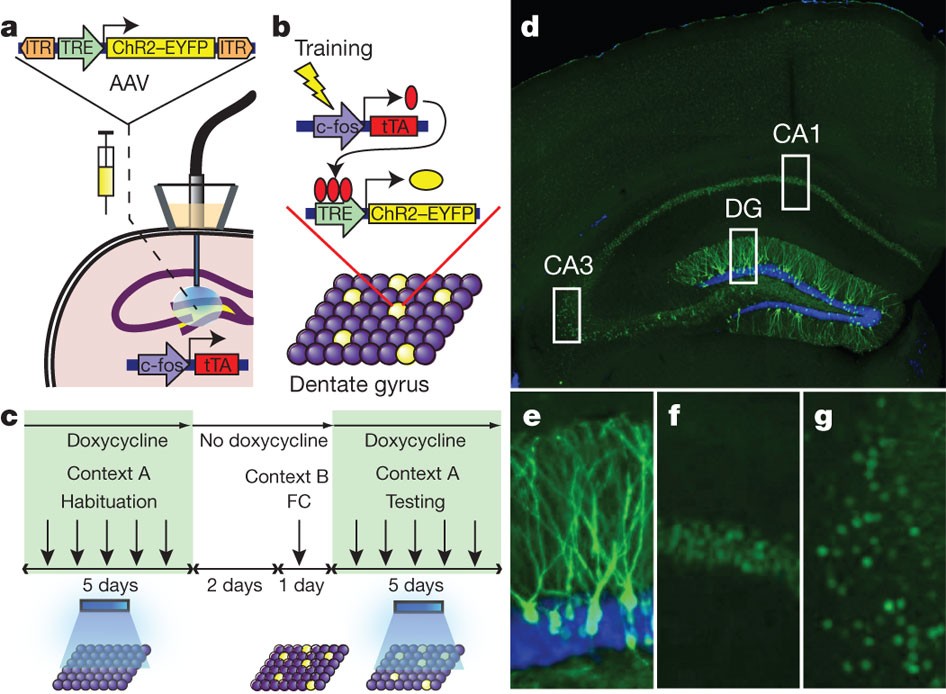
- In 2013 Steve Ramirez and Xu Liu, then at MIT, reported planting a fearful memory in mice by tagging hippocampal cells active during fear learning and switching them back on with light in a safe cage.
- Four of the five mice showed nothing, the fifth froze, and inspection of its brain found the tagging protein had landed in a slightly different part of the hippocampus than the team had aimed for.
- Ramirez, now an associate professor at Boston University's Center for Memory and Brain, published "How to Change a Memory" with Princeton University Press in 2025.
- That book has been short-listed for the 2026 Royal Society Trivedi Science Book Prize, putting the memory-manipulation argument in front of a general readership.
Why it matters
- constraint The demonstrated method requires a tagging protein placed in specific hippocampal cells and light delivered to those same cells, so any human version starts as a neurosurgical procedure rather than a prescription.
- decision With PTSD and dementia named as targets, someone other than the labs able to do the editing has to decide who authorizes an edit on a patient, and no published result yet forces that conversation.
- exposure The population named as the beneficiary overlaps with the author's own stated experience of loss, PTSD and addiction, so the case for the technology is being made from inside the affected group rather than by a sponsor.
- precedent Ramirez's argument that unexamined negative results hide real findings gives other labs a reason to reopen experiments they filed as failures, which is cheap to do and rarely rewarded.
The four mice that did nothing were a control group, and nobody designed them that way. Ramirez and Liu put their tagging protein where their hypothesis said the fear memory should live, hit that target in four animals, and got no response [3][4]. In the fifth, the protein went slightly wide, and that animal froze [5]. The variable carrying the result was surgical variance. The effect at the moment of discovery was one animal in five, 20 percent [13], and the thing separating the responder from the non-responders was anatomy the team had not chosen.
Ramirez does not oversell the luck. Asked what would have happened without the error, he said the correctly aimed surgeries would all have hit the wrong spot, the result would have read as negative, and they would have gone hunting through other parts of the hippocampus; he puts the delay at "maybe six months or less" [16]. The accident bought months rather than the insight. His more portable claim from the episode is about how labs handle failure: unintended outcomes are common, a negative result arrives with a million available excuses, and few people go back to look [10]. He credits the fifth mouse with teaching him to read head-scratching data more slowly [11].
The thing the mouse work does not tell you is what the mouse was remembering. The measured output was freezing [12]. That establishes a defensive state evoked in a safe cage by switching a tagged cell population back on, which is a real behavioral fact and not a description of a memory's content. Content is the part a patient would be asked to consent to having altered. The interview credits the 2013 paper with propelling the field [15] without laying out what has been replicated since [12], and it is that later record, not the original five animals, on which any clinical claim would have to rest.
Twelve years separate that observation from the book in which Ramirez sketches easing PTSD and guarding against dementia [14][9]. My view, with its condition attached: the consent rules for memory editing are worth drafting now, while the evidence is entirely rodent, because the alternative is that they get written by whichever group first holds a fundable human protocol. The condition is the readout. If the only available measure of a successful edit stays behavioral, informed consent is being asked to cover a change nobody can yet describe to the person agreeing to it.
What to watch
- A human protocol naming PTSD or dementia as an indication, and which body is asked to sign off on it.
- An animal readout that characterises the content of an implanted memory rather than the defensive behaviour it produces.
- The 2026 Royal Society Trivedi Science Book Prize decision, which sets how far this book's framing travels beyond neuroscience.
Clarity's read
What the record supports and how the coverage leans. The claims behind it follow.
Reality
- Evidence42
- Adoption
- Insufficient
- Hype gap+28
- Incentives62
- Confidence52
Claim ledger
Ranked by verification strength, evidence, and original report placement.
- [1]
In 2013, MIT neuroscientists Steve Ramirez and Xu Liu published a paper detailing how they had created false memories in mice.
- [2]
The team used optogenetics, in which cells' activity is manipulated using light, to plant a fearful memory in the brain and then reactivate that memory with pulses of light.
- [3]
The initial experiments used a protein to tag brain cells in the hippocampus that were active during formation of a fearful memory, and those fear memory-bearing cells were then reactivated while the mice were perfectly safe.
- [4]
The first four mice showed no response; the fifth froze in fear.
- [5]
Analysis of the fifth mouse's brain showed the protein had been placed by accident in a slightly different location of the hippocampus than in the others, inadvertently finding the spot where the memory was stored and showing it could be manipulated and controlled.
- [6]
Ramirez is now associate professor of psychological and brain sciences at Boston University and works at its Center for Memory and Brain.
- [7]
His book "How to Change a Memory: One Neuroscientist's Quest to Alter the Past" was published by Princeton University Press in 2025.
- [8]
"How to Change a Memory" has been short-listed for the 2026 Royal Society Trivedi Science Book Prize.
- [9]
In the book Ramirez conceptualizes a world where memories could be manipulated to help ease a person's PTSD or guard against dementia, and he draws on his personal experiences, including with loss, PTSD and addiction, to probe these ideas.
- [10]
Ramirez said unintended outcomes of experiments are pretty common but "we just don't look for them often," because a negative result invites a million reasons why an experiment may not have worked as predicted.
- [11]
Ramirez said the episode taught them to look more deeply when results are confusing or head-scratching, and that "biology is so squishy" that results sometimes zig when expected to zag.
- [12]
The Live Science article and interview report results in mice, describe the measured response as the animal freezing in fear, and do not describe any human application of the technique or any subsequent replication record.
- [13]
One of the five mice in the initial experiment, or 20 percent, showed the freezing response.
- [14]
Twelve years separate the 2013 paper from the 2025 publication of Ramirez's book.
- [15]
The breakthrough helped to propel research in the field by showing that memories can be artificially constructed.
- [16]
Ramirez told Live Science that if the surgery had not been botched, all the surgeries would have been done correctly, would have hit the wrong spot, and everything would have been a negative result; he said the error "would have delayed the inevitable by maybe six months or less" and that they would likely have tried other parts of the hippocampus.
Sources
1 independent publisher whose own reporting we read for this story.
Topics and entities
Follow any of these and your For You feed starts watching them — no settings page required.