Science2 publishers3 min readPublished
Genome sequencing names Bolivia's tilcayo, the first new living cat species since 1923
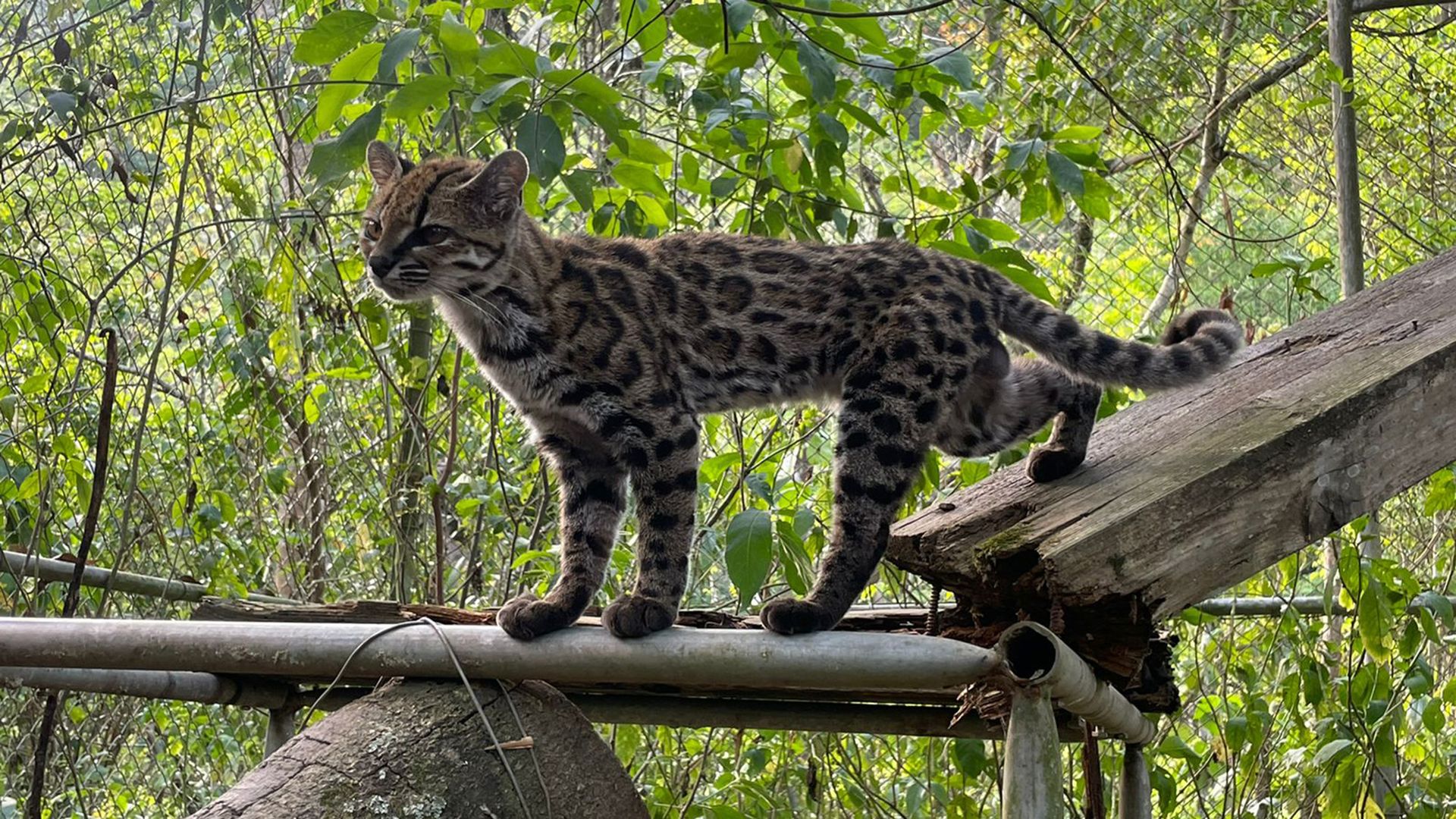
Leopardus tilcayo of the Bolivian Yungas was counted inside Leopardus tigrinus until 38 sequenced genomes separated it. The living animal itself is known from two individuals, one of them a captive male.
The Scientist · Science desk
What happened
- A study published on Thursday, Sept. 17 in Current Biology sequenced complete genomes from 38 Leopardus cats collected in South and Central America, eight of them taken from museum specimens.
- The authors conclude that tiger cats are five distinct species, confirming four names already proposed and adding one new one, Leopardus tilcayo, along with a new subspecies, L. tigrinus antisuyo.
- L. tilcayo is the first new living cat species described in over a century, the last being the Uruguayan pampas cat, Leopardus fasciatus, in 1923.
Compiled by The ScientistSomething wrong?How this is made
Why it matters
- constraint Range maps and population counts for these cats now require genetic sampling, because a small spotted cat seen on an Andean slope cannot be sorted into one of five near-identical species by eye.
- decision Whoever redoes the L. tigrinus assessment has to do it on the animals left after Bolivia's are removed, and those are the ones the study describes as having had limited genetic data all along.
- exposure L. tilcayo enters the conservation queue with a formal name and a living record of two animals, so the first protection argument for its Bolivian forests has to be made without a population figure.
- capability Old collections can settle questions field observation cannot: teeth, bones, skin and fur from eight countries carried enough signal to support a species description without new captures.
The species claim rests on 26 tiger cat genomes taken from across the animals' known range, part of a set of 38 complete Leopardus genomes analysed by Eduardo Eizirik of the Pontifical Catholic University of Rio Grande do Sul and his colleagues [3]. The other 12 genomes came from Leopardus species that are not tiger cats [4]. Eight of the 38 samples were museum material, and the team worked from teeth, bones, muscle tissue, skin and fur collected in Costa Rica, Colombia, Peru, Bolivia, Brazil, Suriname, Guyana and Venezuela [1][2]. On that comparison the cats of the Bolivian Yungas, on the eastern slopes of the Andes, fall outside the lineage holding L. tigrinus and L. pardinoides, which they left nearly 1.4 million years ago [7][8].
The morphological record is much thinner. The description of L. tilcayo, named for the local word for the animal, rests on two live cats in Bolivia: one caught and photographed in the wild, and one in captivity [10][33]. The captive male, Tigrino, is the type specimen for the whole species, and he arrived about 10 years ago at Senda Verde, a Bolivian refuge for trafficked wildlife [11]. "It didn't look like the other [cats]," said Paola Nogales-Ascarrunz, a biologist at the refuge and a co-author of the study, "but we didn't expect a new species itself" [13]. Head and body run about 42 to 50 centimetres, and the cat weighs 1.5 to 2 kilograms [14].
For anyone who has to count these animals, the thin morphology is the working problem. "The five tiger cat species are all cryptic species. They're morphologically very similar," Jonas Lescroart of the University of Antwerp, a member of the team, told New Scientist [16]. Live Science reports they can be told apart only by genetic analysis or small differences in markings [17]. That means a sighting cannot be assigned to one of the five without a genetic sample [34].
The conservation record has not caught up. The IUCN Red List classes L. tigrinus as vulnerable [24]. The Bolivian cats sat inside L. tigrinus when that assessment was made, so it covered animals the genomes now place in a species of their own [6][31]. Eizirik says the new species and the new subspecies will have to be evaluated and protected as distinct units, and that the forests they live in are shrinking as agriculture expands [25]. The Peruvian animals, L. tigrinus antisuyo, remain inside L. tigrinus as a subspecies; only the Bolivian population leaves the species [27][5].
Tiger cats were first described in French Guiana in 1775, and twentieth-century taxonomists folded the regional names into the single species L. tigrinus [18]. Genomic work has been unpicking that since 2013, when tiger cats were split into a northern and a southern species, followed by L. emiliae in 2017 and L. pardinoides in 2024 [19]. Three revisions in eleven years [20]. Genetic data on L. tigrinus itself stayed limited through all of it [21]. Fabio Oliveira do Nascimento, a taxonomist at the Museum of Zoology of the University of Sao Paulo who was not involved in the work, told Live Science that the tiger cat family tree has been "highly contentious and poorly understood" [22].
What to watch
- A revised IUCN assessment for L. tigrinus computed with the Bolivian animals removed, plus a first assessment for L. tilcayo.
- Further Leopardus genomes from populations isolated by Andean mountains and rivers, where Leslie Lyons expects more species.
- Genetic sampling that maps where L. tilcayo and L. tigrinus actually meet along the Andean slopes.