InvestNot yet confirmed elsewhere1 publisher3 min readPublished
LG Display stakes its profit recovery on a maskless OLED process it says gets 24% more panels per glass
LG Display says its maskless FLiPP OLED process gets 24% more panels from each mother glass and cuts process time by 40%. The company is staking its profit recovery on it while third-quarter operating profit is expected to fall about 25%, Seoul Economic Daily reported.
The Investor · Invest desk
What happened
- Chief technology officer Choi Young-seok said FLiPP will go first into OLED for tablets, laptops and monitors, then expand to other areas.
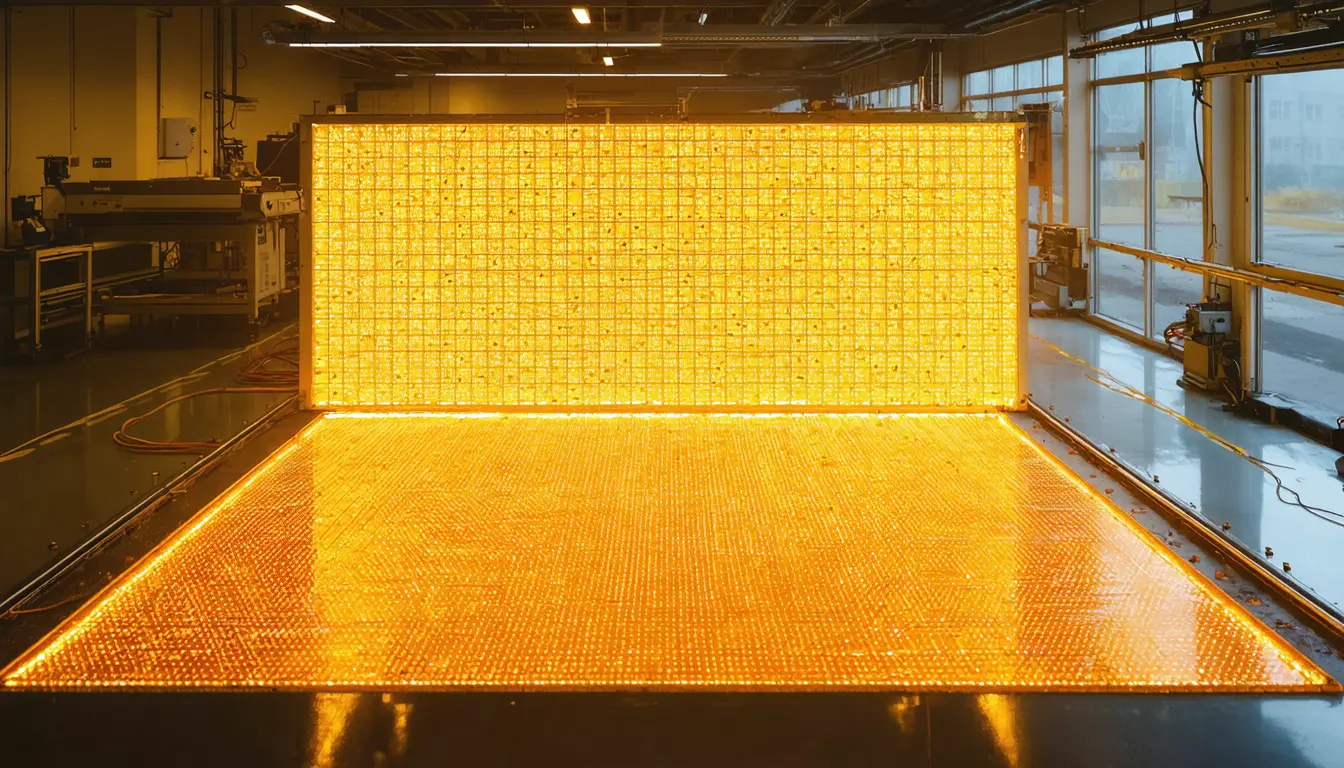
- FLiPP swaps the fine metal mask for photolithography, coating organic material over the transistor layer and using ultraviolet light to remove what spreads past each pixel.
- LG says FLiPP can make panels of up to 100 inches, while the fine metal mask method is specialised for panels of 1 to 27 inches.
Why it matters
- cost If FLiPP yields match FMM's, an eighth-generation line turns out about 2.07 times the panels per hour, so its fixed costs spread over roughly twice the units.
- decision Leading with IT panels sets FLiPP against FMM inside the mask's own size range on cost per panel, and holds back TV, where the 100-inch reach would matter, for later.
- exposure Choi speaks of securing yields as future work, so the recovery LG is staking on FLiPP rests on a figure the company has not published.
LG's two headline figures compound. Cutting process time by 40% [7] lets a line run about 1.67 times as many mother glasses in the same hours [17]. If each glass also carries 24% more panels [6], output per line-hour comes to about 2.07 times the fine metal mask figure [15]. That holds only if FLiPP yields match FMM's and the 40% covers the whole glass cycle [15]. On the 24% alone, any cost that scales with the glass falls to about 81% of its FMM level per panel [16].
The gains come from taking a part out. In the FMM method, a thin metal sheet punched with pixel-sized holes is laid over the transistor layer and organic material is deposited through it [14]. According to Seoul Economic Daily, the equipment is expensive, the masks are hard to scale up, and they bend easily, so material misses its pixel cell and defects follow [11]. The mask's thickness also limits the share of the glass taken up by pixels, and that lowers brightness [11]. LG says FLiPP lifts brightness 1.6-fold and lifespan 2.4-fold while using 13% less power [9].
The launch order is the more revealing choice. Choi called FLiPP the most advanced process innovation available for eighth-generation production [3], and LG says it reaches 100 inches against FMM's 1 to 27 [8]. Yet the first products are tablets, laptops and monitors [4], a market whose tablets and laptops sit inside the mask's 27-inch ceiling [8]. So FLiPP's first test is against FMM on cost per panel, in sizes FMM already serves. TV, where the size advantage would show, comes later. Choi also put the saving on FMM equipment development at tens of billions of won a year [7], money LG stops spending on the process it is replacing [5].
Choi tied the advantage to LG's history. "Properly adopting the FLiPP process is possible only for a company like LG Display that has run both existing TV and smartphone OLED businesses," he said [12]. He added: "Following product development, we will draw on our mass-production know-how in existing technologies such as white OLED to pursue performance improvements and secure yields early for FLiPP as well." [13] That second remark puts yields in the future tense. LG did not give a yield figure, a mass-production date or the cost of converting lines.
The slow case has yields arriving late, so the expected 25% fall in third-quarter operating profit [1] is followed by more quarters FLiPP does not reach. A middle case has FLiPP working in IT panels only, with TV and phone panels left on existing processes. The strong case has it moving up to TVs, past FMM's 27-inch limit [8]. We think the per-glass figures are credible, because they come from removing a part with known defect problems. We also think the recovery LG is staking on FLiPP [2] is a bet on yields it has not yet shown. The counter-case is Choi's own: that years of running TV and smartphone OLED let LG reach mass-production yields faster than a newcomer could [12]. If the first FLiPP IT panels ship at yields near FMM's, that case wins, and most of the roughly doubled line output [15] shows up in cost per panel.
What to watch
- LG Display's third-quarter results, due shortly, and whether management attaches a FLiPP mass-production date or line-conversion spending to them.
- The first yield figure LG gives for FLiPP IT panels against its fine metal mask lines.
- Any move to put FLiPP into TV panels above FMM's 27-inch limit, the size range where the process has no mask-based competitor.
Clarity's read
What the record supports and how the coverage leans. The claims behind it follow.
Reality
- Evidence30
- Adoption8
- Hype gap+40
- Incentives75
- Confidence35
Claim ledger
Ranked by verification strength, evidence, and original report placement.
- [1]
LG Display's third-quarter operating profit is expected to fall about 25% from a year earlier when results are announced shortly.
- [2]
LG Display plans to stake its recovery in profitability and product competitiveness on the new FLiPP technology.
- [3]
Choi Young-seok, chief technology officer at LG Display, said at an online tech seminar on FLiPP held on the 8th that FLiPP is the most advanced process innovation available for eighth-generation production.
- [4]
"We will apply FLiPP first to IT OLED processes for tablets, laptops and monitors, then expand to other areas," Choi said.
- [5]
FLiPP eliminates the fine metal mask, currently a core step in making OLED panels but a source of production inefficiency.
- [6]
"The FLiPP method can produce 24% more OLED panels from a mother glass of the same size than the FMM method," Choi said.
- [7]
"Process time is cut by 40%, and we can also save tens of billions of won a year in FMM equipment development costs."
- [8]
The FMM method is specialized for panels of one to 27 inches, while FLiPP can produce panels of up to 100 inches with relative ease.
- [9]
FLiPP raises brightness 1.6-fold and lifespan 2.4-fold while cutting power consumption by 13%.
- [10]
FLiPP uses photolithography: organic light-emitting material is coated onto the TFT without a mask, and ultraviolet light is applied only to portions that have spread beyond the pixel cells, removing them.
- [11]
FMM equipment is expensive, the masks are hard to scale up for ultra-large panels, they bend easily so organic material is not applied precisely within each pixel cell and defects result, and the mask's thickness limits the aperture ratio, reducing brightness.
- [12]
"Properly adopting the FLiPP process is possible only for a company like LG Display that has run both existing TV and smartphone OLED businesses," Choi said.
- [13]
"Following product development, we will draw on our mass-production know-how in existing technologies such as white OLED to pursue performance improvements and secure yields early for FLiPP as well."
- [14]
The FMM process lays a thin metal sheet perforated with pixel-sized holes over the TFT and then deposits the organic material on top.
- [15]
If FLiPP yields match FMM and the 40% process-time cut applies to the full glass cycle, panels per unit of line time are about 2.07 times the FMM level.
- [16]
With 24% more panels per mother glass, any cost that scales with the glass falls to about 81% of its FMM level per panel, roughly 19% lower.
- [17]
A 40% cut in process time lets a line process about 1.67 times as many mother glasses in the same time.
Sources
1 independent publisher whose own reporting we read for this story.
- en.sedaily.comLG Display Unveils New OLED Process, Lifting Output 24%
1 article · October 10, 2026
Topics and entities
Follow any of these and your For You feed starts watching them — no settings page required.
Entities
- LG DisplayFollow
- FLiPPFollow
- Choi Young-seokFollow
- Fine metal maskFollow