Leonardo DRS puts its four-panel cxMHR air defense radar into initial production
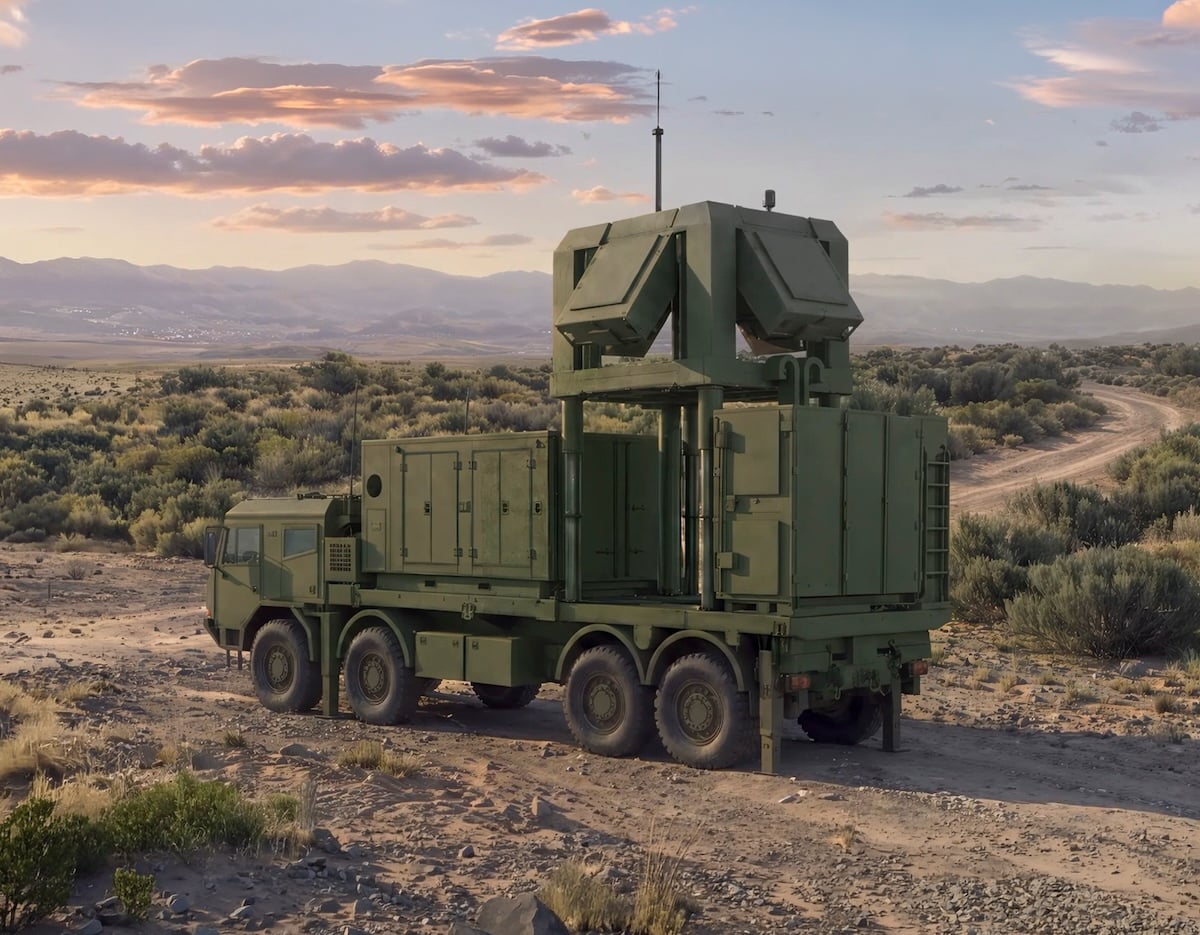
Leonardo DRS has begun initial production of its cxMHR radar, which it rates at 56 miles against drones and 205 against transport aircraft. The company has not published equivalent ranges for every threat it lists.
The Product Desk
Bar comparison of cxMHR detection ranges reported by Leonardo DRS: exceeding 90 kilometers (56 miles) against UAS and loitering munitions, and more than 330 kilometers (205 miles) against transport aircraft.
Detection range reported by Leonardo DRS, by target type
| Item | Value | Claim |
|---|---|---|
| UAS, loitering munitions, over | 90 km | 5 |
| Transport aircraft, over | 330 km | 5 |
What happened
- The company announced the radar at the Association of the U.S. Army's 2026 annual meeting in Washington on October 12.
- Four AESA panels, identification friend-or-foe equipment and command-and-control gear sit in one ISO container that can be moved by air, land or sea and deployed on a single vehicle.
- Leonardo DRS says the radar meets Modular Open Systems Approach standards and supports interfaces including FAAD, Medusa, SAPIENT, Lattice, ASTERIX, MICAD and RAFT.
- The cxMHR adds a C-band variant, aimed at integrated air and missile defense, to the company's existing Multi-Mission Hemispheric Radar family.
Why it matters
- decision A counter-drone site should be sized on the 56-mile figure. The 205-mile number is an aircraft-surveillance figure.
- constraint The cxMHR is a sensor only, so any fire-control-quality tracking claim still depends on interceptors and command systems that someone else supplies.
- exposure A program office cannot yet put the radar on a fielding schedule or price it, because no quantities, orders or dates are public.
Anyone lifting a range from this announcement into a requirement has to choose a target first. Leonardo DRS reports detection beyond 90 kilometers (56 miles) against unmanned aircraft and loitering munitions, and beyond 330 kilometers (205 miles) against transport aircraft [5]. The larger figure is about 3.7 times the smaller [14]. Cruise missiles, rockets and tactical ballistic missiles are also on the threat list [7], and the company has not provided equivalent figures for every threat listed [6]. We'd expect a transport aircraft to be an easier target to see than a loitering munition.
The radar uses C-band and a digital AESA design. Its beams are steered electronically, so it can revisit areas of interest without rotating an antenna [8].
The pitch and the product are at different stages. Max Cohen, senior vice president and general manager of Leonardo DRS RADA Technologies, said: "The cxMHR gives our customers a deployable, single-vehicle capability that delivers persistent 360-degree surveillance, long-range detection, and fire-control-quality tracking against today's most challenging air threats." [11] The company says AI-enabled tracking and classification helps produce the fire-control-quality tracking in that sentence [9]. What exists so far is the start of initial production [1]. The announcement did not disclose production quantities, customer orders, delivery schedules or a timeline for operational deployment [12].
A buyer can sort this with a 2x2. Put each threat in your requirement on it. One axis is whether the vendor has stated a range for that target. The other is whether a delivery date exists. Stated range and a date: plan around it. Stated range, no date: ask for a quote and keep the sensor you have. No stated range, with a date: ask for test data before the date matters. Neither: leave it off the plan.
On what Leonardo DRS has published, drones, loitering munitions and transport aircraft sit in the second box, because ranges exist and dates do not [5][12]. Cruise missiles, rockets and tactical ballistic missiles sit in the fourth until the company publishes ranges for them, since the article lists none [6][7].
What to watch
- Whether Leonardo DRS publishes detection ranges for cruise missiles, rockets and tactical ballistic missiles.
- A first customer order or delivery schedule for the cxMHR.
- Any independent demonstration of the fire-control-quality tracking the company claims.
Clarity's read
What the record supports and how the coverage leans. The claims behind it follow.
Reality
- Evidence30
- Adoption8
- Hype gap+35
- Incentives70
- Confidence55
Claim ledger
Ranked by verification strength, evidence, and original report placement.
- [1]
Leonardo DRS has launched its cxMHR radar and begun initial production of the system.
- [2]
Leonardo DRS announced the milestone at the Association of the U.S. Army's 2026 Annual Meeting & Exposition in Washington, D.C., on October 12.
- [3]
The cxMHR uses four active electronically scanned array panels integrated with identification friend-or-foe equipment, command-and-control components and supporting hardware, all housed in an ISO container that can be moved by air, land or sea and deployed on a single vehicle.
- [4]
Leonardo DRS says the cxMHR is designed to meet Modular Open Systems Approach standards and supports interfaces including FAAD, Medusa, SAPIENT, Lattice, ASTERIX, MICAD and RAFT.
- [5]
Leonardo DRS reports detection ranges exceeding 90 kilometers (56 miles) against UAS and loitering munitions, and more than 330 kilometers (205 miles) against transport aircraft.
- [6]
The range figures apply to different target categories; the company has not provided equivalent range figures for every threat listed.
- [7]
The cxMHR is designed to detect, track and identify multiple aerial targets simultaneously, including unmanned aircraft systems, loitering munitions, cruise missiles, rockets and tactical ballistic missiles.
- [8]
The radar uses C-band radio frequencies and a digital AESA architecture, which electronically directs radar beams so it can scan and revisit areas of interest without physical antenna rotation.
- [9]
The cxMHR incorporates AI-enabled tracking and classification, which the company says helps produce fire-control-quality tracking.
- [10]
The radar itself is a sensor, not an interceptor.
- [11]
"The cxMHR gives our customers a deployable, single-vehicle capability that delivers persistent 360-degree surveillance, long-range detection, and fire-control-quality tracking against today's most challenging air threats," said Max Cohen, senior vice president and general manager of Leonardo DRS RADA Technologies.
- [12]
Leonardo DRS has not disclosed production quantities, customer orders, delivery schedules, or a timeline for operational deployment in its announcement.
- [13]
Leonardo DRS already markets a family of Multi-Mission Hemispheric Radar systems for counter-drone operations, very-short-range air defense and hemispheric surveillance; the cxMHR adds a C-band variant positioned for integrated air and missile defense.
- [14]
The stated transport-aircraft range (330 km) is about 3.7 times the stated range against UAS and loitering munitions (90 km).
Get this ledger inside ChatGPT. Ask about any of our stories and the answer brings its figure, each claim’s verdict and the sources. Free, no account.
Sources
1 independent publisher whose own reporting we read for this story.
Topics and entities
Follow any of these and your For You feed starts watching them — no settings page required.
Topics
- Air defense radarFollow
- Counter-Drone SystemsFollow
- Defense industryFollow
Entities
- Leonardo DRSFollow
- cxMHRFollow
- Association of the United States ArmyFollow
- Max CohenFollow