Product9 publishers3 min readPublished Updated
Nvidia's Grace-plus-Blackwell superchip now has two Yoga bodies, a 20-core CPU and up to 128GB of unified memory. The only Lenovo laptop from the same announcement with an October date and a price is the $700 IdeaPad Vibe.
The Product Desk · Product desk

Compiled by The Product DeskSomething wrong?How this is made
The real limit of this machine shows up at about the one-hour mark for anyone running the 128GB configuration through a render deadline. Lenovo says the Yoga Pro 9n supports up to 80W TDP [8], and the battery is 92.5Wh [7]. Divide one into the other and a chip held at its ceiling empties a full charge in roughly 69 minutes, before the OLED panel and the two SSDs take their cut [24]. The 140W adapter in the box is the honest spec [9].
That matters because the pitch for on-device models is independence from the network, but the power budget only extends that independence as far as a socket. Nvidia's framing is a petaflop of compute in a chip purpose-built for slim Windows laptops [3], which Jensen Huang has called a "superchip" for "personal AI computers" running agents and models on-device [4]. Lenovo's own answer to who this is for is narrower and more useful: "creators and developers whose work demands substantial local computing capability in a premium, portable design" [13]. The workload list runs to video editing, 3D rendering, software development and AI app development [28]. This is a mobile workstation with an inference story attached, aimed at the MacBook Pro and the Surface Ultra [14].
Price and availability are the two numbers missing from the announcement. Mashable was told pricing and availability "will be announced at launch" [5]. Engadget reads the silence as a consequence of volatile component markets [6], which is a different statement from routine launch timing, and a more informative one. The only machine in the same Lenovo slate carrying both a price and a month is the IdeaPad Vibe at $700, with AMD Ryzen AI 400 models first in October and Snapdragon X versions in November [17]. That machine runs AMD or Qualcomm silicon with up to 32GB of memory [18]. Local agentic inference in this announcement is a premium configuration with the price field blank [26], not yet a standard retail laptop spec anywhere in the lineup, and Microsoft appears only as the competitor named in Lenovo's press materials [14]. The spec sheets do not fully agree either: Mashable lists the convertible's panel as 2.8K at 2,880 x 1,800 [11], while Engadget calls it 1.8K [12].
For the person filling in a configuration sheet, this comes down to a grid rather than a wish. One axis: does the data have to stay on the device because of a client contract or a compliance rule. The other: does the work happen away from mains power. Both yes is the only quadrant where up to 128GB of 9400 MT/s unified memory [16] at an unannounced price beats a rented GPU. Data-bound but desk-bound gets the same output from a tower, and the 80W ceiling in a 16.7mm chassis [29] argues for the tower anyway. Mobile but cloud-tolerant is an ordinary thin laptop and an API key. Neither is a Vibe at $700 [17].
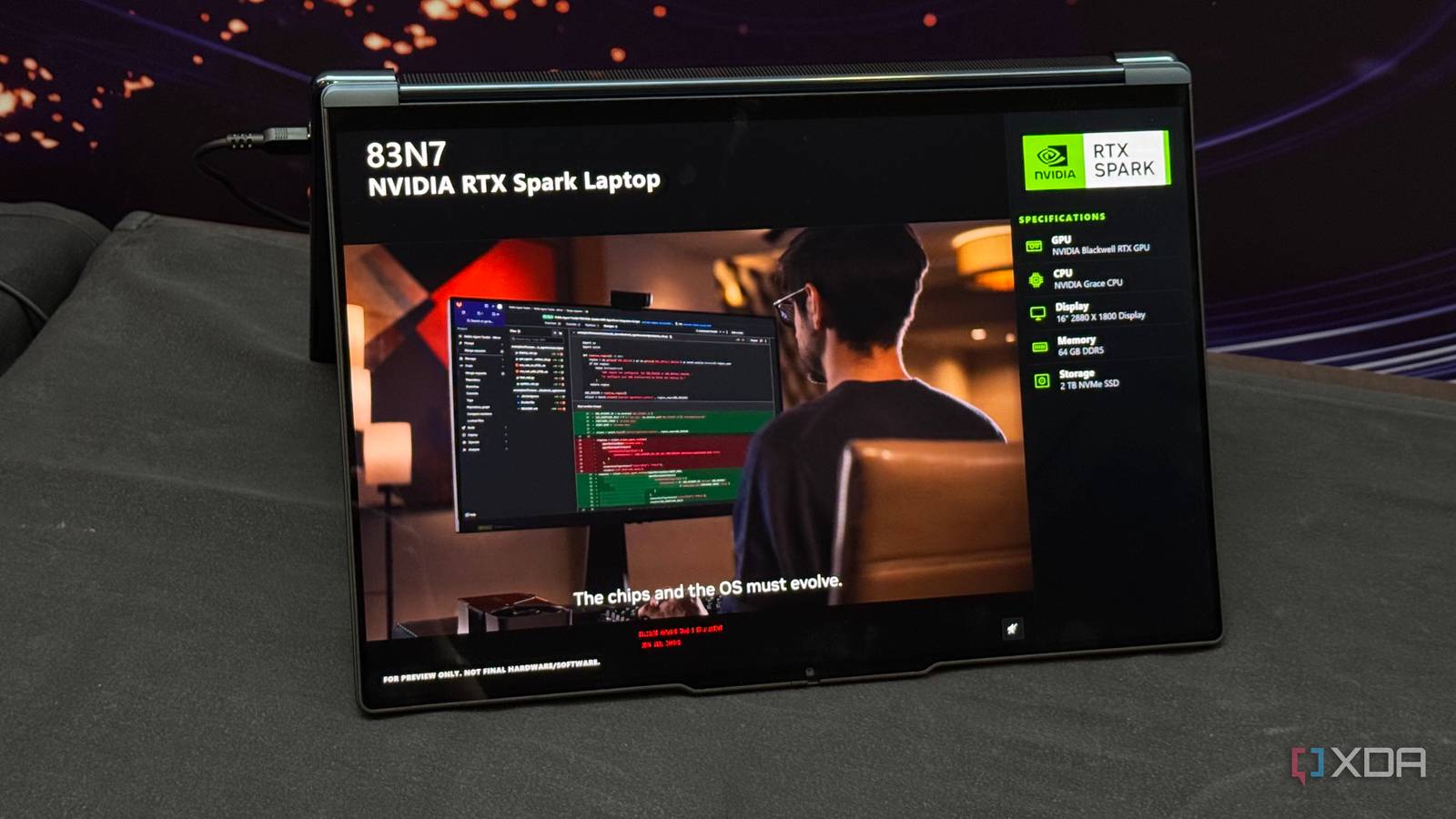
The convertible halves the flagship on both of the specs that decide which models fit, at up to 64GB of memory and up to 2TB of storage against 128GB and 4TB [25], so the pen surfaces and the 360-degree hinge [10] are what the extra 0.64 pounds buys. Name the model weights and name the data that cannot leave, and the quadrant picks itself. Everything else on these sheets is a preference.
Ranked by verification strength, evidence, and original report placement.
Pricing and availability for both Yoga laptops "will be announced at launch", according to a press release Lenovo shared with Mashable.
The RTX Spark platform in both laptops includes an Nvidia Grace CPU with up to 20 cores and an Nvidia Blackwell RTX GPU with up to 6,144 cores.
Engadget wrote that Lenovo's withholding of price and availability is "possibly quite understandable given the volatility of the component markets right now".
Nvidia says RTX Spark provides up to 1 petaflop of compute and up to 128GB of memory, and was purpose-built for slim Windows laptops.
The Yoga Pro 9n has a 15.3-inch 2.5K (2,560 x 1,600) OLED display with a 48 to 165Hz refresh rate and 1,100 nits peak HDR brightness, up to 128GB RAM, up to 4TB of SSD storage across two slots, a 92.5Whr battery, and a starting weight of 3.64 pounds.
At IFA 2026 in Berlin, Lenovo showed its first two Windows laptops powered by Nvidia's RTX Spark platform: the Yoga Pro 9n and the Yoga 9n 2-in-1.
Follow any of these and your For You feed starts watching them — no settings page required.
Evidence-backed comparisons of source perspectives and observed adoption signals. Read the methodology
Which Builder, Operator, and Investor concerns the observed source mix emphasized—not a truth score.
Evidence, demonstrated adoption, hype gap, incentives, and confidence are assessed independently, each on its own current evidence. How these are measured.
One press release, eight retellings
Every dimension, core count and battery figure here traces back to Lenovo's own release and Nvidia's platform claims. Notebookcheck and VideoCardz add real value by reading the fine print — M.2 2242 bays, the N1X tiers, FP4 rather than general petaflops — but nobody has measured anything. The convertible's resolution appearing three different ways in print is the tell that this is spec-sheet transcription rather than hands-on work.
Announced, still unavailable to buy
There is no unit anyone can buy: no price, no date, no reviewer sample. What does count is platform breadth — Mashable lists Asus, Dell, HP, Microsoft and MSI also building Spark machines, and MSI's Prestige N16 Flip AI+ got there first as a hybrid. Set against Lenovo's own IdeaPad Vibe, priced at $700 with an October ship, the Spark pair is the part of the lineup furthest from a customer.
Superchip claims, numbers not yet checked
Nvidia's petaflop is FP4 AI throughput, as only VideoCardz spells out, and the 'all-day battery life' claim Mashable relays goes unexamined next to an 80W chip envelope and a 92.5Wh cell. Huang's 'personal AI computer' language and Lenovo's promise of coordinated local agents are repeated by most of the coverage without a single measured workload behind them. The specs are precise, but every performance claim so far comes from Nvidia and Lenovo.
A trade show, and a memory market
This is IFA launch publicity: Lenovo controls the release, the images and the quote from Jun Ouyang, and Nvidia benefits from every retelling of the superchip framing. The withheld price has its own incentive shape — Engadget attributes it to component market volatility and 9to5Google to RAMageddon, which means Lenovo gets the coverage now and sets the number once memory costs settle.
Well documented on paper, unproven in practice
That these two laptops exist, on this platform, with these ceilings, is about as well established as an unshipped product gets — eight reports and Lenovo's own sheet agree. Confidence drops on anything requiring hardware: performance, real battery life, thermal sustain, and the convertible's actual panel resolution.
product
Nvidia dates the Arm-based RTX Spark N1X to October without naming a price1 publisher
build
China's accelerator swap makes Cambricon supply, not export policy, your ship-date risk1 publisher
product
Lenovo caps its 16-inch Spark laptop at half the memory of the 15-inch Pro1 publisher
invest
Samsung Finally Has Foundry Pricing Power, and It Is Charging China For It3 publishers
Publishers with included, body-backed reporting in this cluster.
2 articles · September 3, 2026
1 article · September 3, 2026
2 articles · September 3, 2026
1 article · September 3, 2026
2 articles · September 3, 2026
1 article · September 3, 2026
1 article · September 4, 2026
1 article · September 3, 2026