Lee shelves Korea's CPTPP application for the year to rebuild trust with farmers and fishers
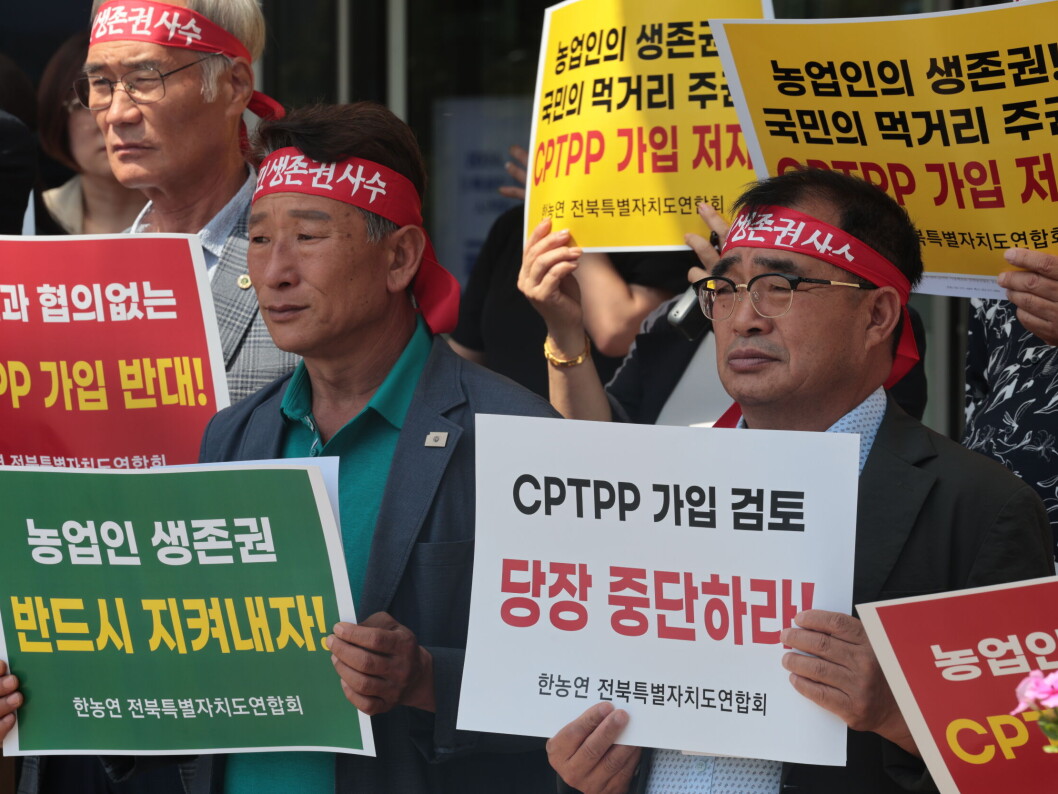
President Lee Jae Myung shelved Korea's bid to join the 12-member CPTPP this year after farmers and fishers objected. Seoul set no new deadline, so exporters hoping for tariff cuts in Japan, Mexico and the rest of the bloc cannot count on an application before next year.
The Investor · Invest desk
Ranked bars of projected average annual output losses from joining the CPTPP: farming 710 billion won, fisheries 81.7 billion won, forestry 60.6 billion won, per a government analysis covering the first 15 years.
Avg. annual output loss, first 15 years of membership (govt analysis) In billion won a year
| Rank | Item | Value | Claim |
|---|---|---|---|
| 1 | Farming | 710 billion won a year | 16 |
| 2 | Fisheries | 81.7 billion won a year | 16 |
| 3 | Forestry | 60.6 billion won a year | 16 |
What happened
- Lee issued the order two days after telling a Cabinet meeting to revisit the bid from scratch, dropping a plan to push for membership at Vietnam's November CPTPP ministerial.
- The Blue House said state funds will cover a 700 billion won shortfall in a farm and fishing fund that lawmakers created as a condition for ratifying the 2015 Korea-China FTA.
- A Sept. 28 analysis by the Ministry of Trade, Industry and Resources and other ministries found joining would leave Korea's real GDP 0.38 percentage points higher after 10 years.
Why it matters
- cost The state takes on 700 billion won of farm and fishing compensation now, while the manufacturing gains the ministries project from membership are pushed back by at least a year.
- constraint Exporters have no filing date to plan staged tariff phase-outs around in a bloc producing about 15% of global GDP, and next year is the earliest an application could go in.
- decision By tying the bid to restored trust and setting no deadline, the presidency has handed farm and fishing groups control of the calendar for Korea's trade policy toward the bloc.
- precedent A third Korean government stopping short of an application leaves CPTPP members a record to weigh when Seoul next asks for their support.
Added together, the ministries' projections put the primary sector's loss at about 852.3 billion won of output a year [19]. Manufacturing and its upstream and downstream industries gain an average of 6.3 trillion to 6.7 trillion won a year over the same 15 years [15]. That works out to roughly 7.4 to 7.9 won of added production for every won that farms, forests and fisheries lose [20]. Small and mid-sized firms alone were projected to take 1.1 trillion to 1.2 trillion won a year of the gain [15], about 1.3 to 1.4 times the whole primary-sector loss [24]. Across the 15 years, about 12.8 trillion won of output is lost and 94.5 trillion to 100.5 trillion won is added [21].
The fund now being topped up had a 1 trillion won target [8]. A 700 billion won shortfall [7] implies roughly 300 billion won collected since 2015, or 30% of what lawmakers set [22]. In effect, Seoul is paying the compensation promised for the Korea-China FTA before it asks farmers and fishers to accept the next pact [8]. That bill comes to about 82% of one year's projected CPTPP loss for the whole primary sector [23].
The JoongAng Daily reported that the reversal is widely seen as a way to avoid deepening farmers' anger over a nationwide government survey of farmland ownership meant to root out speculation [26]. "Above all, restoring trust between the government and farmers and fishers comes first," presidential spokesperson Kang Yu-jung said in a written briefing [4]. On Sept. 29, Lee had argued for joining. "Korea is an open trading nation that depends on trade, so FTAs are unavoidable for expanding its export markets," he wrote on X [10]. "We had been holding talks behind the scenes with several countries to apply this year, but it is unfortunate that trade policy wavers with the domestic political situation," a government source told the paper [11].
We see three ways this goes. In the first, open-ended consultation plus the fund money produces an application next year, a year late but intact [25]. In the second, the bid follows its predecessors. The Park government expressed interest in the TPP in 2013, put the Korea-China FTA first and never joined the talks [12]. The Moon government approved an accession plan in April 2022, and opposition from farmers and fishers plus delays in reporting to the National Assembly kept it from ever filing [13]. In the third, the US tariff pressure that the JoongAng Daily sets as the backdrop [1] pushes Lee into the timetable he has just declined to set [5].
We think the second is likelier. The record shows that outcome twice, and this year's decision came out of the same farm and fisher opposition [2]. Heo Yoon, an international trade professor at Sogang University, said, "It is a trade strategy Korea needs too at a time when the World Trade Organization is not doing its job" [17]. He said Korea could expect benefits such as "tariff cuts and the cumulation of origin in trade with countries like Japan and Mexico" [18]. What would prove us wrong is a public hearing plan in the official gazette, the notice the government needed by mid-October for the bid to come up at November's meeting [6].
What to watch
- When the state money actually reaches the Agricultural and Fishing Villages Collaborative Cooperation Fund, and whether farm and fishing groups treat it as settling the 2015 promise.
- Whether the nationwide farmland ownership survey that angered farmers is completed, scaled back or dropped.
- Any statement on Korea from CPTPP members around Vietnam's November ministerial meeting.
Clarity's read
What the record supports and how the coverage leans. The claims behind it follow.
Reality
- Evidence55
- Adoption5
- Hype gap+15
- Incentives60
- Confidence50
Claim ledger
Ranked by verification strength, evidence, and original report placement.
- [1]
The delay comes as U.S. tariff pressure and spreading protectionism upend the global trading order; critics warn Korea risks missing a chance to widen its export markets and diversify its trade.
- [2]
Korea will not apply to join the CPTPP this year after President Lee Jae Myung shelved the bid in the face of opposition from farmers and fishers.
- [3]
Lee ordered the government on Thursday not to submit a membership application this year, two days after he told a Cabinet meeting to revisit the issue from scratch; the government had planned to push for membership around a CPTPP ministerial meeting Vietnam hosts in November.
- [4]
"Above all, restoring trust between the government and farmers and fishers comes first," presidential spokesperson Kang Yu-jung said in a written briefing Thursday.
- [5]
Lee told ministries to keep listening to farmers and fishers rather than set a deadline, Kang said.
- [6]
For Korea's bid to come up at the November meeting, the government would have had to announce a public hearing plan in the official gazette by mid-October.
- [7]
The government will use state funds to cover a 700 billion won shortfall in the Agricultural and Fishing Villages Collaborative Cooperation Fund, the Blue House said.
- [8]
Lawmakers agreed to create the fund, with a target of 1 trillion won, as a condition for ratifying the Korea-China FTA in 2015.
- [9]
The CPTPP is a 12-member trade bloc that includes Japan, Canada, Australia and Mexico; it took effect in 2018, its members account for about 15 percent of global GDP, and it phases out most tariffs on goods traded among members in stages.
- [10]
"Korea is an open trading nation that depends on trade, so FTAs are unavoidable for expanding its export markets," Lee wrote on X on Sept. 29.
- [11]
"We had been holding talks behind the scenes with several countries to apply this year, but it is unfortunate that trade policy wavers with the domestic political situation," a government source said.
- [12]
The Park Geun-hye administration expressed interest in 2013 in the Trans-Pacific Partnership, the CPTPP's predecessor, but put other negotiations such as the Korea-China FTA first and never joined the talks.
- [13]
The Moon Jae-in administration formally pursued membership in 2021 and approved an accession plan in April 2022; opposition from farmers and fishers and delays in reporting to the National Assembly kept it from ever filing an application.
- [14]
Joining would put Korea's real GDP 0.38 percentage points higher after 10 years than if it stayed out, according to a Sept. 28 analysis by the Ministry of Trade, Industry and Resources and other ministries.
- [15]
Production in manufacturing and its upstream and downstream industries would rise by an average of 6.3 trillion to 6.7 trillion won a year over the first 15 years after the pact takes effect, with small and medium-sized enterprises accounting for 1.1 trillion to 1.2 trillion won of that a year.
- [16]
Farming, forestry and fisheries would lose an average of 710 billion won, 60.6 billion won and 81.7 billion won in output a year, respectively, over the same 15 years.
- [17]
"It is a trade strategy Korea needs too at a time when the World Trade Organization is not doing its job," Heo Yoon, an international trade professor at Sogang University, said.
- [18]
Heo Yoon said: "In particular, Korea can expect benefits such as tariff cuts and the cumulation of origin in trade with countries like Japan and Mexico".
- [19]
Combined projected annual output loss for farming, forestry and fisheries is about 852.3 billion won.
- [20]
The projected manufacturing-side gain is about 7.4 to 7.9 times the combined primary-sector loss.
- [21]
Over 15 years, primary-sector losses total about 12.8 trillion won against 94.5 trillion to 100.5 trillion won of added manufacturing-side production.
- [22]
A 700 billion won shortfall against a 1 trillion won target implies about 300 billion won collected, 30% of the target.
- [23]
The 700 billion won top-up equals about 82% of one year's combined projected primary-sector loss from joining.
- [24]
The projected SME gain alone is about 1.3 to 1.4 times the combined primary-sector loss.
- [25]
With no application this year and no deadline set, the earliest possible filing is next year, with no committed date.
- [26]
The shift is widely seen as an effort to avoid deepening discontent among farmers, who have pushed back hard against a nationwide government survey of farmland ownership meant to root out speculation.
Get this ledger inside ChatGPT. Ask about any of our stories and the answer brings its figure, each claim’s verdict and the sources. Free, no account.
Sources
1 independent publisher whose own reporting we read for this story.
- koreajoongangdaily.comKorea delays CPTPP bid amid farmer backlash
1 article · October 10, 2026
Topics and entities
Follow any of these and your For You feed starts watching them — no settings page required.
Entities
- CPTPPFollow
- Lee Jae-myungFollow
- Kang Yu-jungFollow
- Ministry of Trade, Industry and ResourcesFollow
- Heo YoonFollow
- Jang Sang-sikFollow
- Korea International Trade AssociationFollow
- Agricultural and Fishing Villages Collaborative Cooperation FundFollow
- Korea-China Free Trade AgreementFollow