LeadershipNot yet confirmed elsewhere1 publisher2 min readPublished
Kospi drops 6.25% as a Broadcom casino remark and a CXMT report hit chip stocks
Kospi fell 6.25% on Tuesday as chip stocks slid after Broadcom CEO Hock Tan likened many AI investors to casino gamblers. The Guardian paired the remark with a report on China's CXMT memory chip, so the record does not isolate one cause.
The Board Room · Leadership desk
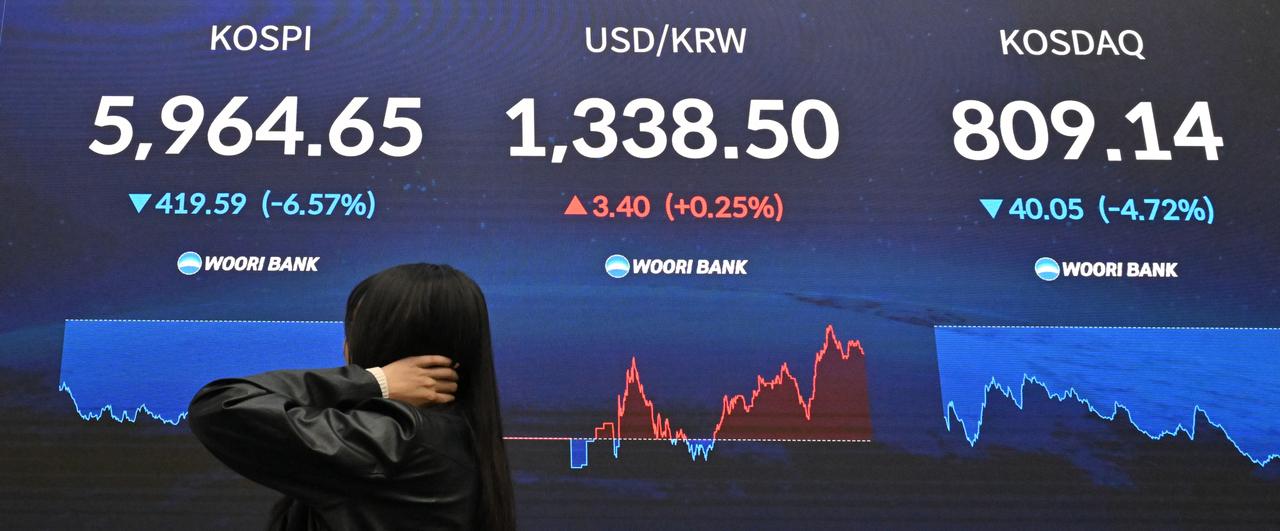
Key figures: memory chip maker SK Hynix shares fell 10% and Samsung Electronics shares fell 7.4% on the South Korean exchange, while TSMC shares fell roughly 2%.
| Figure | Value | Note | Claim |
|---|---|---|---|
| Memory chip maker SK Hynix, shares down | 10% | 4 | |
| Samsung shares, down | 7.4% | 4 | |
| TSMC, down roughly | 2% | 14 |
What happened
- Samsung Electronics dropped 7.4% on the South Korean exchange and the memory chip maker SK Hynix fell 10%.
- The South China Morning Post reported on Monday that CXMT had made good progress on a DRAM design that would boost memory density, and investors worry it could challenge Samsung, SK Hynix and Micron.
- Japan's Nikkei fell 1.8% and the Taiwan exchange lost almost 2%, with TSMC down by a similar amount.
- Tan said OpenAI's annualised revenue of $50bn at the end of September suggested a viable business model but gave little guarantee of long-term profitability.
Why it matters
- contradiction The Guardian's headline credits Tan, but its text names a CXMT report as the trigger the sell-off followed. A reader taking the headline at face value could read a memory-competition move as a verdict on AI funding.
- decision Memory competition and AI financing are separate exposures with different holders at risk. One Seoul session cannot support resizing either, so the choice between them waits on more evidence.
- constraint If a sizeable share of lab enterprise revenue is pilot spending, as Tan said, topline growth alone is a weak test of whether debt-funded AI buildouts pay back.
The pattern of losses points to the memory report as the larger driver in Korea. SK Hynix fell 10% while TSMC fell by about 2% [4][3], a gap of about 8 points [14]. Tan's comments were about AI investors in general, and in our view a remark that broad would hit the largest chip names alongside the memory makers. CXMT makes DRAM, the chips that store data other AI chips draw on [16], and the memory makers are the companies investors fear it could challenge [15]. The Guardian does not apportion the move between the two triggers.
The record is not clean. SoftBank, an OpenAI investor, lost 8.5% and Tokyo Electron, a chip equipment maker, fell 7.15% [5]. Neither is described as a memory chip maker, so the CXMT report does not obviously explain them.
The case for treating the casino line as the bigger story, and the CXMT item as a Korean sideshow, is that AI shares were already unsettled by concern that companies are spending heavily on AI infrastructure funded by debt [7]. The passages the Guardian quotes from Tan are about investor expectations, and none of them mention debt. "A lot of investors have no clue what they are investing in," Tan said at a conference in Singapore [8]. Of OpenAI, he said: "For now it's still losing money because they're spending a lot on training," [11]
On revenue quality, Tan said a sizeable portion of AI labs' enterprise revenue came from pilot projects [12]. His illustration was a child in a video arcade. "Your parents give you $10 of tokens, you finish it in 10 minutes and you haven't learned anything," he said [13].
Wall Street gave no clear signal. The Nasdaq composite slipped 0.4% on Monday and US futures pointed to a mixed open [6]. One session in Seoul cannot show whether debt-funded AI spending is under pressure or whether memory makers have a new competitor, and AI shares had been volatile in recent months before it [7].
What to watch
- Whether Micron, Nvidia, AMD and Broadcom fall in step when Wall Street opens, after futures pointed to a mixed open; a broad US slide would favor the AI-funding reading.
- Further detail from CXMT or other reporting on the DRAM architecture, since the Guardian relays a South China Morning Post report on it.
- New OpenAI revenue or profitability disclosures that test Tan's view of the $50bn annualised figure.
Clarity's read
What the record supports and how the coverage leans. The claims behind it follow.
Reality
- Evidence55
- Adoption
- Insufficient
- Hype gap
- Insufficient
- Incentives
- Insufficient
- Confidence50
Claim ledger
Ranked by verification strength, evidence, and original report placement.
- [1]
Shares in semiconductor companies fell on Tuesday after the boss of Broadcom compared many AI investors to 'casino' gamblers and Chinese memory chip maker CXMT said it had made good progress on a new chip architecture.
- [2]
South Korea's benchmark Kospi index tumbled 6.25% as investors dumped chip stocks.
- [3]
Japan's Nikkei fell 1.8% and the Taiwan exchange lost almost 2%, with TSMC down by a similar amount.
- [4]
Samsung Electronics shares dropped 7.4% on the South Korean exchange, while memory chip maker SK Hynix was down 10%.
- [5]
In Japan, chip equipment maker Tokyo Electron fell 7.15% while SoftBank Group, an OpenAI investor, lost 8.5%.
- [6]
US stock futures pointed to a mixed open on Wall Street after the Nasdaq composite slipped 0.4% on Monday; Micron slid 3.9% while Nvidia, AMD and Broadcom also fell.
- [7]
AI shares have been on a rollercoaster in recent months, amid concerns that companies are spending eye-watering amounts on AI infrastructure, funded by debt.
- [8]
'A lot of investors have no clue what they are investing in,' Tan said at a conference in Singapore, in comments reported by Bloomberg.
ReportedSupportedSource: Hock Tan, Broadcom chief executive, as reported by Bloomberg and relayed by the GuardianView cited source - [9]
Tan said such investors 'set very extreme expectations only to find out that it's almost like they are in a casino'.
- [10]
Tan said OpenAI's annualised revenues of $50bn at the end of September suggested a viable business model but offered little guarantee on long-term profitability.
- [11]
'For now it's still losing money because they're spending a lot on training,' Tan said, speaking of OpenAI.
- [12]
Tan noted that a sizeable portion of AI labs' enterprise revenue came from pilot projects.
- [13]
'Your parents give you $10 of tokens, you finish it in 10 minutes and you haven't learned anything,' Tan said, illustrating pilot-project spending with a video arcade.
- [14]
SK Hynix's 10% fall exceeded TSMC's fall of roughly 2% by about 8 percentage points.
- [15]
The sell-off came after the South China Morning Post reported on Monday that CXMT had made good progress on new DRAM architecture that would boost memory density; investors are worried it could challenge Samsung, SK Hynix and Micron, the world's biggest memory chip makers.
ReportedContestedSource: South China Morning Post report, as relayed by the GuardianView cited source - [16]
CXMT makes DRAM chips, which store the data that other AI chips draw on for their calculations.
Sources
1 independent publisher whose own reporting we read for this story.
- theguardian.comChip stocks slide after Broadcom boss likens AI investing to ‘casino’
1 article · October 13, 2026
Topics and entities
Follow any of these and your For You feed starts watching them — no settings page required.
Topics
- AI investment bubble debateFollow
- Memory chips and DRAMFollow
- Semiconductor stocksFollow