Oracle pillar from a Kibyra chapel wall ties the city to a regional knucklebone tradition
Turkish researchers report in Gephyra that a pillar found in 2024 at Kibyra carries replies from a 56-answer knucklebone oracle. Its verses sit closest to the Kremna copy, with slips the authors put down to stonemasons or local editing.
The Scientist · Science desk
Key figures: 56 possible answers carved in stone, each a short reply in Greek verse; 5 knucklebones thrown by each asker; 4 possible faces per bone, valued 1, 3, 4 or 6.
| Figure | Value | Note | Claim |
|---|---|---|---|
| Possible answers carved in stone, in Greek verse | 56 answers | 3 | |
| Bones thrown by each asker | 5 knucklebones | 2 | |
| Possible faces per bone | 4 faces | 15 |
What happened
- Each asker threw five knucklebones, and each bone could land on a face valued 1, 3, 4 or 6.
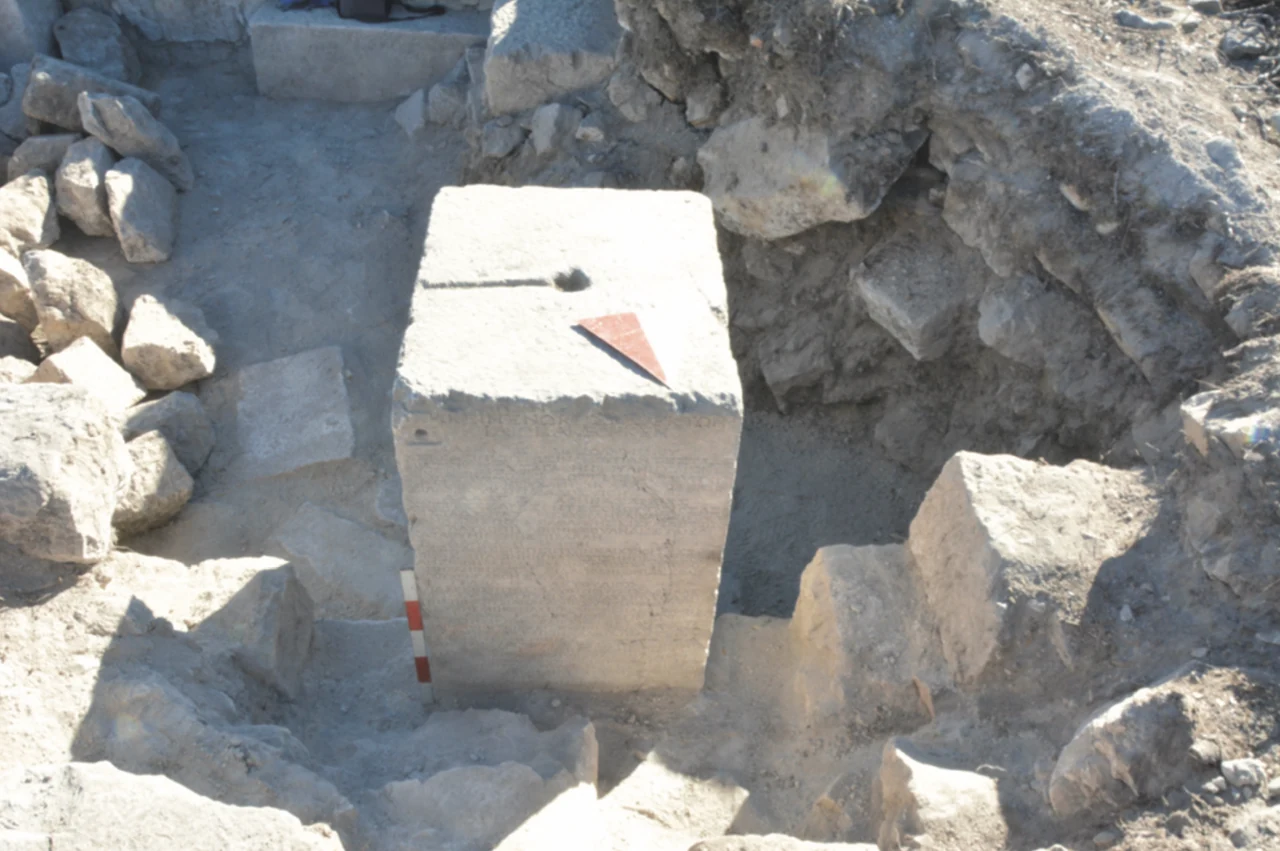
- The pillar is about 4 feet tall and carved on every side, and the researchers date it to the second or third century C.E.
- A partly lost dedication says someone paid for the oracle and for a statue of Hermes at their own expense.
Why it matters
- capability Scholars working on the reconstructed original now have another witness to test it against, including one reply placed differently from the other copies.
- constraint The slips cannot yet be sorted into mason's errors and editors' choices, because the yardstick is a reconstruction built from the sister copies.
- precedent If the donor was a market official, Kibyra's pillar would pair with the one at Termessos, but the upper block that would show it has not been found.
The count of 56 is the number of ways five four-faced bones can fall when order is ignored [15]. In the full oracle, every possible throw therefore had its own verse [3]. The thing this doesn't tell you is how many of those verses survive on the Kibyra pillar. Discover's report on the study does not say.
The verses are short and practical. The reply for five 4s says, in the authors' translation, "The sun has set, and deadly night has come upon us," and advises that it is better "neither to buy nor to sell" [4]. Discover reports that many of the carved messages tell the asker to stop rushing and wait, and one surviving reply says "it is not yet the time" [14]. Another warns "Do not put your hand into the mouth of a wolf" [14].
The case for a shared tradition is a textual comparison. Copies carved in other towns preserve largely the same answers, and from them scholars have pieced together the common text they all derive from [11]. The Kibyra text is closest to the one from Kremna, though it has slips of its own [11]. One answer has two words in reverse order and drops a phrase [12]. Another reply turns up at a different point in the sequence from where the other copies put it [13]. The researchers take that as a sign that Kibyra had its own editors [13].
We think the claim of participation is well supported. A local copy that tracks one sister text closely and departs from it in small, specific ways is what a copied tradition would produce. The condition is the yardstick. The slips are measured against a reconstructed original [12], and that original is itself built from the other copies [11]. The authors blame careless stonemasons or local editing for the grammatical mistakes and the lines that break the poem's rhythm [12]. The text alone cannot separate a tired mason from an editor.
Who used the oracle is a separate question. The region had no large oracle centers of its own, and pillars like this one answered everyday troubles such as illness, trade, travel and losses [7]. Earlier scholars suggest merchants were the main audience [8]. The Kibyra pillar was most likely moved into the chapel wall as building stone from the city's agora [6]. In the researchers' view the donor may have held a market office, as was the case with a comparable pillar at Termessos [10]. The donor's name was probably on the upper block. It has not been found [10].
What to watch
- Recovery of the missing upper block, which would test the guess that the donor was a market official.
- A published count of which of the 56 replies survive at Kibyra, and which sit in different positions from the other copies.
- Further copies from other southern Asia Minor towns, which would change the reconstructed original the slips are measured against.
Clarity's read
What the record supports and how the coverage leans. The claims behind it follow.
Reality
- Evidence58
- Adoption
- Insufficient
- Hype gap−5
- Incentives
- Insufficient
- Confidence55
Claim ledger
Ranked by verification strength, evidence, and original report placement.
- [1]
A study in Gephyra by Turkish researchers describes an oracle stone found in 2024 in a chapel wall at the ancient city of Kibyra, in what is now Turkey, and says it shows the city took part in a knucklebone oracle tradition shared across southern Asia Minor.
- [2]
Someone seeking advice from the oracle threw five knucklebones; each bone lands on one of four faces, valued at 1, 3, 4, or 6.
- [3]
The asker matched the combination of face values to one of 56 possible answers carved in stone, each a short reply in Greek verse.
- [4]
The reply for the throw where all five bones land on the face valued at 4 reads, in the authors' translation, "The sun has set, and deadly night has come upon us," and advises that it is better "neither to buy nor to sell."
- [5]
The Kibyra pillar stands about 4 feet tall and is carved on every side; the researchers date it to the second or third century C.E.
- [6]
The researchers say the pillar was most likely moved into the chapel wall as building stone from the city's agora, or marketplace.
- [7]
The region had no large, famous oracle centers of its own in this period; cities sometimes sent people to Klaros or Didyma to ask on the town's behalf, but pillars like this one answered everyday troubles like illness, trade, travel, and losses.
- [8]
Earlier scholars suggest merchants were the main audience for such pillars and that the idea may have spread from town to town as a fashion.
- [9]
A partly lost dedication on the Kibyra stone says that someone paid for the oracle and for a statue of the god Hermes, with its base and decorations, at their own expense.
- [10]
The donor's name was probably on the upper block, which has not been found; the researchers say the donor may have been a market official, as at a similar pillar in the city of Termessos.
- [11]
Stones in other towns across the region carried versions of much the same set of answers, and scholars have used them to reconstruct the shared original; the Kibyra text is closest to the one from Kremna, though it has slips of its own.
- [12]
Measured against the reconstructed original, the researchers blame careless stonemasons or local editing for grammatical mistakes and lines that break the poem's rhythm; in one answer, two words are swapped and a phrase is missing.
- [13]
Another Kibyra reply sits at a different position than in other copies, which the researchers take as a sign that Kibyra had its own editors.
- [14]
Many of the messages carved into the oracle stone tell the asker to stop rushing and wait; surviving replies include "it is not yet the time" and "Do not put your hand into the mouth of a wolf."
- [15]
Five bones with four possible faces each, counted as combinations without regard to which bone shows which face, give 56 distinct outcomes, the same number as the oracle's 56 answers.
Sources
1 independent publisher whose own reporting we read for this story.
- discovermagazine.comA Roman-Era Oracle Stone Turned Goat Knucklebone Throws Into Divine Advice
1 article · October 13, 2026
Topics and entities
Follow any of these and your For You feed starts watching them — no settings page required.
Topics
- Ancient divinationFollow
- ArchaeologyFollow
- EpigraphyFollow