A 30-minute hot bath lowered blood pressure more than the same time on a bike in 25 adults
UWA researchers found a 30-minute hot bath lowered blood pressure more than 30 minutes of cycling in 25 adults with overweight or obesity. The authors offer passive heat as an option for people who cannot exercise regularly and caution against reading it as better than exercise.
The Scientist · Science desk
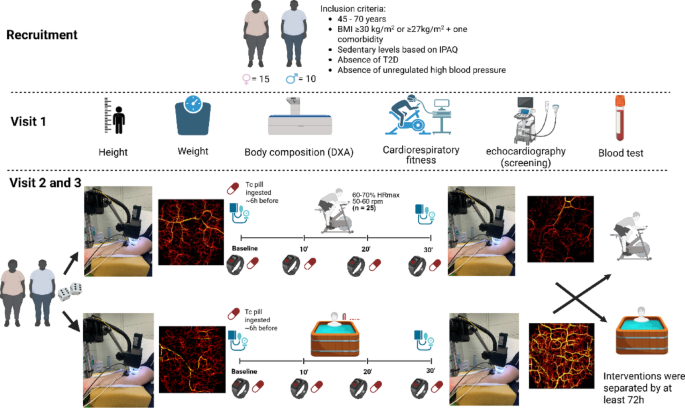
What happened
- The participants were aged 45 to 70, and each completed both sessions in random order, separated by at least 72 hours.
- In one session they were immersed in 104-degree-Fahrenheit water for 30 minutes; in the other they rode a stationary bike at moderate intensity for the same time.
- Imaging of the skin showed larger increases in vessel diameter, blood flow and flow velocity after the bath than after cycling, and more vessels with detectable flow.
- Core body temperature rose more and both systolic and diastolic pressure fell more after the bath, while cycling produced the stronger heart rate response.
Why it matters
- constraint The data cover the immediate effect of one session, so lasting blood pressure benefit, the outcome a clinician would act on, is out of this design's reach.
- decision Exercise improves vessel health through regular practice, so a fair test of baths would set repeated baths against a regular exercise program, not one bath against one bike ride.
- precedent Earlier repeated-immersion work was in healthy young adults; this study extends the single-session result to older adults with overweight or obesity but leaves the repeated-bath question open.
The crossover design is the strongest part of this study. Because every volunteer supplies both conditions, age, weight and baseline vessel health cancel out of the comparison, and 25 people yield 50 sessions [14]. Random order and the gap of at least 72 hours between sessions [2] guard against the first session colouring the second.
The authors' explanation for the skin result is direct heating of the skin combined with the rise in whole-body temperature [7]. In Discover's account, a warming body widens its vessels so heat can leave through the skin [8]. The water was 104 degrees Fahrenheit, about 40 degrees Celsius [15]. That mechanism fits the larger rise in core temperature in the bath arm.
The vessel result has a narrower comparator than it first appears. Discover says the skin changes exceeded those seen after certain forms of exercise [16], and this study tested one form: 30 minutes of stationary cycling at moderate intensity [3].
The thing this doesn't tell you is how big the blood pressure difference was. Discover's account gives the direction but not the figures in millimetres of mercury, so we cannot judge whether the gap matters clinically.
The motivating gap is large: around 31 percent of adults worldwide do not meet recommended physical activity levels [11]. We think a single-session result like this one is enough to justify the longer trial. Advice to those adults has to wait for it.
What to watch
- A repeated-bath trial in the same age group that reports blood pressure after several weeks of baths.
- The paper's own blood pressure figures in millimetres of mercury, which would show whether the difference is clinically meaningful.
- Any head-to-head trial of repeated baths against a regular exercise program in people who can exercise.
Clarity's read
What the record supports and how the coverage leans. The claims behind it follow.
Reality
- Evidence40
- Adoption
- Insufficient
- Hype gap+25
- Incentives
- Insufficient
- Confidence45
Claim ledger
Ranked by verification strength, evidence, and original report placement.
- [1]
Researchers from the University of Western Australia compared the effects of a hot bath with moderate exercise in people with overweight or obesity, in a study published in the European Journal of Applied Physiology.
- [2]
The study tested 25 adults aged 45 to 70 with overweight or obesity; each completed two sessions in random order, separated by at least 72 hours.
- [3]
In one session participants were immersed in 104-degree-Fahrenheit water for 30 minutes; in the other they cycled on a stationary bike for the same time at moderate intensity.
- [4]
The researchers monitored heart rate, body temperature and blood pressure, and used non-invasive optical coherence tomography to examine tiny blood vessels in the skin.
- [5]
Hot water immersion led to greater increases in skin blood vessel diameter, blood flow and blood flow velocity than cycling, and more tiny vessels showed detectable blood flow after bathing.
- [6]
Participants had a greater rise in core body temperature and a larger reduction in both systolic and diastolic blood pressure after the bath, while cycling produced a stronger heart rate response.
- [7]
The researchers suggest the greater blood vessel response to bathing may come from a combination of direct skin heating and the overall rise in body temperature.
- [8]
As the body warms up, blood vessels widen, helping release heat through the skin.
- [9]
The findings come from a relatively small experiment examining the immediate effects of one session; the authors note the results do not show whether regular hot baths can produce lasting improvements in blood pressure or cardiovascular health.
- [10]
The research team cautions against interpreting the results as evidence that hot baths may be better than exercise, and says passive heat therapy could offer a complementary way to stimulate blood vessels, especially for people who cannot exercise regularly.
- [11]
Around 31 percent of adults worldwide do not meet recommended physical activity levels.
- [12]
Previous studies in healthy young adults linked repeated hot water immersion to improved blood vessel function and reduced arterial stiffness; whether the benefits extend to older adults with cardiovascular risk factors such as obesity was less clear.
- [13]
Regular exercise is known to improve blood vessel health.
- [14]
Twenty-five participants each completing two sessions gives 50 sessions in total.
- [15]
104 degrees Fahrenheit is about 40 degrees Celsius.
- [16]
According to the study, a 30-minute soak can trigger changes in the tiny blood vessels beneath the skin that exceed those seen after certain forms of exercise.
Sources
1 independent publisher whose own reporting we read for this story.
- discovermagazine.comTaking a Short, Hot Bath May Lower Blood Pressure More Than Moderate Exercise
1 article · October 13, 2026
Topics and entities
Follow any of these and your For You feed starts watching them — no settings page required.
Entities
- Optical coherence tomographyFollow
- European Journal of Applied PhysiologyFollow
- Discover MagazineFollow
- University of Western AustraliaFollow