InvestIndependently confirmed4 publishers3 min readPublished Updated
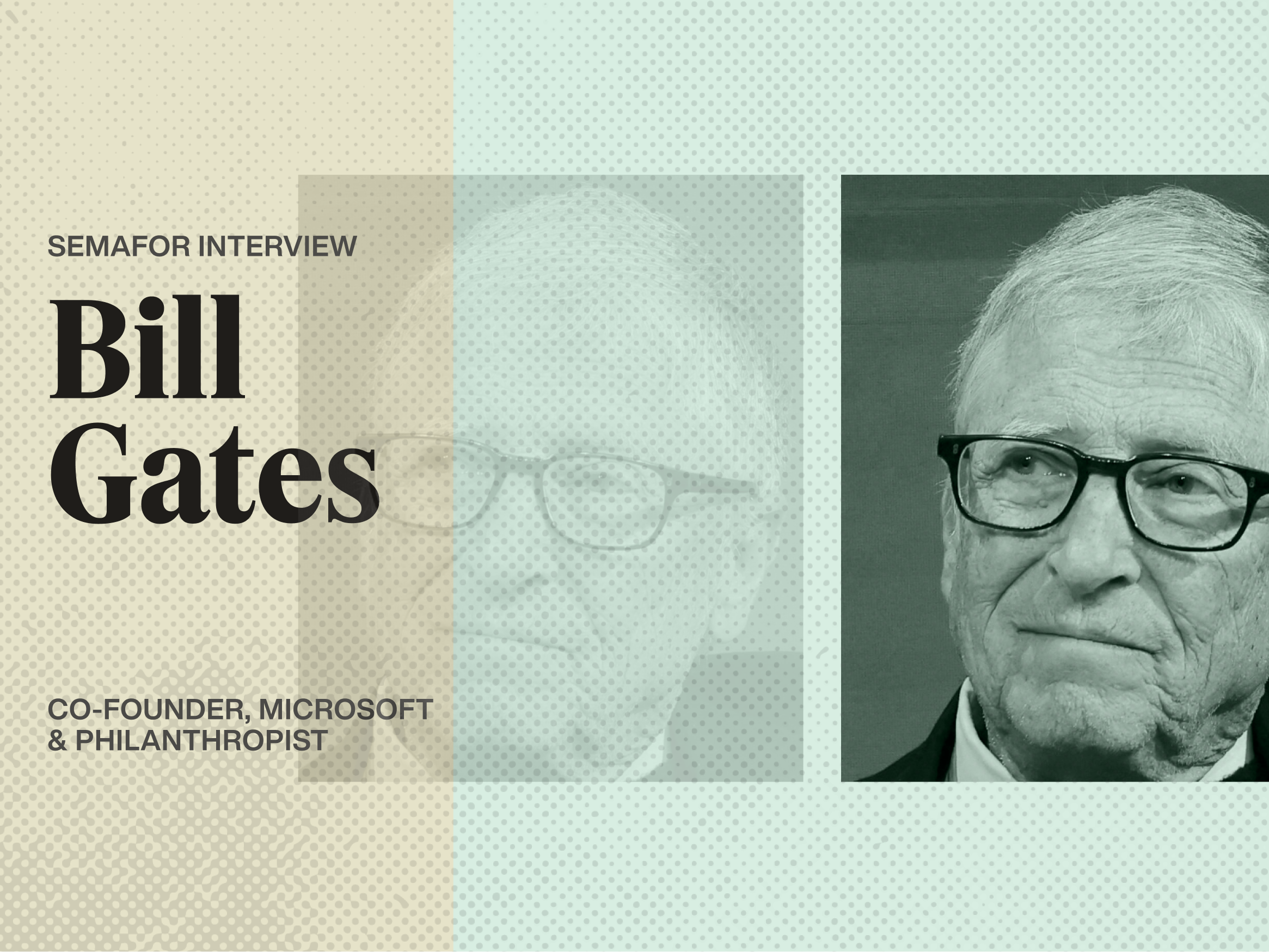
Gates now wants firms taxed on their AI use. Nobody has defined the base.
His reversal from "manageable" to "insane" hands legislatures a fiscal instrument. But a levy on use is paid by adopters, and the only measured job damage so far sits at entry level.
The Investor · Invest desk
What happened
- Gates now predicts economic catastrophe and far fewer jobs than exist today, having written three years ago that the transition would be bumpy but manageable.
- His blog post, published Wednesday, asks political and technology leaders for two things: new worker protections, and taxes on companies based on their use of AI.
- He says breadth, not speed, is the problem, and that there is not a job that AI leaves unaffected.
Why it matters
- decision Anyone who picks up the proposal has to choose a base before it can be scored, and every candidate base sends the bill to AI buyers rather than to the labs selling the models.
- contradiction The measured damage in the record is a hiring gap in one age band, and one tracker finds nothing at all, so a levy on economy-wide AI consumption is aimed at a harm that has not yet been observed...
- exposure With its AI chief privately in Gates's camp and its president publicly in the jobs-get-created camp, Microsoft has no single answer to give a legislator who asks which it believes.
The ask is one clause long, and it does not say what it taxes. Gates wants companies taxed according to their use of AI [4]. Use is not a defined base. Compute purchased, model seats licensed, tokens billed, or headcount reduced against a baseline produce different revenue and different avoidance routes. Whichever is picked, the incidence points the same way: a levy on use is remitted by the buyer, not the seller, so the bank and the retailer pay while the lab's revenue line is untouched [20]. That is not a windfall tax on frontier developers. It is a consumption tax on adoption, and it is legible to a finance ministry precisely because use is invoiced.
The evidence does not yet fit the base either. The IMF's estimate that AI could affect nearly 40% of jobs globally and 60% in advanced economies is an exposure count, not a casualty count [14]. Stanford found no economy-wide displacement but a 19% employment gap for 22-to-25-year-olds in exposed occupations, arriving mostly through hiring that did not happen [15]. Yale's Budget Lab has not found a clear AI footprint in the labour market at all [16]. Gates concedes his warning is a forecast rather than a reading of today's topline employment data [17]. The one harm anybody has measured therefore sits at the entry level [18], and a tax on corporate AI consumption does nothing for a 23-year-old who was never hired. Wage subsidies and apprenticeship rules reach that person. A use tax reaches procurement.
The silence he complains about is also not uniform. Gates says he is "deafened by the silence" and in shock at being first to call this insane [3], while also saying Mustafa Suleyman privately holds the same view [10]; Brad Smith made the orthodox case in June that AI will displace some jobs even as it creates others [13]. Those two hold titles at the same company [19], so the largest AI vendor is carrying both readings and cannot bring one position to a hearing. Demis Hassabis has put forward something more specific than a memo: an industry-funded, federally overseen standards body modeled partly on FINRA, testing frontier models before release and able to coordinate a slowdown [11].
The durable part of Gates's argument is not the job count, it is the politics. He expects the reaction to disappearing jobs to make "the data center thing look like nothing" [9], and he says virtually all the fixes require governments to play a role [7]. On that reading, a use tax is a premium paid for the industry's licence to keep operating, which is why it could attract support from people who reject the labour forecast underneath it. The weakest part sits next door in the same interview: his claim that bioterrorism risk is now 50 times natural pandemic risk [8] arrives with no method attached and no second name behind it.
What to watch
- Whether any legislature drafting from Gates's line defines "use" as compute, seats, tokens, or reduced headcount, since each base produces a different payer.
- Whether Suleyman or Smith puts a position on the record, rather than Gates characterising Microsoft's private view for them.
- Whether the Yale Budget Lab or Stanford figures move in the next reading, which is the only test of Gates's forecast that exists.
Clarity's read
What the record supports and how the coverage leans. The claims behind it follow.
Reality
- Evidence55
- Adoption
- Insufficient
- Hype gap+40
- Incentives45
- Confidence60
Perspective Coverage
4 publishers- Builder
- Builder 21%
- Operator
- Operator 49%
- Investor
- Investor 30%
Claim ledger
Ranked by verification strength, evidence, and original report placement.
- [1]
Three years ago Gates wrote that the coming "bumpy" AI job disruption would lead to a "manageable" transition and that the technology would help people work efficiently.
- [2]
Gates now says AI will wreak economic catastrophe, with "far fewer" jobs than exist today, citing the speed of AI's advancements and what he calls a non-existent response from government and tech leaders.
- [3]
Gates said: "I am in a state of shock that I'm sort of the first one saying, 'This is crazy. This is insane'... I'm just deafened by the silence."
- [4]
In a blog post published Wednesday, Gates asks technology and political leaders to respond more urgently to AI threats, namely to create new policies to protect workers and to tax companies based on their use of AI.
- [5]
Gates said breadth rather than speed is what worries him: "There isn't a job that isn't affected," predicting that in the majority of occupations humans will eventually be "vastly inferior to the AI doing the job."
- [6]
Gates told Semafor that AI has crossed dangerous thresholds in biology, cybersecurity, white-collar work, and human relationships.
ReportedSupportedSource: Bill Gates, interview with Semafor2 sources— create a free account to open themView cited source - [7]
Many of the risks Gates outlines are specific to richer, Western countries, and Gates said virtually all of the fixes will require governments to play a role.
- [8]
Gates said the blog post is the first of several planned essays, including one with deeper analysis of biological risks, and said "The bioterrorism risk is 50 times the natural pandemic risk now."
- [9]
Gates asked "What is the backlash going to be as these jobs go away?" and said "It'll make the data center thing look like nothing."
- [10]
Gates said some technologists privately agree with his current stance, including Microsoft AI CEO Mustafa Suleyman, whose 2023 book The Coming Wave argued society was unprepared for AI's changes.
- [11]
Google DeepMind co-founder Demis Hassabis recently proposed a federally overseen frontier-AI standards body modeled partly on FINRA, funded largely by industry and empowered to test advanced models before release, which he said could eventually be made mandatory and coordinate a slowdown among frontier labs.
- [12]
In 2023 Gates, Suleyman, Hassabis and hundreds of other tech and policy leaders signed a statement saying the risk of extinction from AI should be treated as a global priority alongside pandemics and nuclear war.
- [13]
Microsoft President Brad Smith wrote in June that AI "will displace some jobs, even as it creates others" and that "when technology increases supply, human ambition often generates more demand."
- [14]
The IMF estimates AI could affect nearly 40% of jobs globally and 60% in advanced economies.
- [15]
Stanford researchers found no economy-wide displacement but a 19% employment gap for 22-to-25-year-olds in exposed occupations, largely through reduced hiring.
- [16]
Yale's Budget Lab has yet to find a clear AI-related labor-market footprint.
- [17]
Gates acknowledged that his warning is a forecast, not a reading of today's topline employment data.
- [18]
In the research cited, the only measured employment damage is confined to one age band, while the larger figures describe exposure rather than realised job loss.
- [19]
The two named executives on opposite sides of the AI jobs question, Suleyman and Smith, hold senior titles at the same company, Microsoft.
- [20]
A tax assessed on companies' use of AI is remitted by the deployers and buyers of AI systems rather than by the labs selling them, leaving vendor revenue unaffected by the levy itself.
Sources
4 independent publishers whose own reporting we read for this story.
- cnbc.comBill Gates warns of economic upheaval from AI
1 article · August 26, 2026
- fortune.comBill Gates fears world leaders are unprepared for 3 major AI risks: ‘Stunted’ child development; emboldened criminals; and vanishing jobs for Gen Z
3 articles · August 26, 2026
- qz.comBill Gates warns the world isn't ready for the AI upheaval
1 article · August 26, 2026
- semafor.com'This is crazy. This is insane': Bill Gates has changed his mind about AI and jobs
1 article · August 26, 2026
Topics and entities
Follow any of these and your For You feed starts watching them — no settings page required.