ProductNot yet confirmed elsewhere1 publisher2 min readPublished
IDC expects PC prices to stay above 2025 levels after memory supply eases
IDC projects average PC selling prices up 18.3% in 2026 after Q3 shipments fell 20.1%, according to TechRepublic's report on its figures. The 18.3% covers 2026 only, and IDC ties part of the Q3 drop to early stocking, so 2027 budgets need a higher baseline but no assumed second rise.
The Product Desk
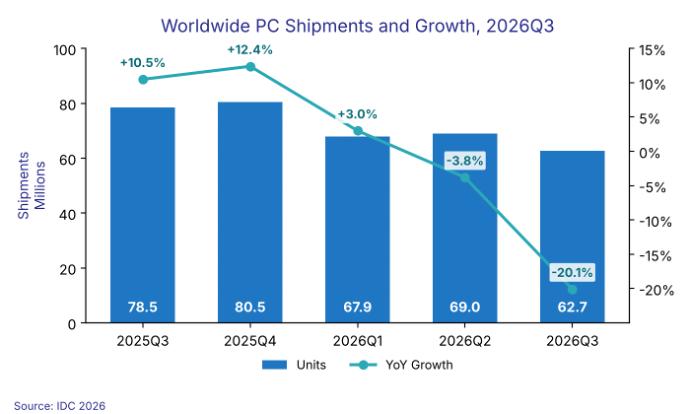
Key figures: IDC projects average PC selling prices will rise 18.3% in 2026. Preliminary third-quarter 2026 shipments were approximately 62.7 million units, down 20.1% year over year. IDC's June 2 outlook forecast an 11.3% decline in 2026 shipments.
| Figure | Value | Note | Claim |
|---|---|---|---|
| Average PC selling price rise, 2026 projection | 18.3% | 2 | |
| Third-quarter units, about | 62.7 million | 3 | |
| Third-quarter shipment fall | 20.1% y/y | 1 | |
| 2026 shipments, forecast | 11.3% decline | 7 |
What happened
- IDC's Oct. 8 report put preliminary third-quarter shipments at about 62.7 million units, against 78.5 million a year earlier.
- Lenovo shipments fell 22.6%, Dell 25% and HP 30.9% year over year, so each of the three named makers fell by more than the market as a whole.
- IDC's June 2 outlook had already forecast an 11.3% decline in worldwide PC shipments for 2026.
- IDC expects PC prices to remain above 2025 levels even as memory supplies eventually improve.
- IDC's memory analysis says AI infrastructure demand is competing with consumer devices for DRAM and NAND capacity.
Why it matters
- decision A 2027 refresh line has to start above 2025 unit prices, yet the only sourced price number is a 2026 industry average, so the budget owner has to build the range from live quotes.
- exposure A fleet standardised on a low-cost configuration is the most exposed if manufacturers trim those options, as TechRepublic says they may, and a market average would not show it.
- constraint Deferral has little behind it: IDC's June outlook expects no meaningful memory relief before the end of 2027, and TechRepublic's Micron coverage says tightness could run through 2028.
Whoever owns the refresh budget has to put one number on a line: what a laptop costs in 2027. The two figures in circulation, 20.1% [1] and 18.3% [2], are easy to read as one finding. They answer different questions.
What teams tell themselves about a 20% drop is that buyers balked at the price. What IDC says happened is narrower. It attributed part of the downturn to manufacturers and distributors buying inventory earlier in 2026, ahead of anticipated memory-related price increases. That pulled shipments into the first half and left the third quarter without its usual seasonal boost [6].
The count also covers PCs shipped to distribution channels or end users, not retail purchases alone [5]. On that definition the quarter shipped 15.8 million fewer units than a year earlier [17]. IDC assigns part of that gap to purchases made in the first half [6].
The price figure has limits of its own. The 18.3% is an industrywide average, not an increase IDC expects for every computer [10]. Individual prices will keep depending on manufacturer pricing, configurations, inventory levels and retailer promotions [12]. TechRepublic's report does not include a 2027 price figure, so carrying 18.3% forward into 2027 would be an assumption IDC has not made in the material reported.
In our view, configuration is where a standardised fleet will see the effect first. TechRepublic says manufacturers may respond by adjusting memory configurations or limiting lower-cost options [18]. A purchase order written around one entry-level model is more exposed to that than an average across the whole market.
We'd sort each device group on two questions. The first is whether the machine still does its job and still receives security updates, which is where TechRepublic's checklist for buyers starts [15]. The second is whether the replacement date is fixed by something outside IT's control, such as a lease.
- Adequate machine, flexible date: hold and watch quotes. TechRepublic says buyers in this position have more flexibility to monitor pricing [14]. - Adequate machine, fixed date: ask for quotes early on today's configuration and the next tier up, and budget above 2025 unit prices [9]. - Failing machine, either date: buy now. In TechRepublic's words, "comparing current configurations and discounts may be more useful than waiting for an uncertain market recovery" [14].
The cost in the first two cells is price risk that sits with you. The cost in the third is paying an elevated price, and the only near-term relief the report points to is retail discounts and excess inventory [13].
What to watch
- Whether IDC revises its June 2 forecast of an 11.3% shipment decline for 2026 now that the third-quarter figures are in, and whether it publishes a 2027 price figure.
- Whether Lenovo, HP and Dell change base memory configurations or drop entry-level models in their next fleet price lists.
- Whether retail discounts and excess inventory show up in fleet quotes, which TechRepublic names as the remaining source of relief.
Clarity's read
What the record supports and how the coverage leans. The claims behind it follow.
Reality
- Evidence55
- Adoption
- Insufficient
- Hype gap+8
- Incentives
- Insufficient
- Confidence55
Claim ledger
Ranked by verification strength, evidence, and original report placement.
- [1]
IDC's preliminary figures show global PC shipments fell 20.1% year over year in the third quarter of 2026.
- [2]
IDC projects average PC selling prices will rise 18.3% in 2026.
- [3]
IDC's Oct. 8 report put preliminary worldwide PC shipments at approximately 62.7 million units in the third quarter of 2026, compared with 78.5 million units a year earlier.
- [4]
Lenovo's third-quarter shipments fell 22.6% year over year, HP's fell 30.9%, and Dell's fell 25%.
- [5]
IDC's figures measure PCs shipped to distribution channels or end users, rather than retail purchases alone.
- [6]
IDC attributed the downturn in part to manufacturers and distributors purchasing inventory earlier in 2026 ahead of anticipated memory-related price increases, which shifted shipments into the first half and left the third quarter without its usual seasonal boost.
- [7]
In its June 2 PC market outlook, IDC forecast an 11.3% decline in worldwide PC shipments for 2026.
- [8]
IDC's June 2 outlook warned that meaningful relief from memory shortages was unlikely before the end of 2027.
- [9]
IDC expects PC prices to remain above 2025 levels even as memory supplies eventually improve.
- [10]
IDC's price projections reflect industrywide averages rather than increases expected for every individual computer.
- [11]
In its memory market analysis, IDC explained that growing demand for AI infrastructure is competing with consumer devices for DRAM and NAND memory capacity.
- [12]
Individual PC prices will continue to depend on manufacturer pricing, configurations, inventory levels and retailer promotions.
- [13]
Retail discounts and excess inventory could still provide opportunities for buyers.
- [14]
For buyers who need a computer immediately, comparing current configurations and discounts may be more useful than waiting for an uncertain market recovery, while those whose existing machines still perform adequately have more flexibility to monitor pricing.
- [15]
TechRepublic's checklist for buyers begins with current performance: whether the computer handles everyday tasks reliably and continues to receive security updates.
- [16]
TechRepublic's earlier coverage of Micron's memory shortage warning examined how AI-driven demand could keep memory and storage supplies tight through 2028.
- [17]
Third-quarter 2026 shipments were about 15.8 million units below the year-earlier quarter.
- [18]
PC manufacturers may respond to rising component costs by adjusting memory configurations or limiting lower-cost options.
Sources
1 independent publisher whose own reporting we read for this story.
- techrepublic.comPC Prices Could Stay High Through 2027: What Buyers Should Know
1 article · October 12, 2026
Topics and entities
Follow any of these and your For You feed starts watching them — no settings page required.
Topics
- Memory chip shortageFollow
- AI infrastructure demandFollow
- PC MarketFollow