Hyundai's Pune plant takes India capacity to 994,000 vehicles, 6,000 short of a million
Hyundai inaugurated its Pune plant at 170,000 units a year, taking India capacity to 994,000 with Chennai's 824,000. Pune opens with the Venue, a model Chennai already built, so the volume to fill it has to come from exports and EVs.
The Investor · Invest desk
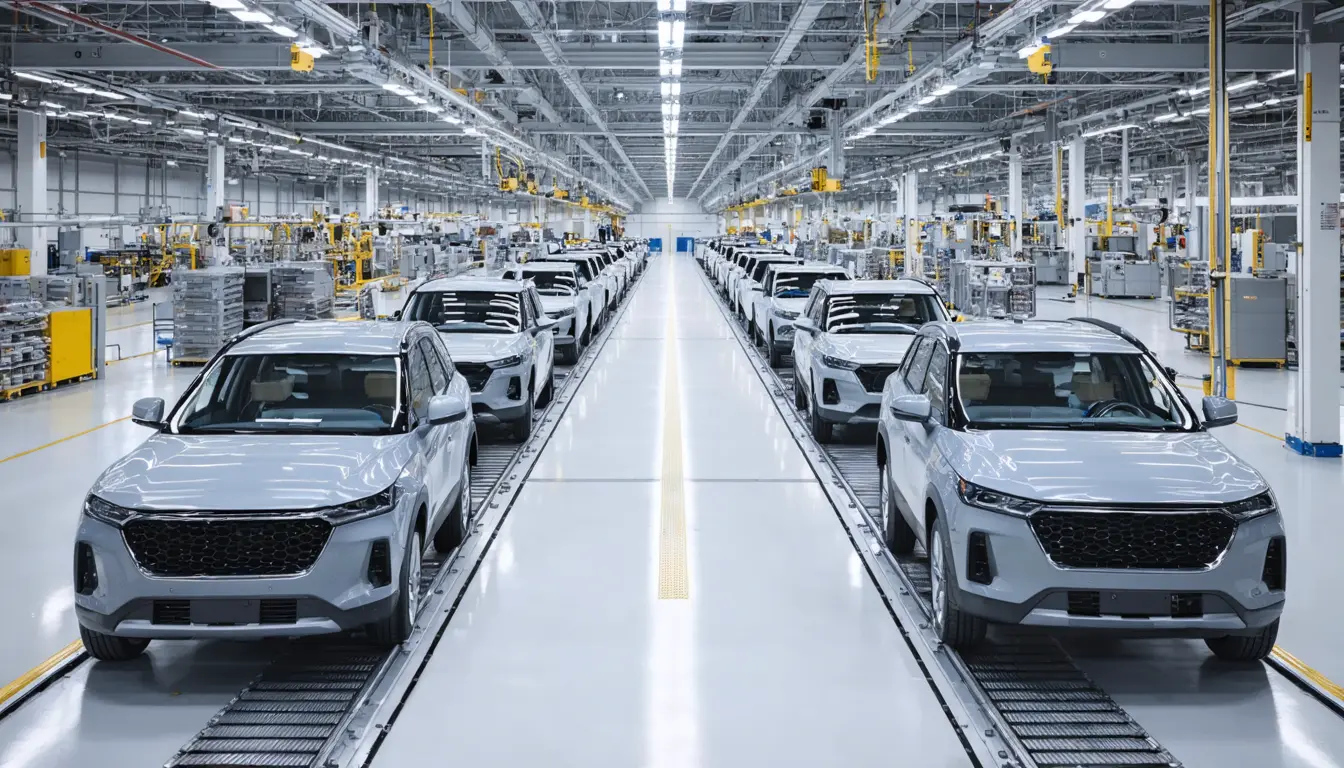
Key figures: Chennai plus Pune at 250,000 units is 1,074,000 units a year of Hyundai India capacity; Chennai plus Pune at 320,000 units is 1,144,000 units a year; Hyundai's two Chennai plants together produce 824,000 units.
| Figure | Value | Note | Claim |
|---|---|---|---|
| India capacity, Chennai plus Pune at 250,000 | 1,074,000 units a year | 15 | |
| Chennai plus Pune at 320,000 | 1,144,000 units a year | 16 | |
| Chennai's two plants | 824,000 units | 3 |
What happened
- The plant sits on the site of a former General Motors factory that Hyundai acquired in 2023.
- Opening output is led by the second-generation Venue compact SUV, for India and for export to more than 30 countries in Latin America, Africa and the Middle East.
- Hyundai Motor India plans to lift exports to 30 percent of its total production by 2030.
Why it matters
- cost Hyundai pays for a 20.6% larger Indian footprint before the EV and export demand behind it is shown, and idle-plant cost falls on Hyundai if either sells below plan.
- constraint The million-unit label holds only after the ramp, so a slip in the two-year path to 250,000 leaves India capacity under the figure in the Korea Herald's headline.
- exposure Hybrids are due at Pune only eventually, so until then the export plan rests on a single named model.
Chennai's two plants produce 824,000 units a year [3] and Pune opens at 170,000 [2], so the total is 994,000, short of a million by 6,000 [14]. The round number arrives with the ramp. Pune at 250,000 within two years makes 1,074,000 [15], and Pune at 320,000 by 2030 makes 1,144,000 [16]. Against Chennai's base, that is a 20.6% addition at launch [17] and 38.8% at the 2030 figure [18].
"Since the launch of the Hyundai Santro, India has become a key pillar of Hyundai's global success," Chung Euisun, Hyundai Motor Group's executive chair, said in his opening speech [13]. Last year the group sold 852,164 units in India, an 18.7% share behind Maruti Suzuki [6], against 1.42 million units of annual group capacity once Kia's Anantapur plant is counted [5]. That is 60.0% [19]. If exports sit on top of that sales figure, utilization is higher. The group projects capacity above 1.5 million after 2028 [5].
The export case has less behind it. The Venue leads Pune's opening output [7]. It has sold 802,221 units in India from its 2019 launch through May [8], and the Herald puts global cumulative sales at past 850,000 [8]. If the two figures share a date, overseas Venue sales are at least about 47,800 units [21], or 5.6% of the total [22].
Hyundai Motor India wants exports at 30% of total production by 2030 [11]. On Chennai's 824,000 plus Pune's 320,000, and assuming output reaches capacity, that is 343,200 vehicles a year [20]. The Indian subsidiary has exported more than 4 million passenger vehicles since 1999 [12], so the export business exists. The Herald did not disclose a current annual export figure, so the distance to 30% cannot be measured from its numbers.
Pune taking over Venue production frees Chennai's lines for EV output [9], and a dedicated compact electric SUV for India is due early next year [10], against a government push for 30 percent EV sales by 2030 [9]. We think the first 170,000 units at Pune are mostly existing volume moved, and that Chennai's EV lines decide whether 994,000 gets used. The counter-case is that a second-generation Venue, sold to more than 30 countries [7], adds volume by itself. We would be wrong if Pune reaches 250,000 within two years while Chennai keeps its lines full with EVs.
What to watch
- Pune's output against the 250,000-unit target within two years, and whether Chennai's freed lines fill once the compact electric SUV launches early next year.
- Hyundai Motor India's annual export volume, which would show how far the share sits from the 30 percent goal for 2030.
- A date for hybrid models at Pune, the first second product named for the plant.
Clarity's read
What the record supports and how the coverage leans. The claims behind it follow.
Reality
- Evidence55
- Adoption60
- Hype gap+15
- Incentives
- Insufficient
- Confidence60
Claim ledger
Ranked by verification strength, evidence, and original report placement.
- [1]
Hyundai officially inaugurated the Pune plant on a Wednesday in a ceremony attended by Hyundai Motor Group Executive Chair Chung Euisun, Hyundai Motor CEO Jose Munoz and senior Indian officials including Maharashtra Chief Minister Devendra Fadnavis.
- [2]
The Pune plant begins with an initial annual capacity of 170,000 units, with plans to ramp up to 250,000 units within two years and 320,000 by 2030.
- [3]
Hyundai's two Chennai plants together produce 824,000 units; with Pune, Hyundai's annual capacity in India approaches 1 million.
- [4]
The Pune facility is built on the site of a former General Motors plant that Hyundai acquired in 2023.
- [5]
Together with Kia's Anantapur facility, Hyundai Motor Group's overall capacity in India stands at 1.42 million units annually and is projected to surpass 1.5 million units after 2028.
- [6]
Last year Hyundai Motor Group sold 852,164 units in India, securing 18.7 percent market share as the second-largest automaker behind Maruti Suzuki.
- [7]
Pune's initial output is led by the second-generation All-New Venue compact SUV, targeting the domestic market and export to over 30 countries across Latin America, Africa and the Middle East; hybrid models will eventually be added to the lines.
- [8]
Since its 2019 launch the Venue posted 802,221 sales in India through May this year, and overseas shipments increased global cumulative sales to past 850,000 units.
- [9]
By taking over Venue production, the Pune plant frees up Chennai's lines to accelerate EV output, aligning with the Indian government's push for 30 percent EV sales by 2030.
- [10]
Hyundai plans to launch a dedicated compact electric SUV tailored for the Indian market early next year.
- [11]
Hyundai Motor India plans to lift its export share to 30 percent of total production by 2030.
- [12]
Hyundai's local subsidiary has surpassed 4 million cumulative passenger vehicle exports since 1999, and its Chennai complex shipped more than 3.7 million units across 150 countries through July 2025.
- [13]
Chung said in his opening speech: "Since the launch of the Hyundai Santro, India has become a key pillar of Hyundai's global success."
- [14]
Chennai plus Pune at launch is 994,000 units a year, 6,000 short of 1,000,000.
- [15]
Chennai plus Pune at 250,000 units is 1,074,000 units a year.
- [16]
Chennai plus Pune at 320,000 units is 1,144,000 units a year.
- [17]
Pune's initial 170,000 units are a 20.6% addition to Chennai's 824,000.
- [18]
Pune's 2030 figure of 320,000 units is a 38.8% addition to Chennai's 824,000.
- [19]
Last year's group sales of 852,164 units equal 60.0% of the group's 1.42 million units of annual capacity.
- [20]
If production reaches capacity (Chennai 824,000 plus Pune 320,000 = 1,144,000), a 30% export share is about 343,200 vehicles a year.
- [21]
If both Venue figures share a date, overseas Venue sales are at least about 47,800 units, because the global figure is a floor ('past 850,000').
- [22]
That floor of about 47,800 units is at least 5.6% of the Venue's global cumulative sales.
Get this ledger inside ChatGPT. Ask about any of our stories and the answer brings its figure, each claim’s verdict and the sources. Free, no account.
Sources
3 independent publishers whose own reporting we read for this story.
- en.sedaily.comHyundai Opens Third India Plant, Pledges $15.5 Billion Through 2032
1 article · October 14, 2026
- en.yna.co.krHyundai Motor expands production capacity in India
1 article · October 14, 2026
- koreaherald.comHyundai nears 1 million vehicle capacity in India with new Pune plant
1 article · October 14, 2026
Topics and entities
Follow any of these and your For You feed starts watching them — no settings page required.
Topics
- Indian auto marketFollow
- Electric VehiclesFollow
- Automotive manufacturingFollow