InvestNot yet confirmed elsewhere1 publisher2 min readPublished
Hyundai Engineering's modular steel joint passes the seismic verification Korea has required since May 2024
Hyundai Engineering won Korean Society of Steel Construction certification for an H-beam modular joint that held at 4% story drift, twice the 2% required. The tested frame had two stories, so the high-rise case rests on a stacking trial at the company's own test facility.
The Investor · Invest desk
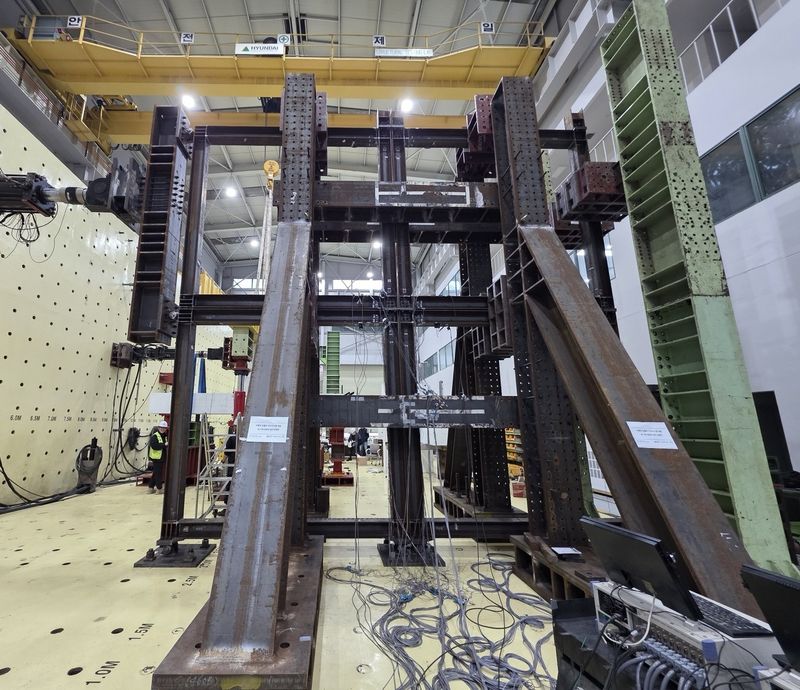
Bar comparison of story drift. Hyundai Engineering's modular steel joint kept its performance with no structural damage or strength loss at 4% story drift. The current Korean Design Standard requires a maximum of 2%. The test used a full-scale two-story frame.
Story drift, cyclic loading test on a full-scale two-story frame In % story drift
| Item | Value | Claim |
|---|---|---|
| Hyundai joint, held without damage | 4% story drift | 4 |
| Korean Design Standard requirement | 2% story drift | 4 |
What happened
- Korea's steel seismic standards, revised in May 2024, bar new joint technologies from actual projects until the society, designated by the transport ministry, verifies them.
- Hyundai Engineering passed cyclic loading tests on two or more identical specimens and then a technical review.
- The design uses standardized, off-the-shelf H-beams as primary members, and the company says that cut costs and steadied material supply.
- A two-way alignment guide absorbs errors within a set range in both horizontal directions as cranes lift modules into place.
- A horizontal bolting method lets workers fasten bolts from the front, where earlier practice meant fastening them vertically in cramped spaces inside ceilings or columns.
Why it matters
- decision Hyundai Engineering is directing the certification at data centers and industrial buildings first, so engineering and sales effort goes there and no high-rise project is on its stated list.
- precedent Rival builders with a newly developed steel joint face the same verification, and Hyundai Engineering's 4% result gives their test data a number to be compared with.
- exposure The assembly-time saving is Hyundai Engineering's own statement. On an illustrative five-day job, a cut of more than 20% means under four days, and the case for the horizontal bolting method stands on that figure.
The 4% figure is a measurement on one frame, and the frame is small next to the buildings the design is meant to compete in. The incumbent approach, built-up rectangular steel tube members cut and welded from plate, has mainly been used in modular buildings of medium height or taller [12]. Stacked construction was verified at H-Modular Lab, the full-scale facility Hyundai Engineering and Hyundai Steel built together in November 2024 [7]. The company did not disclose the stack height tested there, a maximum building height for the system, a percentage cost saving or a named project.
Hyundai Engineering said the simplified structure, with building loads transferring directly to the columns, reduced force concentration in specific areas and leaning to one side [10]. The structural safety verification was conducted with researchers from the Korean Society of Steel Construction [11], the body that certified the system [1].
The company's case for the commercial side is speed on site. "The competitiveness of modular construction depends not only on the precision of factory production but also on how quickly and safely modules can be assembled on site," an official at Hyundai Engineering said [9].
We think the certification is real and the high-rise inference is early. The outcomes differ. The joint may stay in the data centers and industrial buildings the company named and never meet a tall stack [8]. A high-rise client may appear, and the H-Modular Lab stacking data then becomes the document that matters. Or rivals may clear the same verification with joints of their own [2], and a 4% result against a 2% maximum [4] stops being distinctive. The first is the one the company's stated plan points to. We would be wrong if Hyundai Engineering names a high-rise project that uses the joint, or publishes stacking results at height.
What to watch
- Whether Hyundai Engineering names a high-rise project that uses the joint or publishes stacking results from H-Modular Lab.
- The first data center or industrial building to adopt the certified system, and any cost figure attached to it.
- Whether other Korean modular builders announce joints verified by the society under the May 2024 rule.
Clarity's read
What the record supports and how the coverage leans. The claims behind it follow.
Reality
- Evidence55
- Adoption10
- Hype gap+25
- Incentives70
- Confidence55
Claim ledger
Ranked by verification strength, evidence, and original report placement.
- [1]
Hyundai Engineering said it has won technical certification from the Korean Society of Steel Construction for a steel modular joint structural system co-developed with Hyundai Steel.
- [2]
Under seismic design standards for steel structures revised in May 2024, newly developed steel joint technologies must be verified by the Korean Society of Steel Construction, designated by the Ministry of Land, Infrastructure and Transport, before they can be applied to actual projects.
- [3]
Hyundai Engineering passed cyclic loading tests using two or more identical specimens, as well as a technical review.
- [4]
In cyclic loading tests on a full-scale two-story frame, the technology maintained performance without structural damage or strength degradation at a story drift of 4%, double the 2% maximum required under the current Korean Design Standard.
- [5]
The new horizontal bolting method is designed so that workers fasten bolts from the front; previously bolts had to be fastened vertically in cramped spaces inside ceilings or columns.
- [6]
A two-way alignment guide system directs modules into the correct position as they are lifted and installed by crane; guides mounted on the modules absorb errors within a set range in both horizontal directions.
- [7]
The technology has been applied at H-Modular Lab, a full-scale modular test facility that Hyundai Engineering and Hyundai Steel built together in November 2024, where stacked construction was verified.
- [8]
Hyundai Engineering plans to expand the use of off-site construction technology in data centers and industrial buildings on the back of the certification.
- [9]
"The competitiveness of modular construction depends not only on the precision of factory production but also on how quickly and safely modules can be assembled on site," an official at Hyundai Engineering said.
ReportedSupportedSource: An official at Hyundai Engineering, as reported by en.sedaily.comView cited source - [10]
Hyundai Engineering said simplifying the structure so that building loads transfer directly to the columns also reduced force concentration in specific areas and leaning to one side.
- [11]
Structural safety verification was conducted with researchers from the Korean Society of Steel Construction.
- [12]
Existing modular buildings of medium height or taller have mainly used built-up rectangular steel tube members, fabricated by cutting and welding steel plates; the process is complex, can raise costs, and quality and dimensional precision can vary by manufacturer.
- [13]
Hyundai Engineering adopted standardized, off-the-shelf H-beams as the primary structural members, and said this cut costs and improved the stability of material supply.
- [14]
The company said the horizontal bolting method improves worker safety and cuts on-site assembly time by more than 20%.
- [15]
A cut of more than 20% in on-site assembly time means a job that took five days by the old method would take under four days (illustrative five-day base).
Sources
1 independent publisher whose own reporting we read for this story.
- en.sedaily.comHyundai Engineering Wins Certification for Modular Steel Joint System
1 article · October 11, 2026
Topics and entities
Follow any of these and your For You feed starts watching them — no settings page required.