Science1 publisher2 min readPublished
Japan pins its neutral-atom quantum roadmap to a March 2031 target
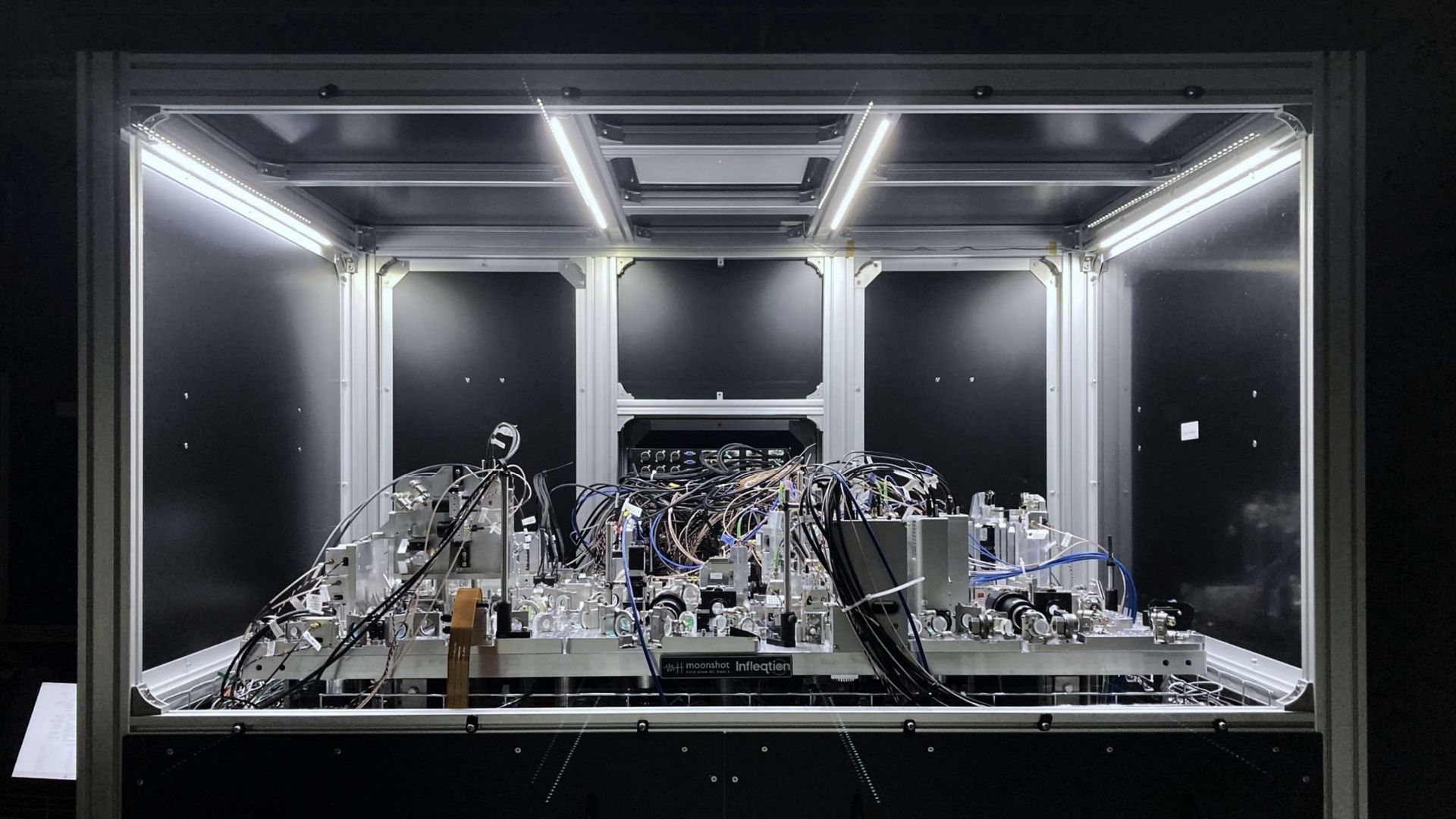
Shunkai holds its qubits in optical tweezers at room temperature, starts with about 50 of them, and is slated to join a shared supercomputing facility as a quantum-GPU hybrid. Its scale-up target of 10,000 qubits is dated March 2031.
The Scientist · Science desk
What happened
- The machine will run with around 50 qubits at first before expanding to roughly 500, according to Live Science.
- The longer-term goal is a 10,000-qubit machine by March 2031.
- The team plans to fold Shunkai into an existing shared supercomputing facility to create a quantum-GPU hybrid computing center.
- Shunkai will be partially opened to outside researchers to develop applications and to test and improve its quantum error correction, Japan's National Institutes of Natural Sciences said.
Compiled by The ScientistSomething wrong?How this is made
Why it matters
- constraint At roughly one error per 1,000 operations, a large share of any atom budget goes to encoding redundancy, so whoever books time on a 10,000-qubit Shunkai will not get 10,000 qubits' worth of trustworthy computing.
- capability Siting the machine inside a facility that already runs GPUs turns hybrid quantum-classical work into a scheduling question for that facility's existing users.
- precedent A qubit target with a month attached gives the field something falsifiable to track, and the interim 500-qubit stage is the first place the schedule can visibly slip.
Shunkai, named for the 17th-century Japanese astronomer Harumi Shibukawa [12], keeps its qubits in a vacuum chamber, held there by tightly focused laser beams called optical tweezers, with microwaves or laser light driving the atoms' quantum states through a calculation [6]. Using neutral atoms instead of superconducting circuits is what lets the machine run at room temperature [8]. The answer is read out with a camera, from the fluorescence of each individual atom [7].
Live Science puts the error rate of a qubit at roughly 1 in 1,000 operations, against about 1 per billion, and in some cases 1 per trillion, for a classical bit [9]. Divide one by the other and a qubit is about a million times more error-prone at the generous end of that comparison, a billion times at the strict end [16]. Quantum error correction closes part of that gap by spending qubits on redundancy in how information is encoded, so that small errors do not scrap a whole computation [18].
Live Science leaves open whether the 10,000 figure counts physical atoms or error-corrected logical qubits, and reports no fidelities for the qubits Shunkai runs now [19]. When the 500-qubit stage arrives, those fidelity figures will say more about March 2031 than the count will.
The full-stack claim is the part with near-term consequences. Shunkai has the software, control and hardware layers needed to take a user's input and return a result [2], and the team plans to open it to external users over the coming years [5]. Kenji Ohmori, the project lead and a professor of photo-molecular science at the Institute for Molecular Science, said that researchers' use of the machine would "lead to ripple effects on various fields in industry, academia, and government around the world" [13].
Neutral-atom arrays can also be rearranged while a calculation is under way, so researchers can change which qubits interact and entangle different pairs [10]. Live Science reports that as a route to both scaling and error correction [11].
The 500-qubit stage is the step an outsider can check soonest. From about 50 qubits to roughly 500 is a tenfold step, and 10,000 is 20 times the 500-qubit stage and 200 times the starting size [17].
What to watch
- Whether the roughly 500-qubit stage is announced with two-qubit gate fidelities attached.
- Which shared supercomputing facility Shunkai joins, and when outside users can actually submit jobs to it.
- Whether the team later specifies the 10,000 figure as physical atoms or error-corrected logical qubits.