Science1 publisher2 min readPublished
A chariot horse burial at Abqaa' adds a skeleton to a record built mostly of stables
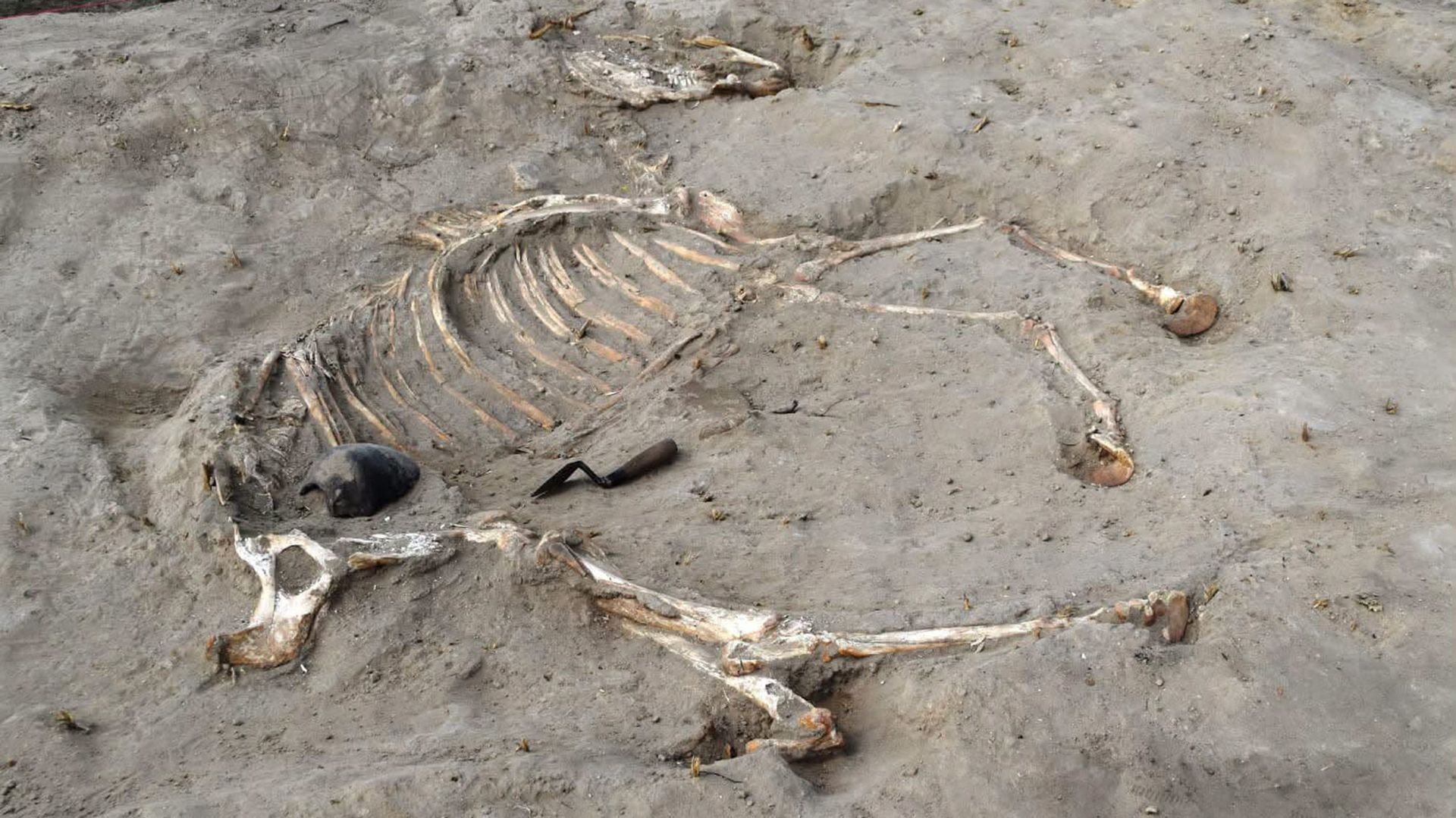
The Egyptian Ministry of Tourism and Antiquities reports a young male horse buried with harness fittings inside a New Kingdom fort in the western Nile Delta, where tablets also name Ramesses II and Merneptah. Researchers not on the dig say horse remains from Pharaonic Egypt are scarce.
The Scientist · Science desk
What happened
- An archaeological team from Egypt's Ministry of Tourism and Antiquities found a horse burial inside a fort at the site of Abqaa', in the Lake District of the western Nile Delta.
- Remains of the animal's harness fittings were recovered nearby, and on that basis the ministry statement calls the burial a likely ceremonial one.
- The fort is dated to the New Kingdom period, circa 1550 to 1070 B.C., and the ministry says it was used to guard against hostile Libyan tribes to the west.
- One tablet from the excavation shows a Libyan prisoner whose clothing marks him as a member of the Meshwesh, his hands bound behind a bent body.
Compiled by The ScientistSomething wrong?How this is made
Why it matters
- capability An intact burial gives researchers a single measurable animal to work on, where the Pharaonic horse record has run mostly to stables and equipment.
- constraint The military label cannot be tested against the bones, because Egyptology has no agreed definition of a war horse; the animal's role stays an inference from where it was found.
- contradiction The ministry statement leaves room for other military activities; Delpeut accepts the chariot and declines the war horse label, so the two readings of the same skeleton differ in how far the military claim reaches.
- precedent Many military forts stand in the same region, and this burial becomes the thing the next fort's horse material gets compared against.
Horse bones are the thin part of this record. "It is an amazing find, simply because we have so few horse remains from Pharaonic Egypt," especially complete skeletons, Lonneke Delpeut, a researcher at the University of Vienna who has studied ancient Egyptian horses, told Live Science in an email [10]. Stables have been excavated, including at the capital of Pi-Ramesses, but the animals themselves have been scarce, Delpeut said [11].
Three thousand years before now is about 1000 BC [1]. That round age needs care. The same report dates the fort to the New Kingdom, circa 1550 to 1070 BC, which puts the stated age some 70 years after the end of that period [1], and about 200 years after Merneptah's reign closed around 1203 BC [2]. The ministry statement as reported does not say how the burial was dated, or whether the horse and the inscribed tablets came out of the same level of the fort [4][17].
The animal is described as a young male of medium size that may have pulled a chariot or worked in other military activities [2]. Delpeut accepts the chariot. "It was certainly a chariot horse. Horses revolutionised mobility and warfare in ancient Egypt, so this horse was without a doubt a valuable animal, reflected by its careful burial," she said [14]. She cautioned against calling it a war horse, "mainly because we do not have a definition of what a war horse is in ancient Egypt" [13].
"Well-preserved horse remains have the potential to provide important information about the life of that individual horse," said Carolyn Willekes, an expert on ancient horses at Mount Royal University in Calgary [15]. The "fact that this appears to be an intentional horse burial also gives tantalizing hints about the equine-human relationship in ancient Egypt and the cultural importance of the horse," Willekes said [16].
The tablets carry the frontier argument, and they are objects the Egyptian state made. One carries the name of Ramesses II, who reigned from about 1279 to 1213 BC [8]. Another names Merneptah, who reigned from about 1213 to 1203 BC, and compares his strength to that of Seth, a god associated with the desert and storms [9]. The prisoner tablet identifies the adversary by dress, as a member of the Meshwesh, and by posture, the bound hands that the statement interprets as submission [6][7]. Between them they place named kings and a named Libyan group at one fort in the western Delta. Live Science contacted the excavation team from the Egyptian Ministry of Tourism and Antiquities for comment and had not heard back at time of publication [17].
What to watch
- An excavation report stating how the burial was dated, and whether the horse lay in the same level as the inscribed tablets.
- Measurements on the individual animal: age at death, pathology, and any skeletal wear consistent with harness or chariot work.