Researchers propose a superfluid helium gyrometer to catch Earth's frame-dragging in a laboratory
UC Berkeley, Austrian Academy of Sciences and Caltech researchers propose a superfluid helium gyrometer to detect Earth's frame-dragging in a lab. The case rests on a new thermal-noise analysis, since random phases can swamp the signal.
The Scientist · Science desk
What happened
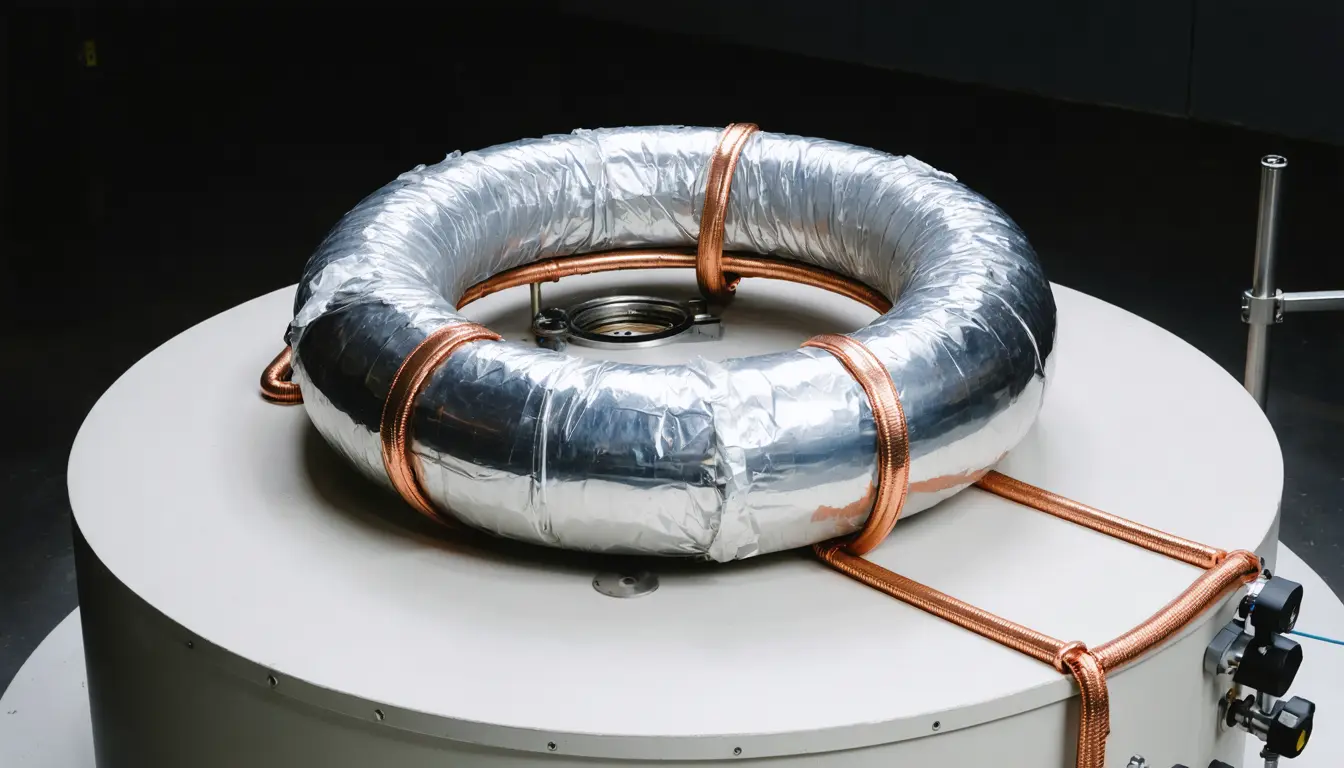
- The proposed sensor fills a doughnut-shaped tube with superfluid helium-4 and watches its flow through a barrier of nanopores, a Josephson junction.
- Rotation would show up as a quantum phase difference across the junction, which the team would read from the motion of a mechanical diaphragm tied to the superfluid loop.
- A Berkeley team led by Richard Packard built similar sensors and used them to measure Earth's rotation, but frame-dragging signatures have proved very difficult to measure with them.
- The three authors named, Ellers, Whaley and Christodoulou, are theorists, so they brought in an experimental physicist who leads a lab at Caltech.
Why it matters
- constraint Thermal noise sets the limit: the frame-dragging phase is small enough that random phases can bury it, so the design stands or falls on how well noise is controlled.
- capability If the design works, a sensor type already used on Earth's rotation could be pushed down to the frame-dragging contribution inside a laboratory.
- decision Anyone weighing a build needs the noise analysis to hold up first, since it is the paper's test of feasibility and sensitivity before any hardware is cooled.
The obstacle is noise. Kai-Isaak Ellers, the paper's first author, said the additional phase from frame-dragging "is extremely small and its contribution can be overwhelmed by random phases due to thermal noise" [6]. Sensors of this kind already read Earth's rotation, so the open problem is the small frame-dragging term and the noise that covers it [5].
To test whether the idea survives that noise, the team ran what Ellers called "a novel analysis of the thermal noise properties of the proposed device" [7]. Keith Schwab's long experience with superfluids, and what is known about their noise properties over a range of temperatures, guided it [7]. Ellers said the theorists went to Schwab, "who builds superfluid devices," and that Schwab "was enthusiastic to work with us to make sure our proposal would be grounded in reality" [9].
In our view, a noise analysis can rule out a design that fails on noise alone. It cannot show that a built device would perform as modeled.
The physics around the proposal is settled. Helium-4 becomes a superfluid below 2.17 kelvin, about minus 271 C [10]. Frame-dragging itself has observational support: Earth's rotation contributes to a slow precession of nearby gyroscopes' spin axes relative to distant stars [11]. A working laboratory sensor would add a second route to an effect that is already observed.
Ellers, Whaley and Christodoulou are theorists [8], and the paper proposes an experiment [2]. The thing this doesn't tell you is how sensitive the device would be. The portion of Phys.org's report available to us does not state a predicted sensitivity, a build schedule, or a comparison with satellite measurements.
What to watch
- A prototype that reports measured thermal noise, so it can be set against the paper's noise analysis.
- A stated sensitivity target for the gyrometer, which would show whether the frame-dragging phase can be separated from noise at all.
Clarity's read
What the record supports and how the coverage leans. The claims behind it follow.
Reality
- Evidence40
- Adoption
- Insufficient
- Hype gap+10
- Incentives
- Insufficient
- Confidence50
Claim ledger
Ranked by verification strength, evidence, and original report placement.
- [1]
General relativity predicts that a rotating object, such as Earth, slightly drags the surrounding spacetime as it rotates, a phenomenon known as frame-dragging.
- [2]
Researchers at UC Berkeley, the Austrian Academy of Sciences and Caltech introduced the idea of a quantum sensor to measure Earth's frame-dragging in a laboratory; the proposed experiment, described in a paper in Physical Review Letters, would use superfluid helium inside a gyrometer, an instrument that measures rotation.
- [3]
The researchers propose filling a doughnut-shaped tube with superfluid helium-4 and detecting changes in its flow via a barrier with tiny holes or nanopores, a Josephson junction.
- [4]
"The experimental signature is a quantum mechanical phase difference that appears across the Josephson junction when the device is rotating. This phase difference is measured by tracking the motion of a mechanical diaphragm connected to the loop of superfluid."
- [5]
Similar sensors have been demonstrated by a UC Berkeley team led by professor Richard Packard and used to measure Earth's rotation, but the small rotational signatures of Earth's frame-dragging have so far proved very difficult to measure with these sensors.
- [6]
"The additional phase deriving from the Earth's frame-dragging effect is extremely small and its contribution can be overwhelmed by random phases due to thermal noise."
- [7]
Ellers said that to assess the feasibility and potential sensitivity of the experiment, "we performed a novel analysis of the thermal noise properties of the proposed device," guided by Keith Schwab's long experience with superfluids and what is known about their noise properties over a range of temperatures.
- [8]
Ellers, Whaley and Christodoulou are theorists, so they contacted an experimental physicist who leads a lab at Caltech to explore their idea further.
- [9]
"We reached out to Keith Schwab, who builds superfluid devices ... Keith knew Birgitta from his Ph.D. work at Berkeley in Richard Packard's group and was enthusiastic to work with us to make sure our proposal would be grounded in reality."
- [10]
Helium-4, the most common form of helium, becomes a superfluid when cooled below 2.17 Kelvin, about -271 C (-456 F); a superfluid is essentially a liquid that can flow without friction.
- [11]
Frame-dragging is backed by real-world observations: Earth's rotation contributes to a slow change, called precession, in the direction of nearby gyroscopes' spin axes relative to distant stars.
Get this ledger inside ChatGPT. Ask about any of our stories and the answer brings its figure, each claim’s verdict and the sources. Free, no account.
Sources
1 independent publisher whose own reporting we read for this story.
- phys.orgQuantum sensor could measure how Earth drags spacetime
1 article · October 15, 2026
Topics and entities
Follow any of these and your For You feed starts watching them — no settings page required.
Topics
- Superfluid heliumFollow
- Quantum SensingFollow
- General relativityFollow
Entities
- University of California, BerkeleyFollow
- California Institute of TechnologyFollow
- Austrian Academy of SciencesFollow
- Physical Review LettersFollow
- Kai-Isaak EllersFollow
- Keith SchwabFollow
- Phys.orgFollow