ScienceNot yet confirmed elsewhere1 publisher2 min readPublished
Voyager's Griffin-1 lunar lander finishes JPL environmental tests ahead of a Falcon Heavy launch
Voyager's Griffin-1 lander passed environmental tests at JPL and is expected to fly 455 kg to Nobile Crater on a Falcon Heavy later this year. The tests covered launch vibration, acoustics, thermal vacuum and electromagnetic interference, NASA's release says.
The Scientist · Science desk
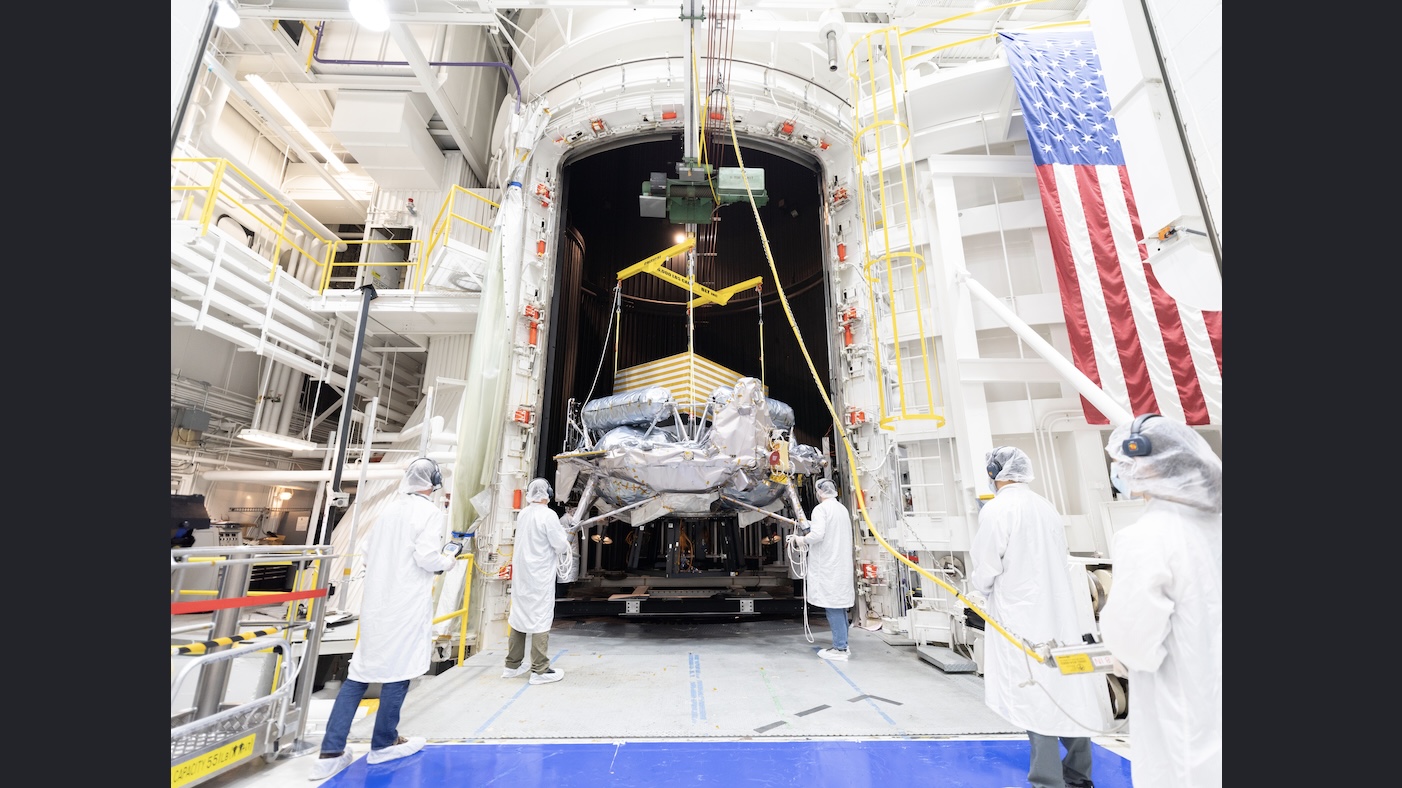
Key figures: in the thermal vacuum test Griffin-1 baked at up to 75 C, a hot-to-cold span of 175 degrees Celsius; in the acoustic test horns blasted it with up to 153 decibels.
| Figure | Value | Note | Claim |
|---|---|---|---|
| Thermal vacuum test, baked at up to | 75 °C | 10 | |
| Hot-to-cold test span | 175 °C | 13 | |
| Acoustic test, up to | 153 dB | 9 |
What happened
- In the 25-Foot Space Simulator, a thermal vacuum chamber at JPL, the lander spent about two weeks alternately baking at up to 167 F (75 C) and freezing as low as minus 148 F (minus 100 C).
- A sealed acoustic chamber hit the spacecraft with up to 153 decibels from giant horns powered by compressed nitrogen gas, to mimic the roar of launch.
- Testing began in July, after the 1,265-kilogram spacecraft was trucked from Voyager Lunar Systems' Pittsburgh facilities to JPL.
- Griffin-1 carries 10 science and technology demonstrations from six countries, including Astrolab's FLIP rover, which NASA describes as the largest commercial payload ever delivered to the Moon.
Why it matters
- exposure Ten demonstrations from six countries ride one lander, so a single landing outcome decides the fate of all of them.
- constraint Ground qualification is not a launch slot: final assembly, launch-readiness operations and shipment to Cape Canaveral all still come first.
- decision Anyone planning around Griffin-1 can treat the JPL result as evidence of survival through launch and deep space, and should carry the landing as an open flight risk.
The campaign ran wider than the two headline tests. Engineers first spun the spacecraft on a special table to measure its mass properties, a check for unexpected wobbles that feeds the navigation and landing work [6]. Electromagnetic interference and compatibility testing came next, in an anechoic chamber, to confirm that signals from the electronic components do not interfere with one another [7]. Then came the shaker table: hundreds of sensors monitored the lander as it was rattled in three directions with increasing force [8].
Each test targets a fault that cannot be repaired after launch. The thermal vacuum run alone spanned 175 degrees Celsius from its hot end to its cold end [13], and the lander alternated between the two [10].
NASA's release says the results show Griffin-1 can survive spaceflight [1]. John Thornton, an executive vice president at Voyager, went further. He said the completed testing "demonstrates that Griffin-1 is ready for the extreme journey ahead: launch, through deep space, to the lunar South Pole" [11]. Both statements come from the lander's builder and from the agency whose CLPS initiative the mission belongs to [2]. The release does not say how the test levels compare with Falcon Heavy's predicted environment, or whether any test turned up an anomaly.
The thing this doesn't tell you is how Griffin-1 behaves at the stage no chamber reproduces. Descent and landing at Nobile Crater happen only in flight [3]. In our view the JPL result is good evidence that the hardware tolerates launch loads and the thermal extremes, provided the test levels cover the flight environment. It is limited evidence about the landing itself.
What to watch
- A firm Falcon Heavy launch date, and word that launch-readiness operations and the shipment to Cape Canaveral have finished.
- Any published test margins or anomaly reports from the JPL campaign, including how the 153-decibel level compares with Falcon Heavy's flight environment.
- The landing attempt at Nobile Crater and delivery of the FLIP rover, the first flight evidence on the part of the mission no chamber tests.
Clarity's read
What the record supports and how the coverage leans. The claims behind it follow.
Reality
- Evidence50
- Adoption
- Insufficient
- Hype gap+15
- Incentives60
- Confidence70
Claim ledger
Ranked by verification strength, evidence, and original report placement.
- [1]
Griffin-1 passed a series of tests at JPL that simulated the extreme temperatures and vacuum of space and the shaking and noise of launch; NASA's release says the results show the spacecraft is ready to survive the rigors of space exploration.
ReportedSupportedSource: NASA/JPL release2 sources— create a free account to open themView cited source - [2]
Griffin-1 is part of NASA's CLPS (Commercial Lunar Payload Services) initiative within the Moon Base Program and is expected to launch later this year aboard a SpaceX Falcon Heavy rocket.
ReportedSupportedSource: NASA/JPL release2 sources— create a free account to open themView cited source - [3]
Griffin-1 will deliver more than 1,100 pounds (455 kilograms) of cargo to Nobile Crater near the lunar South Pole, which categorizes it as an infrastructure-class lander.
ReportedSupportedSource: NASA/JPL release2 sources— create a free account to open themView cited source - [4]
Griffin-1 will carry 10 science and technology demonstrations from six countries, including the largest commercial payload ever delivered to the Moon, Astrolab's FLIP (FLEX Lunar Innovation Platform) rover.
ReportedSupportedSource: NASA/JPL release2 sources— create a free account to open themView cited source - [5]
Testing began in July after the 2,789-pound (1,265-kilogram) spacecraft was trucked from Voyager Lunar Systems' manufacturing facilities in Pittsburgh to JPL.
ReportedSupportedSource: NASA/JPL release2 sources— create a free account to open themView cited source - [6]
Engineers spun the spacecraft on a special table to measure its mass properties, a test that lets them look for unexpected wobbles; the data is key to understanding readiness for navigation in flight and landing on the lunar surface.
ReportedSupportedSource: NASA/JPL release2 sources— create a free account to open themView cited source - [7]
Griffin-1 underwent electromagnetic interference and electromagnetic compatibility testing in an anechoic chamber to make sure signals from its electronic components do not interfere with one another.
ReportedSupportedSource: NASA/JPL release2 sources— create a free account to open themView cited source - [8]
During vibration testing, hundreds of sensors monitored Griffin-1 as a shaker table rattled it in three directions with increasingly intense force to simulate the ride out of Earth's atmosphere on a massive rocket.
ReportedSupportedSource: NASA/JPL release2 sources— create a free account to open themView cited source - [9]
To mimic the roar of launch, giant horns powered by compressed nitrogen gas blasted the spacecraft with up to 153 decibels inside a sealed acoustic chamber.
ReportedSupportedSource: NASA/JPL release2 sources— create a free account to open themView cited source - [10]
In the 25-Foot Space Simulator thermal vacuum chamber, for about two weeks, Griffin-1 alternately baked at up to 167 degrees Fahrenheit (75 C) and froze at temperatures as low as minus 148 F (minus 100 C).
ReportedSupportedSource: NASA/JPL release2 sources— create a free account to open themView cited source - [11]
demonstrates that Griffin-1 is ready for the extreme journey ahead: launch, through deep space, to the lunar South Pole
ReportedSupportedSource: John Thornton, executive vice president, Voyager, quoted in the NASA/JPL release2 sources— create a free account to open themView cited source - [12]
After the JPL tests, Griffin-1 returned to Voyager Lunar Systems' facility for final assembly, followed by launch-readiness operations before shipment to Cape Canaveral.
ReportedSupportedSource: NASA/JPL release2 sources— create a free account to open themView cited source - [13]
The hot-to-cold span of the thermal vacuum test is 175 degrees Celsius.
Sources
1 independent publisher whose own reporting we read for this story.
- nasa.govNASA JPL Testing Readies Voyager Technologies Lander for Moon Mission
2 articles · October 13, 2026
Topics and entities
Follow any of these and your For You feed starts watching them — no settings page required.