Science2 publishers3 min readPublished Updated
China points a drill, not a flag, at Shackleton's shadows
Chang'e-7 launches Aug. 24 with an orbiter, a rover and a six-legged hopper meant to jump into permanently dark craters. What it measures will constrain where anyone builds a base.
The Scientist · Science desk
Drafted by a language model from the sources cited here and checked against its claim ledger before publication. How we use AISend a correction
What happened
- Chang'e-7, China's seventh moon mission, is scheduled to launch on a Long March 5 rocket from the Wenchang Space Launch Center on Hainan Island on Monday, August 24 local time.
- Chang'e-7 aims to be the first mission to touch down directly at the moon's south pole, where it will search the region's dark craters for water ice.
- No one knows how big the lunar polar ice reservoirs are, or their actual distribution across the lunar south pole.
- NASA's Moon Base, part of the Artemis program, would be sited near the south pole; so would China's International Lunar Research Station, on which Russia is a major partner.
- The mission includes an orbiter as well as a lander, which carries a rover and a novel hopping robot.
Compiled by The ScientistSomething wrong?How this is made
Why it matters
China is scheduled to launch Chang'e-7, its seventh moon mission, on a Long March 5 rocket from the Wenchang Space Launch Center on Hainan Island on Monday, August 24 local time [1]. The stated job is to touch down directly at the lunar south pole and search the region's dark craters for water ice [2], which matters because nobody yet knows how large the polar ice reservoirs are or how they are distributed [3], and both NASA's Artemis-era Moon Base and China's International Lunar Research Station, on which Russia is a major partner, would be sited near the south pole [4].
The hardware is an orbiter plus a lander carrying a rover and a hopping robot [5]. The spacecraft takes up to six days to reach lunar orbit [6], putting it there around Aug. 30 [2], then spends two months preparing for a November landing [7]. The target is Shackleton Crater, 21 kilometers wide, with a rim that grazes the pole; no spacecraft has ever landed so close [8]. The China National Space Administration will pick the exact flat, sunlit spot once the mission is in orbit [9]. The rover then images the site, runs radar over the subsurface and examines soil for signs of ice [10].
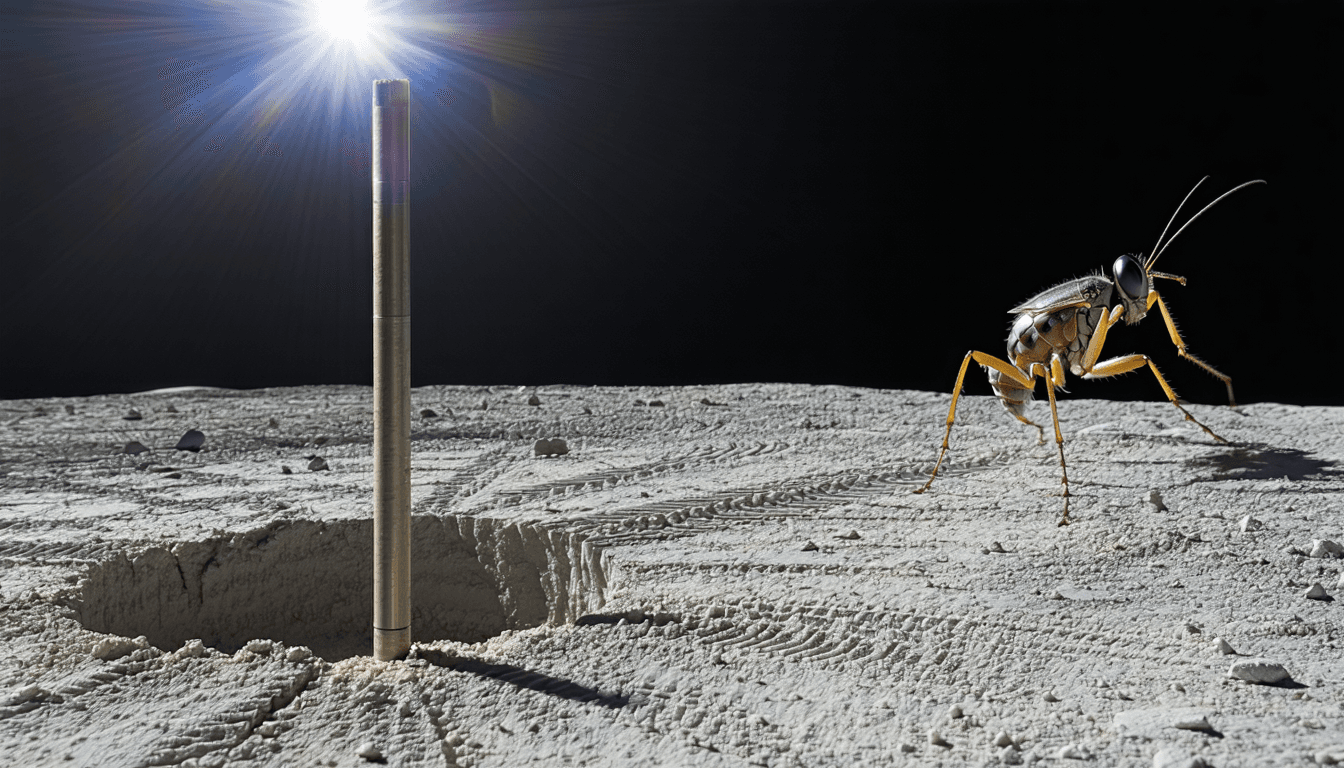
The hopper is the interesting part. It fires a rocket thruster to jump up to 15 kilometers at a time, aiming at permanently shadowed craters near Shackleton [11], enough in one jump to cover roughly 70 percent of Shackleton's own diameter [1]. It has six legs, crawls away from ground disturbed by its own plume before sampling, and carries a drill [12]. The craters it is aiming for never see sunlight and sit a few dozen degrees above absolute zero [13].
Set against that ambition, the precedent is thin. There has never been a landed mission to find water on the moon, according to Norbert Schorghofer of the Planetary Science Institute [14]. Nothing has descended into the moon's shadowed south-polar craters, though NASA crashed a rocket into one in 2009 and watched a plume of water vapor come out [15]. The most recent attempt at this class of vehicle, the Micro Nova hopper flown on a 2025 Intuitive Machines mission, was lost when the lander fell on its side during touchdown [16]. If Chang'e-7's hopper works, it would be only the second vehicle after NASA's Ingenuity helicopter on Mars to fly more than once on another world [17].
The competitive read is straightforward. Schorghofer says that if the mission succeeds China "will be the leader in lunar science," and that setting Apollo aside, "they will have surpassed everyone, including the United States, in lunar exploration in the short-term" [18]. Simone Dell'Agnello of Italy's National Institute for Nuclear Physics says there are big reservoirs of ice water at the poles [19]. Rajeswari Pillai Rajagopalan of the Australian Strategic Policy Institute describes intensifying competition between the two sides and notes that Chang'e-7 could collect much of the water data both nations want [20]. That data will not be shared easily: U.S. congressional legislation forbids most NASA collaboration with China [21], while Chang'e-7 itself carries equipment from several international partners [22].
Watch three things. The landing site CNSA announces from orbit, since a rim-adjacent flat site determines how many shadowed craters are within hopper range. Whether the November descent lands upright, which is where the last hopper attempt failed. And whether the drill returns ice at depth rather than surface traces, because base siting depends on accessible quantity, not detection.