General Fusion's LM26 reaches 1.1 keV by crushing plasma with a metal wall
General Fusion's LM26 heated plasma electrons to 1.1 keV by mechanical compression, a mark earlier machines reached only with lasers or superconducting magnets. For anyone pricing fusion power, cheaper hardware is still a claim General Fusion makes about its own materials.
The Product Desk
Evidence map of four claims. Supported: LM26 reached 1.1 keV electron temperatures. Insufficient: that it is the first to pass 1 keV without superconducting magnets or lasers; that reactors can be built from conventional industrial metals; that a grid pilot plant comes around 2035.
- Supported General Fusion's LM26 reached electron temperatures of 1.1 keV just before peak compression., claim 1
- Insufficient evidence Every laboratory that previously passed 1 keV used massive superconducting magnets or high-powered lasers; LM26 is the first machine to hit this temperature using low-speed physical compression., claim 12
- Insufficient evidence Mechanical compression avoids the need for rare, delicate materials; commercial plants will use a circulating liquid-metal barrier that absorbs neutron radiation and heat, so engineers can build reactors from conventional industrial metals., claim 13
- Insufficient evidence If engineering milestones hold, General Fusion expects to build its first operational grid pilot plant around 2035., claim 14
| Claim | State | Claim number |
|---|---|---|
| General Fusion's LM26 reached electron temperatures of 1.1 keV just before peak compression. | Supported | 1 |
| Every laboratory that previously passed 1 keV used massive superconducting magnets or high-powered lasers; LM26 is the first machine to hit this temperature using low-speed physical compression. | Insufficient evidence | 12 |
| Mechanical compression avoids the need for rare, delicate materials; commercial plants will use a circulating liquid-metal barrier that absorbs neutron radiation and heat, so engineers can build reactors from conventional industrial metals. | Insufficient evidence | 13 |
| If engineering milestones hold, General Fusion expects to build its first operational grid pilot plant around 2035. | Insufficient evidence | 14 |
What happened
- The temperature was measured by Thomson scattering, run with the UK Atomic Energy Authority on a custom polychromator built at its Culham site.
- General Fusion has posted the data on its own portal and submitted it to an academic journal for peer review.
- Technicians are refitting LM26 with stronger compression systems to aim for 10 keV, roughly 100 million degrees Celsius.
- General Fusion expects to build its first operational grid pilot plant around 2035 if its engineering milestones hold.
Why it matters
- decision Planners can enter LM26 as a measured temperature, but a lower-cost plant has to go into any model as General Fusion's assumption until a cost estimate is published.
- capability A laser diagnostic that can read the core inside a collapsing liner now exists, so the refitted machine's 10 keV attempt can be checked by the same outside method.
- constraint Anyone planning around this design is relying on a machine that still needs roughly nine times more temperature, and the pilot plant date depends on closing that gap.
On Monday a utility planner opens a forwarded link with one line from upstairs asking whether fusion just got cheaper. The planner has to answer by Friday, and the answer has to hold up through the next budget cycle.
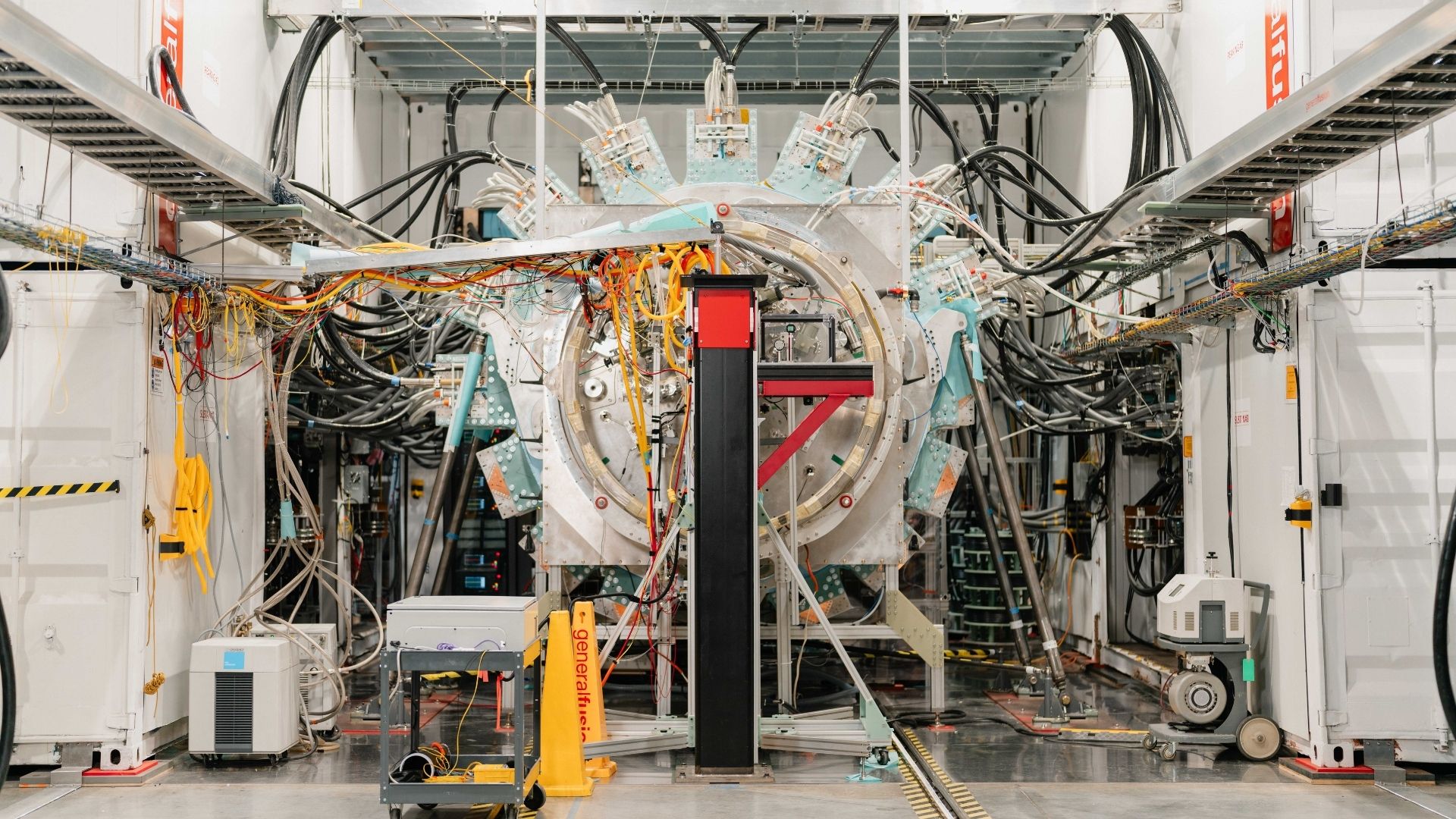
The announcement covers two things: an experiment that has run and a plant that has not been built. LM26 is the experiment. It injects magnetically confined plasma into a chamber and squeezes it with a collapsing metal wall [4]. It got electrons above 12 million degrees Celsius [2]. According to Interesting Engineering, passing 1 keV is an internationally recognized milestone that only a handful of experimental reactors have reached [3]. Taking the reading at all was hard. The plasma sits inside a collapsing liner, and the probe could not disturb it [9].
The plant is still a proposal. According to the article, mechanical compression avoids rare, delicate materials. Commercial plants would run a circulating liquid-metal layer to absorb neutron radiation and heat, so engineers could build reactors from conventional industrial metals [13]. A temperature reading does not test the cost claim. The account does not include a cost estimate for a plant or for the electricity it would sell.
The next physics step is large. The 10 keV target is about nine times the temperature LM26 has reached [11]. Temperature is also only one input: the Lawson criterion General Fusion is working toward is a balance of heat, density and confinement time [8]. Chief executive Greg Twinney described LM26 as one step on a longer road. "We built LM26 to achieve important technical milestones that will help get us to a first-of-a-kind plant in the next decade, and step-by-step we are advancing on this path," he said [15]. The Vancouver company is backed by Canada's Strategic Response Fund and advised by General Atomics [10].
I would file LM26 as a physics result and keep it out of any cost model until General Fusion publishes a plant estimate. That has a cost of its own. A team that waits for the estimate starts its own diligence later than one that follows the refit now, and the refit is where the next hard data will come from [7].
To sort this headline and the next fusion one, use a 2x2. One axis is who measured the number: an outside lab or reviewer, or the company alone. The other is what the number describes: plasma physics, or plant cost and schedule. The 1.1 keV reading goes in outside-measured physics, with a UK national lab on the diagnostic and a journal review still pending [5][6]. General Fusion's 10 keV goal and its path to Lawson go in company-stated physics [7][8]. Its industrial-metals design and pilot plant date belong in company-stated cost and schedule [13][14]. Only the first box goes into a planning model as fact. Everything else goes in as a scenario labelled with General Fusion's name.
What to watch
- Peer-reviewed publication of the LM26 Thomson scattering data, and whether the 1.1 keV figure survives review.
- Results from the refitted LM26 against the 10 keV target, measured with the same UKAEA diagnostic.
- Any General Fusion cost estimate for a first-of-a-kind plant or its electricity, so the industrial-metals claim can be priced.
Clarity's read
What the record supports and how the coverage leans. The claims behind it follow.
Reality
- Evidence45
- Adoption3
- Hype gap+35
- Incentives65
- Confidence50
Claim ledger
Ranked by verification strength, evidence, and original report placement.
- [1]
General Fusion's LM26 reached electron temperatures of 1.1 keV just before peak compression.
- [2]
The LM26 plasma was superheated to more than 12 million degrees Celsius.
- [3]
Surpassing 1 keV is an internationally recognized milestone in fusion physics; only a handful of experimental reactors worldwide have reached it.
- [4]
General Fusion's Magnetized Target Fusion approach injects magnetically confined plasma into a chamber and crushes it over several milliseconds using a contracting solid metal wall.
- [5]
General Fusion partnered with the UK Atomic Energy Authority; a joint team used Thomson scattering with a custom polychromator built at Culham's Diagnostic Innovation Center of Excellence to measure the temperature.
- [6]
Data from the test is published on General Fusion's portal and has been submitted to an academic journal for peer review.
- [7]
Technicians are refitting LM26, boosting its compression systems to target 10 keV, roughly 100 million degrees Celsius.
- [8]
The 10 keV milestone leads toward the Lawson criterion, the balance of heat, density and confinement time required to produce net electricity.
- [9]
Because the plasma sits inside a collapsing metal liner, measuring the core without disturbing the reaction was a major technical hurdle.
- [10]
Vancouver-based General Fusion is backed by Canada's Strategic Response Fund and advised by US firm General Atomics.
- [11]
The 10 keV target is about nine times the 1.1 keV LM26 reached.
- [12]
Every laboratory that previously passed 1 keV used massive superconducting magnets or high-powered lasers; LM26 is the first machine to hit this temperature using low-speed physical compression.
- [13]
Mechanical compression avoids the need for rare, delicate materials; commercial plants will use a circulating liquid-metal barrier that absorbs neutron radiation and heat, so engineers can build reactors from conventional industrial metals.
- [14]
If engineering milestones hold, General Fusion expects to build its first operational grid pilot plant around 2035.
- [15]
"We built LM26 to achieve important technical milestones that will help get us to a first-of-a-kind plant in the next decade, and step-by-step we are advancing on this path."
Sources
1 independent publisher whose own reporting we read for this story.
- interestingengineering.com‘World-first’ 1 keV fusion milestone set without lasers or superconducting magnets
1 article · October 9, 2026
Topics and entities
Follow any of these and your For You feed starts watching them — no settings page required.