Science1 publisher2 min readPublished
Kyushu's colliding laser plasmas reconnected at similar rates under very different inflows
A Kyushu University team moved two laser spots on a carbon target to change the density and magnetic field feeding a reconnection layer. Once a current sheet had formed, the measured rates came out close anyway.
The Scientist · Science desk
What happened
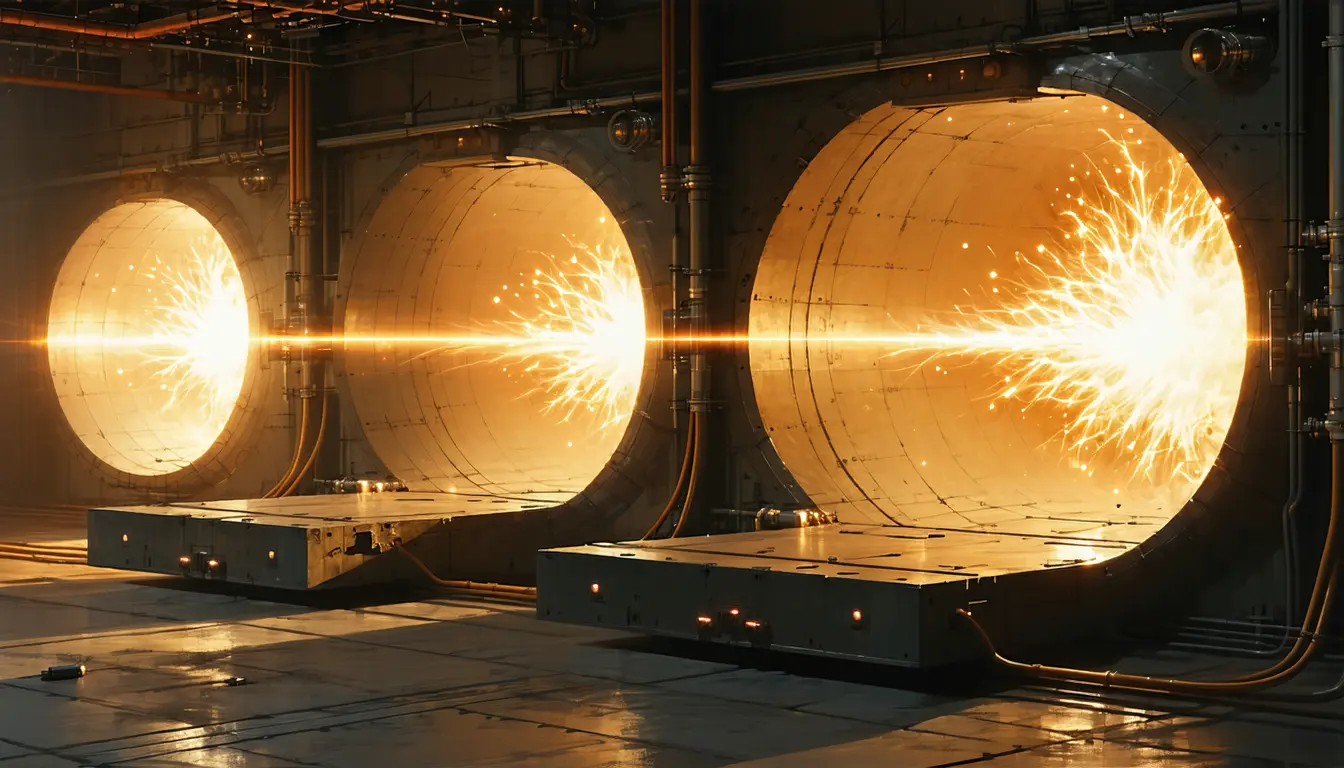
- A Kyushu University group with collaborators at Osaka University fired the Gekko-XII laser at two spots on a carbon target, making two expanding plasma clouds whose magnetic fields reconnected where they collided.
- Moving the two laser spots closer together or further apart substantially changed the density and magnetic field arriving at the reconnection region, which is how the team varied upstream conditions.
- Field expansion histories and reconnection timings differed substantially between configurations, yet once a current sheet had formed the reconnection rates were strikingly similar.
- To follow the process the group built a two-directional laser Thomson-scattering system that reads temperature, density and flow from light the plasma scatters.
- The paper, on Biermann-battery-driven reconnection in laser-ablated plasmas, is published in Physical Review E, with a preprint on arXiv.
Compiled by The ScientistSomething wrong?How this is made
Why it matters
- capability Morita says the reconnection rate and its energy conversion can now be evaluated quantitatively in a laboratory, so theory has a repeatable measurement to be checked against instead of one-off event reconstructions.
- constraint If the layer sets the rate, a flare or magnetosphere model that misjudges inflow density can still land the rate, and the accuracy burden moves to how the code treats the current sheet itself.
- decision Modellers choosing a validation target have to weigh a symmetric laser plasma with self-generated fields against the asymmetric, obliquely magnetised configurations the team has not yet fired.
Rates measured in space plasmas appear to cluster near a universal value, and it had been unclear how much of that depends on the conditions of the plasma flowing into the reconnection region [11]. Space observations and computer simulations left the question open [17]. If the inflow set the rate, moving the laser spots should have moved the rate, so the two-spot geometry attacks the question with a single variable: the laser, the carbon target and the diagnostics stay fixed, and only the separation between the focal spots changes [4][5].
Morita said the rate held. "Our study provides experimental evidence for the robustness of the magnetic reconnection process by demonstrating that fast reconnection can occur at similar rates despite substantially different upstream conditions," he said [8]. The team's conclusion is that fast reconnection is governed by the local physics of the reconnection layer rather than by the properties of the surrounding plasma [2].
The announcement does not report the measured rates, their uncertainty, the number of shots, or the spot separations used; the split of released magnetic energy between plasma heating and high-speed outflow is quantified in the Physical Review E paper [18][10][14]. That matters for how general the conclusion is. "Strikingly similar" [7] means the rates came out close, and leaves open how far apart two configurations can be pushed before they separate.
The fields in these shots are self-generated, by the Biermann battery in laser-ablated plasma, which is what the paper's title describes [14]. The runs aimed at space-like conditions are the next ones, with oblique magnetic fields and asymmetric plasma flows [13]. The configuration tested here is the symmetric one: two clouds raised off the same carbon target, meeting where their fields oppose [4][16].
Morita tied the work to space weather forecasting. "The improved understanding of magnetic reconnection will aid in predicting space weather events that have an impact on satellites, communications systems, navigation technologies and power infrastructure," he said [15]. The path from a laser shot to a forecast runs through the simulation codes, and what this experiment hands them is a set of experimental benchmarks to be tested against [12]. The diagnostic is the durable part. "The measurement techniques established in this study now make it possible to quantitatively evaluate the magnetic reconnection rate and its energy conversion," Morita said [9].
What to watch
- The rate values and uncertainty intervals in the Physical Review E paper, plus the range of spot separations actually spanned.
- Whether the planned asymmetric-flow and oblique-field runs still return similar rates; asymmetry is where the robustness argument would break first.
- Whether simulation groups take up the Thomson-scattering measurements as a validation case for reconnection codes.